Blockchain · Explainer
What Is a Crypto Miner? How Mining Works in 2026
A crypto miner is a person or machine that helps secure a proof-of-work blockchain by competing to add its next block. Mining is not how every cryptocurrency works, and earning rewards is never guaranteed.
By the SkyBitcoins editorial team · Updated
What is a crypto miner, in plain terms?
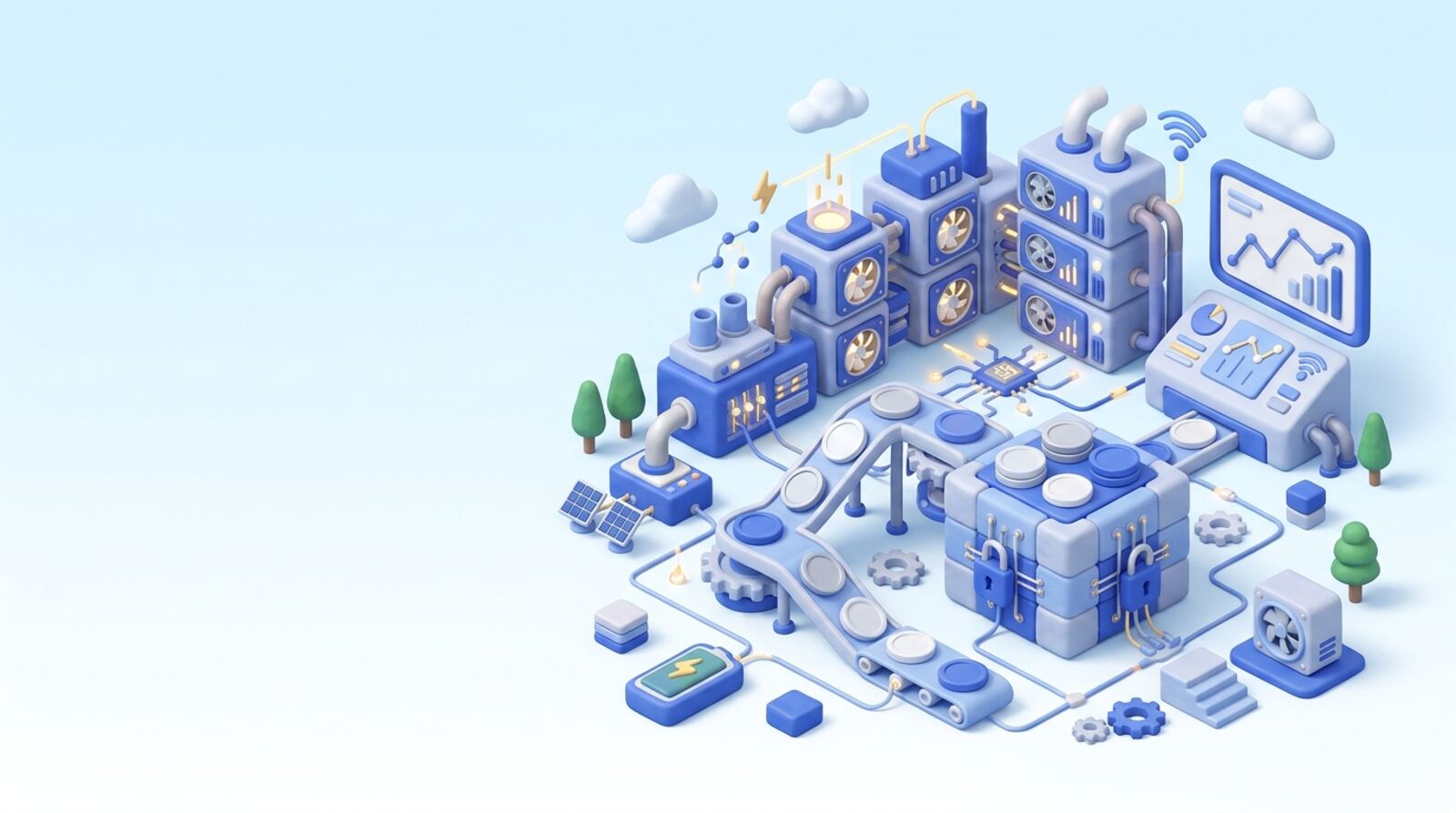
A crypto miner is a person or machine that helps a proof-of-work blockchain agree on which transactions belong in its next block. Miners use computing power to compete for the chance to propose that block. If the network accepts it, the winning miner may receive a protocol reward and transaction fees.
The word “miner” can mean the operator, the mining hardware, or the software running on that hardware. It does not mean that every cryptocurrency is created through mining. Bitcoin uses proof of work; many other networks use different methods, including proof of stake.
Mining is not a guaranteed way to earn money. You may spend more on electricity, equipment and cooling than you receive in rewards, and the outcome depends on the network and its rules. Before buying hardware or signing a mining contract, identify which coin and blockchain it supports, how rewards are paid, and what costs you would have to cover.
How does crypto mining add a block?
On a proof-of-work network, a miner gathers eligible pending transactions and builds a candidate block. Network rules determine which transactions are valid; miners do not get to make invalid transactions valid simply by including them. Other participants can reject a block that breaks those rules.
The miner then repeatedly runs the block data through a hash function, changing a value called a nonce and sometimes other block data. The aim is to produce a hash that meets the network’s current difficulty target. There is no shortcut that reliably predicts the winning result, so miners try many candidates. The first acceptable block that reaches the network can be checked quickly by other participants.
In simplified form, the process is:
- Select valid transactions and assemble a candidate block.
- Repeatedly hash the block data while changing a nonce or other value.
- Share a qualifying block with the network.
- Let other participants verify it and build on the accepted chain.
This competition helps make rewriting past transactions costly, because an attacker would need substantial computing power to catch up and overtake the honest chain.
How is mining different from staking?
Mining is one way a blockchain can reach agreement, but it is not the same as staking. Proof-of-work miners compete using computing power. In proof-of-stake systems, validators lock or otherwise commit assets under the network’s rules and are selected to propose or confirm blocks. Both approaches rely on participants following protocol rules, but their equipment, incentives and risks differ.
Bitcoin is a prominent proof-of-work network. Ethereum, by contrast, moved to proof of stake in 2022, so ETH is not mined on Ethereum’s current network. That distinction matters if you are comparing hardware or looking at websites promising “Ethereum mining”: check carefully what service or asset they actually mean.
A quick comparison:
| Proof-of-work mining | Proof-of-stake validation | |
|---|---|---|
| Main resource | Computing power and electricity | Stake subject to network rules |
| Participants | Miners | Validators |
| Common cost or risk | Hardware, energy, cooling | Capital exposure, penalties and technical risks |
Do not assume that a coin can be mined just because it trades on an exchange or uses blockchain technology. Confirm its current consensus method using the project’s own technical documentation.
Where do mining rewards come from?
A successful miner’s possible reward depends on the network. It may include newly issued coins, transaction fees from the block, or both. The protocol sets the rules, including how issuance changes over time. On Bitcoin, the block subsidy was 3.125 BTC in 2026 following the 2024 halving; transaction fees can vary from block to block. Other networks may use different reward structures.
Mining does not mean each participant receives a regular payment. A solo miner gets the block reward only when they find an accepted block, which may be infrequent or never happen with limited computing power. A pool combines participants’ work and distributes payouts under its own rules. Pool operators may charge fees, set minimum payouts or use different payout methods.
Before counting rewards as income, check:
- The current block reward and whether it changes under the protocol.
- How transaction fees are allocated.
- Pool fees, payout thresholds and payment method, if you use a pool.
- Whether payouts are in the mined coin or another asset.
- Your local tax rules for mining proceeds and expenses.
A displayed reward estimate is not a guaranteed payout or a promise that the coin’s market value will remain steady.
What equipment and costs should you calculate?
Mining can require purpose-built machines, a suitable power supply, ventilation and a reliable internet connection. Bitcoin mining generally relies on application-specific integrated circuit (ASIC) machines designed for the task. Other proof-of-work networks may support different hardware, but support and economics can change. A home computer being able to run mining software does not make it competitive or profitable.
Work out operating costs before buying equipment. A basic electricity estimate is:
Power use in kilowatt-hours × your electricity price per kilowatt-hour.
For a machine that runs continuously, convert its power draw from watts to kilowatts, multiply by the hours it runs, then multiply by your local electricity rate. Add cooling, repairs, internet, pool charges, equipment depreciation and any applicable taxes or import costs. Compare the total with a conservative revenue estimate, not the best-case number on a calculator.
Mining calculators are estimates. Their results can change when network difficulty, rewards, fees, uptime or the coin’s market value changes. They may also omit costs that apply to your home or business. Do not rely on a projected return without checking the assumptions and how quickly the machine could become outdated.
Should you mine alone, join a pool or rent hash power?
You can mine alone or contribute computing power through a mining pool. Solo mining lets you keep the full block reward if you find a block, but rewards can be extremely irregular, especially when your share of the network’s total computing power is small. Pool mining combines work from many participants and typically divides payments according to recorded contributions and the pool’s payout policy.
A pool does not remove mining risk. Read its fee schedule, payout threshold, payout method and rules for downtime or rejected work. Check who operates it, how payouts are calculated and whether you can leave without a penalty. A pool’s estimated daily earnings are not guaranteed.
Be cautious with cloud-mining offers that ask you to pay for a contract instead of operating hardware yourself. Before paying, establish who owns and runs the machines, how the contract calculates payouts, what fees can be deducted, how withdrawals work and whether you can verify mining activity. Guaranteed returns, pressure to recruit others, unclear operators or requests to send funds to a personal wallet are warning signs. Never treat a mining contract as equivalent to owning mining equipment or receiving a guaranteed share of block rewards.
What should you check before spending money on mining?
Mining makes sense to investigate only if you understand the network, can estimate your full costs and are prepared for uncertain revenue. Use this checklist before committing money:
- Confirm the method: Does the coin use proof of work, and is your planned hardware supported?
- Price the whole setup: Include the machine, power delivery, ventilation, electricity, maintenance and any hosting charges.
- Check the rules: Understand pool fees and payouts, or the probability and timing risks of solo mining.
- Stress-test the estimate: Consider lower rewards, higher difficulty, downtime and changing energy prices.
- Review local requirements: Check whether mining is permitted in your location and whether tax or business rules apply.
- Protect your funds: Use a wallet you control where appropriate, secure its recovery phrase offline, and verify payout addresses before using them.
Avoid borrowing money on the assumption that rewards will cover repayments. Do not buy a machine based only on a seller’s earnings estimate, and do not give remote access to your computer or wallet to an unknown operator. If a project promises certain returns or conceals how it earns revenue, step back and verify its claims independently before paying.
How can you avoid mining malware and other traps?
Mining software can be abused when someone installs it on a device without permission. This is called cryptojacking: malware secretly uses a computer’s processor or graphics hardware to mine cryptocurrency for someone else. It may slow the device, increase power use or cause unusual heat and fan activity, though those symptoms can have other causes too.
To reduce the risk, download software only from a source you can verify, check the publisher and requested permissions, and keep your operating system and security tools updated. Be wary of “free” mining tools from unfamiliar downloads, email attachments or pop-ups. Do not disable security protections just because an installer tells you to.
If your device suddenly runs hot or slow, check its resource usage and installed applications. Disconnect it from sensitive accounts if you suspect malware, run a reputable security scan, remove software you do not recognise and change important passwords from a separate trusted device. If the computer belongs to an employer, school or another person, do not install mining software without permission. Mining requires substantial resources; using someone else’s electricity or hardware without consent can cause financial and security harm.
Frequently asked questions
Are all cryptocurrencies mined?
No. Mining is used by proof-of-work networks such as Bitcoin, but many networks use other methods. Ethereum, for example, uses proof of stake rather than mining.
Can I mine Bitcoin with my laptop?
Not usually with ordinary home computers. Bitcoin mining is dominated by specialised ASIC machines, and profitability depends heavily on electricity costs, equipment efficiency, network competition and fees. A computer capable of mining is not necessarily economical to use for it.
What does a crypto miner actually do?
A miner chooses which transactions to include in a candidate block, then repeatedly hashes block data while searching for a result that meets the network’s difficulty target. Other network participants check the resulting block before accepting it.
Is joining a mining pool safer or more profitable?
A mining pool combines the computing power of many participants and shares rewards according to its payout rules. This can make payouts more regular than solo mining, but pool fees, payout thresholds and the pool’s reliability still matter.
How much can a crypto miner earn?
There is no standard return. Revenue changes with the coin’s reward rules, network difficulty, transaction fees and market value, while your costs depend on electricity, equipment, cooling and other expenses. Estimate costs before spending money, and treat any promised fixed return with caution.
Mentioned in this guide
dApps in this guide
Ethereum is an open blockchain for ETH and apps; check variable gas costs and wallet risks before using it.
Common is a self-custodial privacy app for shielding crypto on Arbitrum and Aleph Zero EVM, but fees and audit details need closer checking.
Crypto.com offers broad crypto access and EUR deposits, but check spreads, fees and withdrawal terms before funding an account.
Sologenic offers XRPL trading and liquidity tools, but check feature availability, fees and the SOLO-to-TX transition before using it.
Stake combines casino games and sports betting, but check local legality, licensing, verification and withdrawal terms before depositing.
Keep reading
Related guides
Token · Explainer
What Is Crypto Solo Mining? A Practical Guide
Crypto solo mining means using your own computing power to try to find a valid block without sharing its reward with a mining pool. You keep the block reward if you succeed, but the chance of finding one can be very low and your equipment and electricity costs continue whether you win or not.
Blockchain · Explainer
What Is Crypto Mining? How It Works and What It Costs
Crypto mining is the proof-of-work process that helps secure some blockchains and may reward miners with cryptocurrency. Learn how it works, what it costs, and how to judge whether mining is practical for you.
Blockchain · Explainer
What Is Blockchain? How It Works and What to Check
A blockchain is a shared record kept in sync by a network of computers. Learn how blocks, validation and consensus work, what blockchains are used for, and what their limits mean for you.
Blockchain · Explainer
What Is Proof of Stake? How It Works and Its Risks
Proof of stake (PoS) is a way for a blockchain to agree on valid transactions and secure its records. Learn how validators and staking work, what participants may earn, and the risks to check before committing tokens.
Blockchain · Chain guide
What Is a Layer 2 Blockchain? A Practical Guide
A Layer 2 (L2) handles some blockchain activity away from a Layer 1, aiming to make transactions faster or cheaper while relying on the main chain in a specific way. Learn how the main designs work, what they cost, and what to check before moving funds.
Blockchain · Explainer
What Is a Blockchain Platform? A Practical Guide
A blockchain platform is a shared network where people or software can record transactions and, on some networks, run applications. Learn how platforms work, what they cost to use and how to choose one safely.
Blockchain · Explainer
What Is a Layer 2 in Crypto? A Practical Guide
A layer 2 processes transactions away from a base blockchain to ease congestion, then relies on that base chain in some way. Learn how rollups work, what fees and risks to expect, and how to choose a network.
Blockchain · Explainer
What Is a Blockchain Network? A Practical Guide
A blockchain network is the collection of computers, rules and software that records and checks activity on a blockchain. Understanding how its parts work helps you choose a network, use a wallet and avoid costly mistakes.