Blockchain · Explainer
What Is Crypto Mining? How It Works and What It Costs
Crypto mining is the proof-of-work process that helps secure some blockchains and may reward miners with cryptocurrency. Learn how it works, what it costs, and how to judge whether mining is practical for you.
By the SkyBitcoins editorial team · Updated
What does crypto mining actually do?
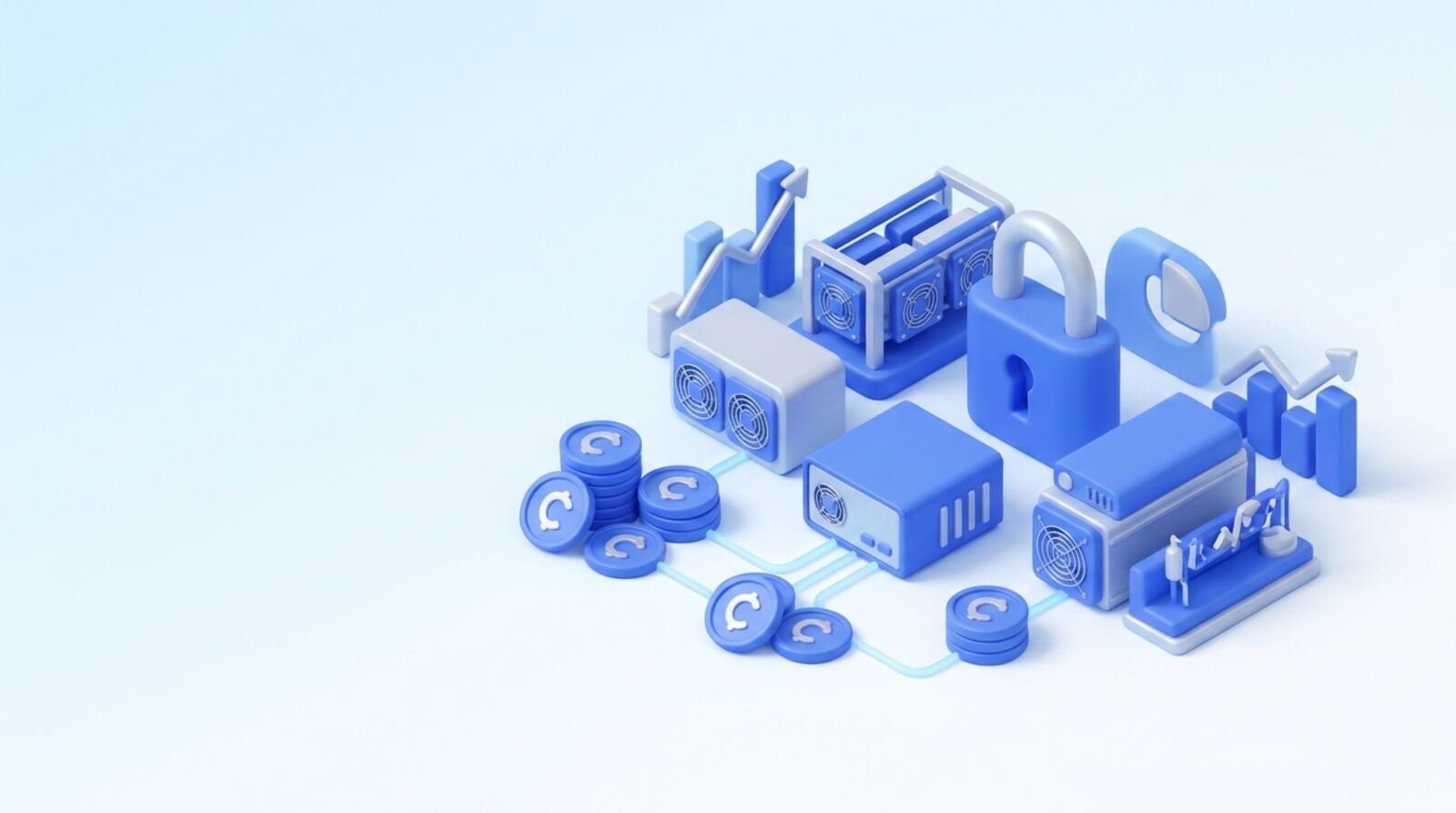
Crypto mining is the process some blockchains use to order transactions and agree on new blocks. Miners run computers that compete to produce a valid proof of work. The network’s nodes check the proposed block, and if it follows the rules, they can accept it and build on it.
Mining also issues new coins on networks that include a block subsidy. It does not mean that computers are digging coins out of the internet, nor does mining alone make a transaction valid: network nodes independently check the rules. Mining helps make it costly to rewrite a proof-of-work chain because an attacker would need to redo substantial computing work.
The distinction matters because not every cryptocurrency is mineable. Bitcoin uses proof of work; Ethereum, for example, moved to proof of stake in 2022, so ETH is not mined. If a project uses another consensus mechanism, check its documentation rather than assuming that buying a powerful computer will earn its token.
How does proof-of-work mining add a block?
In proof of work, a miner gathers eligible transactions and constructs a candidate block. Mining hardware repeatedly hashes data from that block, changing values in an effort to produce a result below the network’s current target. Hashing is a one-way calculation: miners cannot know which attempt will work, so they make many guesses per second.
The first miner to find an acceptable result broadcasts the block. Other nodes check the proof and confirm that the transactions and block comply with the network’s rules. If valid, the block joins the chain. The miner’s work does not guarantee acceptance; an invalid block can be rejected even if it includes a valid proof.
On Bitcoin, the protocol adjusts mining difficulty about every 2,016 blocks to keep block production near its target pace. More computing power does not make a miner’s individual machine solve every block faster in a predictable way; it changes that miner’s share of the total competition. Proof of work is therefore a competitive process, not a puzzle that produces useful scientific results.
Which coins and equipment can you mine?
Start by checking whether the network actually uses proof of work and what hardware its mining algorithm supports. Bitcoin mining now relies primarily on application-specific integrated circuit machines, or ASICs, built for its hashing algorithm. A gaming graphics card or ordinary desktop is not a practical substitute for a competitive Bitcoin ASIC.
Other mineable coins may use algorithms suited to graphics cards or other equipment, but that does not make them profitable or risk-free. A coin’s mining algorithm, total network hash rate, reward rules and market liquidity can change. Some projects also change their consensus or mining rules, which can leave equipment less useful.
Before paying for hardware, confirm:
- The coin is still mined using proof of work.
- Your device supports the network’s current algorithm.
- The machine, power supply and cooling can operate safely in your location.
- You can obtain trustworthy software and a compatible wallet.
- You understand how and when rewards are paid.
Treat claims that a device guarantees a fixed return with caution. Mining rewards depend on competition and network rules, not just the equipment’s advertised speed.
What does mining cost, and how are rewards earned?
Mining revenue is not the same as profit. A miner’s gross rewards may include a block subsidy and transaction fees, but those amounts are shared or received according to the miner’s setup and pool terms. Bitcoin’s block subsidy is 3.125 BTC per block as of 2026, following its 2024 halving; transaction fees are additional and vary. A solo miner receives a reward only if they successfully mine a block.
Your main costs can include:
| Cost | What to check |
|---|---|
| Electricity | The machine’s power draw and your actual rate, including applicable charges |
| Hardware | Purchase price, delivery, repairs and how quickly equipment may become outdated |
| Cooling and space | Heat, ventilation, noise and any facility or hosting charges |
| Pool costs | Pool fees, payout thresholds and payment method |
Use a mining calculator as an estimate, not a promise. Check its assumptions for network difficulty, coin price, uptime, electricity and fees, then test less favorable scenarios. A small change in those inputs can turn a projected profit into a loss. Do not count gross coin rewards as spendable income until you account for operating costs and any tax obligations.
Should you mine alone, join a pool, or use cloud mining?
Solo mining means operating your own miner and keeping the full block reward if you find a block, but the wait can be long and uncertain when your share of network computing power is small. A mining pool combines the work of many miners and typically distributes payouts according to contributed work and its payment rules. Pool payouts are usually more frequent than solo rewards, but pool fees, payout thresholds and methods vary. Joining a pool does not guarantee that mining will be profitable.
Cloud-mining offers deserve extra scrutiny. You may be paying a provider for a contract or a share of mining capacity rather than owning or controlling the machines. Read the contract for fees, payout conditions, cancellation terms and what happens if mining becomes unprofitable. Be wary of guaranteed returns, pressure to recruit others, or unclear information about the operator and equipment.
Before choosing, compare the expected payout pattern with the costs and risks. Confirm that you control the wallet receiving rewards, understand any custody arrangements, and can verify the pool or provider’s terms. Never send cryptocurrency to a stranger who promises to set up a profitable miner for you.
What can go wrong when you mine crypto?
Mining equipment can draw substantial power, produce continuous heat and noise, and need stable ventilation. Check the machine’s electrical requirements and your building’s wiring before operating it. Do not overload outlets, remove safety protections, or run hot equipment in an enclosed space. Residential rules, leases, insurance and local regulations may also restrict noisy or high-power equipment.
There are financial and technical risks too. Hardware can break, lose resale value or become uncompetitive as network difficulty changes. Coin prices and transaction fees fluctuate, while electricity bills continue. Pool or hosting providers can change terms, stop operating or fail to pay. Mining software downloaded from an untrusted source may contain malware, and a compromised computer can expose wallets or credentials.
Protect yourself by downloading software only from a source you have independently verified, keeping operating systems updated, and separating mining devices from computers used for sensitive accounts where practical. Use strong, unique credentials and secure your wallet recovery phrase offline. Never share that phrase with a pool, software provider or supposed support agent. Check tax and business rules in your jurisdiction before starting.
How can you decide whether mining is practical for you?
Use this order before you spend money:
- Choose a network to assess. Confirm it uses proof of work and review its current reward and mining rules.
- Get realistic operating figures. Check the machine’s power use, your electricity rate, cooling needs, hardware cost and any pool or hosting fees.
- Model several outcomes. Estimate returns with current network conditions, then see what happens if difficulty rises, rewards fall, uptime drops or coin prices change. A calculator cannot predict future conditions.
- Check practical constraints. Confirm that your space, electrical setup, noise tolerance and local rules allow the equipment.
- Set up security and records. Choose a wallet you control, verify mining software and keep records of costs and rewards for tax reporting.
If the numbers only work under optimistic assumptions, or you cannot tolerate losing the hardware cost and paying ongoing bills, do not treat mining as a dependable source of income. For many individuals, industrial-scale operators have advantages in equipment purchasing and power costs that are difficult to match at home. Mining is an optional way to participate in some networks, not a necessary step to use cryptocurrency.
Which mining mistakes should you avoid?
Avoid these common errors before committing money:
- Assuming every coin can be mined. Check the consensus method and current project rules first; proof-of-stake networks do not use mining to create blocks.
- Confusing revenue with profit. Include electricity, cooling, hardware depreciation, repairs, pool fees and taxes in your calculation.
- Relying on a single calculator result. Its outputs are only as reliable as the assumptions entered, and network conditions can change.
- Buying hardware before checking power and noise. A machine that cannot be operated safely or legally where you live is not a bargain.
- Trusting guaranteed-return offers. Mining outcomes vary, and a provider’s claims do not remove market or counterparty risk.
- Sharing wallet secrets. A legitimate mining pool does not need your wallet recovery phrase or private keys.
Make your decision using costs you can verify and risks you can afford. Keep mining separate from emergency savings or money you need for essential expenses. If you proceed, start only after understanding how rewards reach your wallet, what the provider charges, and how you will stop the operation if costs become unsustainable.
Frequently asked questions
Can you mine every cryptocurrency?
No. Mining is used by proof-of-work networks, including Bitcoin. Many other networks use proof of stake or a different consensus system instead.
Can you mine Bitcoin with a laptop?
Not necessarily. Bitcoin mining is dominated by purpose-built ASIC machines, and a regular computer is unlikely to compete. Other mineable coins may use different hardware, but profitability still depends on costs and network conditions.
Does crypto mining always make money?
Miners may receive a block subsidy and transaction fees, but they must pay for hardware, electricity, cooling and other expenses. Revenue is not guaranteed, and operating costs can exceed rewards.
What is the difference between mining and staking?
Mining is different from staking. Proof-of-work miners use computing power to compete to add blocks; proof-of-stake validators help secure a network by locking up or delegating tokens under that network’s rules.
Do you have to pay tax on mining rewards?
It depends on your jurisdiction and circumstances. Check local rules and tax requirements before buying equipment or earning mining rewards; do not assume that mining income is tax-free.
Mentioned in this guide
dApps in this guide
Crypto.com offers broad crypto access and EUR deposits, but check spreads, fees and withdrawal terms before funding an account.
Sologenic offers XRPL trading and liquidity tools, but check feature availability, fees and the SOLO-to-TX transition before using it.
Keep reading
Related guides
Blockchain · Explainer
What Is a Crypto Miner? How Mining Works in 2026
A crypto miner is a person or machine that helps secure a proof-of-work blockchain by competing to add its next block. Mining is not how every cryptocurrency works, and earning rewards is never guaranteed.
Token · Explainer
What Is Crypto Solo Mining? A Practical Guide
Crypto solo mining means using your own computing power to try to find a valid block without sharing its reward with a mining pool. You keep the block reward if you succeed, but the chance of finding one can be very low and your equipment and electricity costs continue whether you win or not.
Token · Explainer
How Crypto Mining Works: A Practical Guide
Crypto mining is how proof-of-work networks such as Bitcoin order transactions and secure their ledgers. Before you spend money on equipment, understand the hardware, electricity bill, reward system and risks.
DeFi · Explainer
How Crypto Staking Works and Whether It Benefits You
Crypto staking can earn rewards while helping secure some proof-of-stake networks, but the return is variable and comes with risks. Learn how it works, what it costs and how to decide whether it suits you.
Blockchain · Chain guide
What Is Immutable X? A Practical Guide
Immutable X is an Ethereum Layer 2 built for NFTs and gaming, using zero-knowledge rollup technology to handle activity away from Ethereum mainnet. Learn what it does, how IMX fits in, and what to check before moving funds or using an Immutable X app.
Blockchain · Chain guide
What Is Cosmos? How to Use Its Chains Safely
Cosmos is a network of independent blockchains built with shared tools, not one chain where every app uses the same token. Learn how the Cosmos Hub, ATOM and IBC fit together, and what to check before you transfer or stake.
Blockchain · Explainer
What Is a Layer 1 Blockchain? A Practical Guide
A Layer 1 is a blockchain’s base network: it processes transactions, applies its rules and helps secure the ledger. Learn how it works, how it differs from Layer 2, and what to check before using one.
Blockchain · Explainer
What Is Cloud Mining? How to Check It Before Paying
Cloud mining lets you rent access to cryptocurrency mining equipment run by a third party, rather than buying and operating the machines yourself. Before paying, check the contract, fees, payout rules and whether the provider can show that it operates real mining capacity.