Blockchain · Explainer
What Is a Blockchain Network? A Practical Guide
A blockchain network is the collection of computers, rules and software that records and checks activity on a blockchain. Understanding how its parts work helps you choose a network, use a wallet and avoid costly mistakes.
By the SkyBitcoins editorial team · Updated
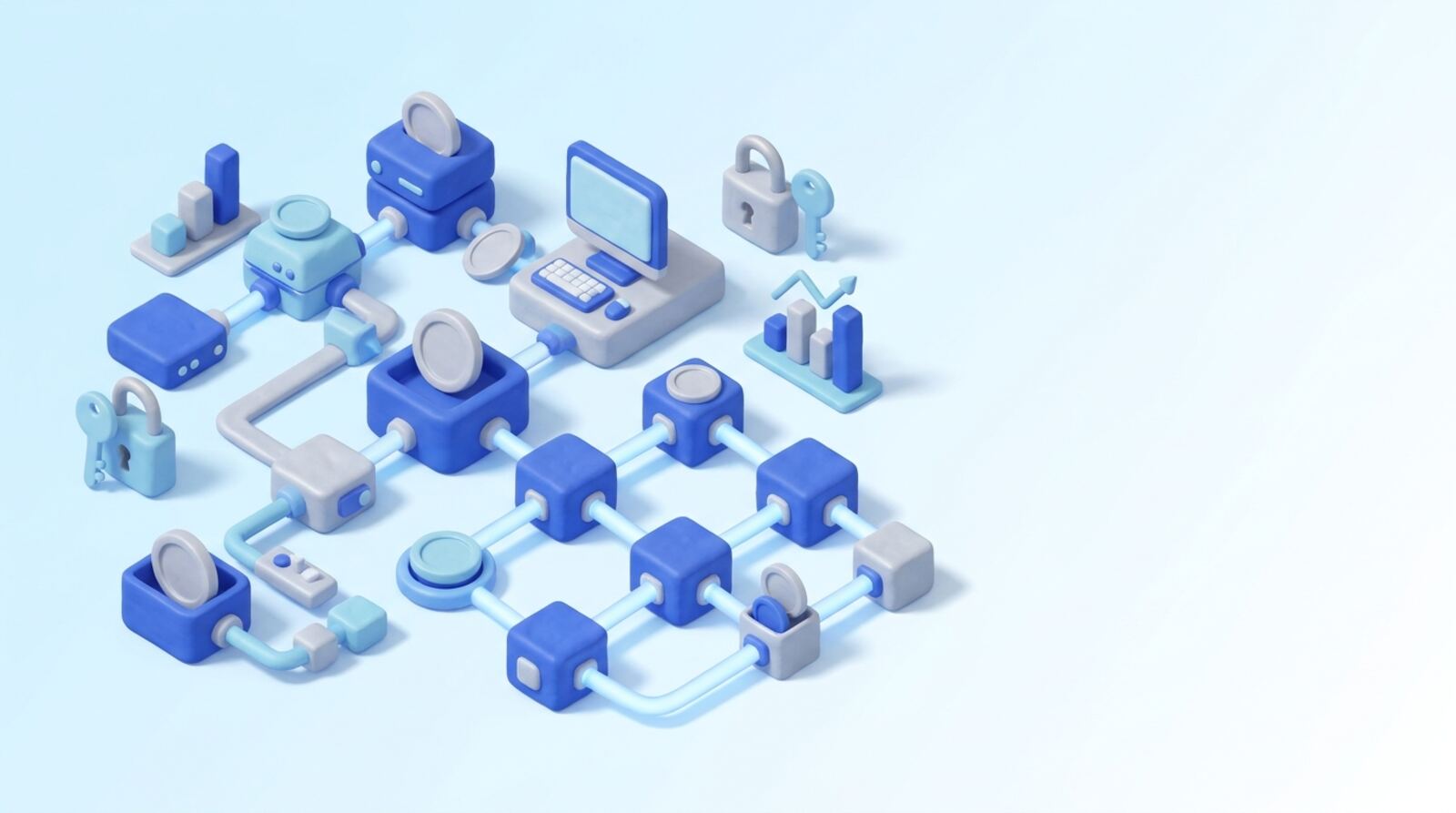
What is a blockchain network, in plain English?
A blockchain network is a group of computers running compatible software and following shared rules to maintain a common transaction record. Instead of one central database owner deciding what gets added, network participants check activity and update copies of the record according to the network’s design.
The blockchain is the record itself: data is arranged in blocks that refer back to earlier blocks. The network includes the computers, software, communication methods and decision rules used to create and check that record. People often use “blockchain” and “blockchain network” to mean the same thing, but the distinction is useful when you are choosing where to send an asset or use an app.
A network can support transfers, tokens and software applications, but it does not guarantee that those services are safe or useful. The important practical questions are:
- Which network does the asset or app use?
- How does the network confirm activity?
- What fees, wallet support and risks apply?
For example, Ethereum and Solana are separate networks with different software, transaction formats and fee systems. An asset or app on one should not be assumed to work on the other.
What happens when you make a blockchain transaction?
A transaction is a request to change the network’s record. That might mean transferring a token, interacting with a smart contract or submitting another supported instruction. The exact steps vary, but a typical public-chain transaction follows this path:
- You prepare it in a wallet. The wallet identifies the network, destination and action, then uses your private key to authorize the transaction. Your key stays under your control if the wallet is genuinely self-custodial.
- The request is broadcast. The wallet sends the signed transaction to a network node, often through an RPC service that passes requests between applications and the network.
- Nodes check it. They test whether it follows network rules, such as whether the signature is valid and the account can cover the requested amount and fee.
- The network confirms it. A block producer or validator includes it in a block, and the network’s consensus process determines whether that block is accepted.
A wallet does not usually store coins inside your phone. It manages the keys that let you authorize actions recorded on the network. Your balance is represented by the network’s data, which is why using the correct network and protecting your recovery phrase matter.
What do nodes do, and do you need to run one?
Nodes are computers running the network’s software. They communicate with other nodes, check transactions or blocks, and keep some or all of the network’s record. A network can have different kinds of nodes, and not every participant performs every job.
Some nodes mainly relay information and verify that proposed activity follows the rules. Others take part in proposing or confirming blocks. The people or organizations operating them may be independent, or activity may be more concentrated; the word “blockchain” alone does not tell you how distributed control is.
For an app or wallet, a node connection is often provided through an RPC endpoint. This is a service that lets software send a request to the network and read responses. You do not need to run a node just to use a wallet, but relying on one provider can create a point of failure: it may be unavailable, impose usage limits or give your app a narrower view of the network.
If you are building software, compare infrastructure providers such as GetBlock or Quicknode for supported networks, billing, reliability terms and security practices. If you are simply using a wallet, choose a reputable wallet and confirm the displayed network before approving activity.
How does a blockchain network agree on its records?
Consensus is the process network participants use to agree which valid transactions belong in the shared record and in what order. It helps prevent conflicting versions of the record from being accepted as the official history. Consensus does not mean every computer votes on every transaction in a simple majority; the details depend on the network’s protocol.
Two widely used approaches are proof of work and proof of stake. In proof of work, miners compete to produce blocks by performing computational work. In proof of stake, validators commit eligible assets under the protocol’s rules and may be selected to propose or confirm blocks. Each approach has different security assumptions, operating costs and participation requirements.
After a transaction appears in a block, some networks treat it as more secure as additional blocks or confirmations build on it. Other networks use different finality rules. A wallet or service may therefore wait before treating a deposit as final.
For you, the useful points are straightforward:
- A transaction marked “pending” has not completed confirmation.
- A displayed confirmation is not a promise that an app or exchange will immediately credit your account.
- Check the receiving service’s deposit requirements before sending a large amount.
Are blockchain networks always public and decentralized?
Public networks generally allow people to inspect activity and, subject to the protocol’s rules, submit transactions or run network software without first getting approval from a central operator. Permissioned networks restrict some roles, such as who can read data, submit transactions or validate blocks. These labels describe access and control, not a simple ranking of quality.
A public network may provide open access but still depend heavily on a small number of infrastructure providers, app developers or large validators. A permissioned network may offer a known set of operators and controlled access, which can suit a business process, but its governance and censorship risks differ from those of an open network.
Do not assume that all public-chain activity is private. Public transaction records can often be viewed and analyzed, even when wallet addresses are not directly labelled with real names. Also, a network’s open rules do not make every token, smart contract or website using it trustworthy.
When assessing a network, look for information about who can validate, how protocol changes are decided, how concentrated participation is and whether the record is publicly readable. If you cannot establish who controls an important service built on the network, treat that as a separate risk rather than assuming the blockchain itself removes it.
What do tokens, wallets and transaction fees have to do with it?
A network may have a native asset used to pay transaction fees, secure the protocol or support other functions. Apps can also create tokens on top of a network. Those tokens are not automatically accepted everywhere, and their value or utility is not guaranteed by the network itself.
A transaction fee compensates for network resources or follows the network’s fee mechanism. It can change with demand, the action you submit and the network’s rules. A simple transfer and a complex smart-contract interaction may have different costs. The fee may be payable in the network’s native asset, even if the token you are sending is something else.
Before confirming a transaction, check:
- The selected network and the destination address.
- The asset and amount being sent.
- The fee estimate and whether it is paid in a different token.
- Whether the action is a transfer or a contract interaction.
Ethereum, for example, supports apps and tokens, while users need to account for its transaction-fee system. Solana is a separate Layer 1 network with its own wallet compatibility and fees. A wallet showing similar-looking assets on different networks does not mean they can be sent interchangeably.
How should you choose a network before sending crypto?
Choose a network based on the specific action you want to take, not on a general claim that one chain is “best.” First confirm that the asset or app supports the network. Then check the practical costs, wallet compatibility and risks before moving funds.
Use this checklist:
- Confirm the exact network. Read the wallet, app or receiving service’s instructions. A familiar token name can exist on multiple networks.
- Check compatibility. Make sure your wallet supports the network and that the recipient accepts deposits on it.
- Estimate total cost. Account for network fees and any app, exchange or bridge charge. Fees can change, so check at the time you act.
- Check the route. If moving value between networks, verify the bridge or cross-chain service, its supported assets, quote and refund conditions.
- Test carefully. Where practical, send a small amount first, while remembering that even a small test can incur fees.
- Keep recovery details safe. Never share a seed phrase or approve an unexpected request to “verify” your wallet.
If you are comparing networks for an app, also assess whether the app’s contracts and support tools are trustworthy. Lower fees or faster confirmations alone do not establish that an app is secure.
Which blockchain network mistakes should you avoid?
The most expensive errors often come from assuming that a blockchain network will fix a mistake or make every connected app safe. Transactions on public blockchains are commonly difficult or impossible to reverse once confirmed. If you send an asset to the wrong address or use the wrong network, recovery may not be available.
Avoid these common mistakes:
- Sending to an unsupported network. Check the recipient’s deposit instructions, not just the token name or address format.
- Confusing a wallet with a network. A wallet is an interface for managing keys and making requests; it does not guarantee that a transaction is correct.
- Ignoring the fee token. You may need the network’s native asset to pay for an action, even when transferring a different token.
- Treating a pending transaction as complete. Wait for the required confirmations and verify the receiving service’s rules.
- Assuming public means private. Addresses and transactions may be visible, so avoid publishing information that connects your identity to an address.
- Approving a contract without understanding the request. A signature or approval can grant permissions or trigger an action; review the details and use trusted software.
Think of the network as the record-keeping and rule-enforcement system, not a guarantee against user error, scams, app failures or asset loss.
Frequently asked questions
Is a blockchain the same as a blockchain network?
A blockchain is the ordered record of data; a blockchain network is the collection of computers and rules that maintains and updates that record. In everyday conversation, people often use the terms interchangeably.
Does every blockchain network have to be decentralized?
Not necessarily. Public blockchains let people participate under published rules, while private or permissioned networks restrict who can join or validate activity. A public network can still have parts, such as an app or service, controlled by a company.
Do blockchain networks charge transaction fees?
A blockchain transaction is not always free. Networks may charge a fee for processing it, and the amount can vary with network demand, transaction complexity and the network’s fee rules.
Can I send crypto from one network to another?
Usually not directly: networks have different software, address formats and assets. To move value between them, you may need a supported bridge or cross-chain service, which adds its own fees and risks. Check the destination network and asset before confirming.
Does blockchain mean a transaction is always safe and reversible?
The record may be difficult to change, but that does not make every network, app or transaction risk-free. Users can still send assets to the wrong address, interact with faulty software or lose access to a wallet.
Mentioned in this guide
dApps in this guide
Ethereum is an open blockchain for ETH and apps; check variable gas costs and wallet risks before using it.
Solana is a Layer 1 blockchain for apps and payments; you’ll need a compatible wallet and SOL for fees.
GetBlock suits teams needing multi-chain RPC and data services, but check usage billing, coverage and SLA terms before relying on it in production.
Quicknode combines managed blockchain RPC with streaming and data tools, but check plan costs, product coverage and security terms before relying on it.
Keep reading
Related guides
Blockchain · Explainer
What Is a Blockchain Platform? A Practical Guide
A blockchain platform is a shared network where people or software can record transactions and, on some networks, run applications. Learn how platforms work, what they cost to use and how to choose one safely.
Security and scams · Explainer
How to Spot Bot Activity in Blockchain Data (2026)
Blockchain data can reveal patterns consistent with automation, but it rarely proves who—or what—is behind an address. Use repeated behavior, timing and transaction links together, then treat your findings as a confidence-based assessment rather than a verdict.
Blockchain · Explainer
Is Multichain Ready for Mass Adoption in 2026?
Multichain use is possible today, but moving between networks still adds choices, costs and security risks that many everyday users should not have to manage. Here’s how to judge whether it’s ready for your needs—and how to reduce the chance of an expensive mistake.
Blockchain · Explainer
5 Reasons to Build on Ethereum in 2026
Ethereum remains worth considering for developers who need programmable contracts, shared standards and access to a broad network of apps. The case is strongest when your users and product benefit from those features—and when you plan for fees, security and Layer 2 trade-offs from the start.
Blockchain · Explainer
How to Use a Blockchain Explorer in 2026
A blockchain explorer lets you search public network records, check transaction progress and inspect addresses. Learn how to choose the right explorer, read a transaction and avoid common mistakes.
Blockchain · Explainer
What Is a Crypto Miner? How Mining Works in 2026
A crypto miner is a person or machine that helps secure a proof-of-work blockchain by competing to add its next block. Mining is not how every cryptocurrency works, and earning rewards is never guaranteed.
Blockchain · Explainer
What Are zk-SNARKs? A Practical Guide
zk-SNARKs let one party prove a statement is true without revealing the secret data behind it. Here’s how the proofs work, what crypto uses them for, and what their limits mean for you.
Blockchain · Chain guide
What Is a Layer 2 Blockchain? A Practical Guide
A Layer 2 (L2) handles some blockchain activity away from a Layer 1, aiming to make transactions faster or cheaper while relying on the main chain in a specific way. Learn how the main designs work, what they cost, and what to check before moving funds.