NFT · Explainer
How Yuga Labs Built an NFT Powerhouse
Yuga Labs’ rise came from turning a popular NFT collection into a wider brand, community and portfolio. But $8.1 billion is not a straightforward, verified market cap: NFT floor-price estimates and a private company valuation measure different things.
By the SkyBitcoins editorial team · Updated
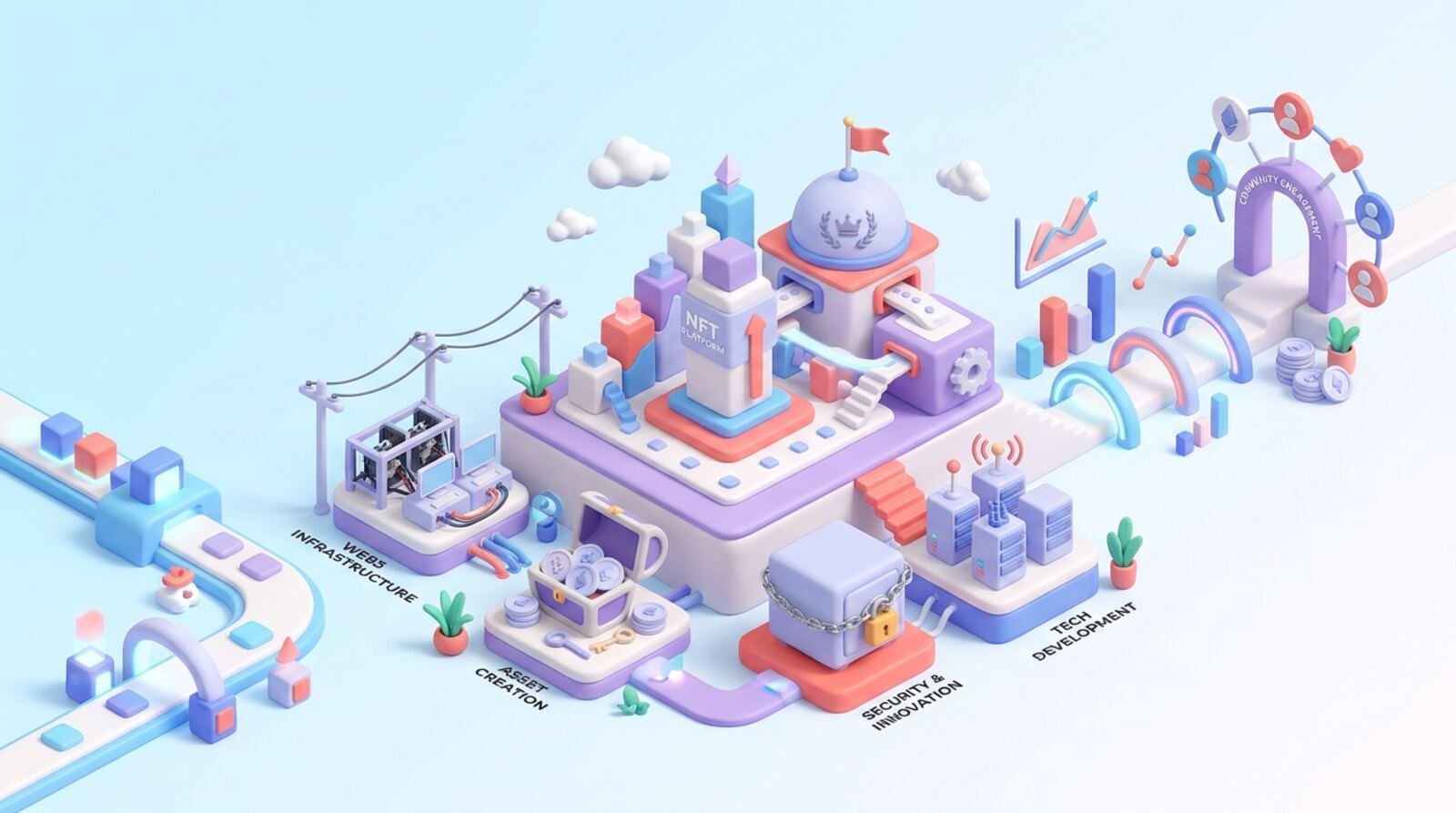
What does the $8.1 billion claim actually measure?
Yuga Labs became a major name in NFTs by building beyond a single profile-picture collection. Bored Ape Yacht Club (BAYC) combined recognizable artwork with a holder community, then Yuga expanded the brand through more collections, intellectual-property offers, acquisitions and plans for a virtual world.
That story helps explain why the company attracted intense attention and investment. It does not establish that its NFTs had a verified $8.1 billion market cap. An NFT collection has no share price in the way a public company does, and Yuga Labs is not the same thing as its collections. A private company funding valuation is a separate measure again.
To make sense of a headline figure, ask what it counts: which collections, on what date, and using which prices? A calculation using floor prices can be useful as a rough snapshot, but it is not the amount holders could all receive if they sold. Prices can move, listings can disappear, and a sale can require accepting less than the current floor.
How did Bored Ape Yacht Club get noticed?
BAYC arrived in 2021, when interest in Ethereum NFTs and profile-picture collections was growing. Its ape portraits gave holders a visible way to signal membership online. The project’s limited supply and recognizable visual identity helped it stand out in a crowded market, while social-media sharing made individual tokens and the collection easy to recognize.
The community angle mattered alongside the artwork. A BAYC purchase was presented as entry to a group, not just ownership of an image. Yuga also offered holders commercial-use rights for their individual ape artwork, a feature that encouraged some owners to develop merchandise, characters or other projects around their NFTs. Rights depend on the applicable terms, so ownership should not be assumed to grant every possible use.
Scarcity and status can reinforce attention, but neither guarantees lasting demand. A limited supply does not ensure buyers will remain interested, and a recognizable brand does not make an NFT easy to sell at a particular price. In a strong market, community activity and public visibility can amplify demand; when sentiment turns, the same assets can become harder to sell.
How did acquisitions and new collections expand the brand?
Yuga turned BAYC into the starting point for a broader portfolio. Mutant Ape Yacht Club extended the ape theme, while Bored Ape Kennel Club added another collection connected to the brand. The company also acquired the CryptoPunks and Meebits intellectual property from Larva Labs in 2022, bringing two established NFT names into its orbit.
This approach can strengthen a company’s position: it can reach collectors who know different projects, build new products around familiar characters and create more reasons for fans to follow its work. It also makes the portfolio more complicated to value. The collections have different histories, communities, supplies, rights and market activity, so combining them into one number requires transparent assumptions.
Acquiring a collection’s intellectual property does not mean every holder gets the same rights across every project. If you own or plan to buy an NFT, check the terms for that specific collection and token. Don’t infer benefits, commercial permissions or future access from the overall Yuga brand alone.
Why did the company attract so much attention and investment?
Yuga’s reach grew through a mix of community, commercial ambition and attention. Holders could identify with a recognizable collection; public figures and online discussion brought extra visibility; and the company pitched a future that included more than static artwork. That combination helped BAYC become a cultural signal as well as a tradeable Ethereum asset.
In 2022, Yuga raised $450 million at a reported $4 billion valuation. That figure described a private funding round at the time. It was not a market capitalization for BAYC, a current estimate of Yuga’s value, or proof that NFT holders could sell their assets for a share of that valuation.
The distinction is important because headlines can blend unlike measures. A company valuation is an investor’s negotiated estimate of the business under particular conditions. An NFT collection estimate may multiply a listed floor price by the number of tokens. Neither measure guarantees what a buyer will pay today, and neither should be treated as cash available to holders.
What did Otherside add, and what did the land sale reveal?
Yuga’s Otherside project aimed to extend the brand into a virtual world, with digital land represented by NFTs. Its 2022 land sale drew heavy demand and caused a surge in Ethereum transaction fees. That episode showed both the appeal of a high-profile launch and the practical costs of competing for block space during a rush.
A virtual-world plan can give a collection a larger story: tokens may be marketed as access, identity or building blocks for a future experience. But plans and promised utility are not the same as a finished product or guaranteed ongoing demand. You should check what is live now, what is only planned, which token or NFT is required, and whether access can change.
Before joining any NFT mint or sale, estimate the full cost rather than focusing only on the displayed price. On Ethereum, network fees can rise when activity is high. A transaction can fail and still consume a fee, and a wallet prompt may authorize more than a simple purchase. Read the transaction details and confirm the collection and contract before signing.
How should you read an NFT market-cap estimate?
A common rough estimate is floor price multiplied by collection supply. The floor is the cheapest current listing, not the average sale price. The multiplication assumes every token could sell at that price, even though selling a large number at once would likely require lower offers and could push prices down.
For a useful comparison, separate these measures:
| Measure | What it describes | What it does not prove |
|---|---|---|
| Floor-price estimate | Supply multiplied by the lowest listing | Cash holders could collectively realize |
| Recent sales | Prices buyers and sellers agreed to in completed trades | That the next NFT will sell at the same price |
| Private company valuation | An investor estimate in a funding deal | The current value of every Yuga NFT |
When someone quotes $8.1 billion, look for the calculation date, collections included, supply used and pricing method. If those details are missing, treat it as an unsupported headline figure rather than a precise valuation. Even a carefully calculated estimate can become stale quickly in a volatile market.
What risks should you check before buying?
Yuga’s success does not remove the risks of buying NFTs. Prices can fall sharply, trading can dry up, and a listed floor can be misleading if few buyers are willing to pay it. A collection’s status or past sales do not guarantee future demand. You also face Ethereum transaction costs, scams that imitate popular collections and the possibility of approving a harmful wallet transaction.
If you are considering a purchase, use this checklist:
- Confirm the collection name and the NFT’s contract on the correct chain.
- Compare the listing with recent completed sales, not just the cheapest ask.
- Add marketplace fees, creator royalties if applicable, and network gas to the total.
- Read the wallet prompt; reject permissions or transfers you do not understand.
- Check the collection’s current rights and utility terms, and decide what you can afford to lose.
Avoid buying because a past market-cap figure sounds authoritative, borrowing to chase a rising floor, or assuming a celebrity association guarantees liquidity. If a listing is unusually cheap or a mint is promoted through an unsolicited message, verify it independently before connecting your wallet.
What is the practical takeaway for NFT collectors?
Yuga Labs became influential by turning BAYC into a recognizable social brand, expanding into related collections, acquiring established NFT intellectual property and pursuing a wider virtual-world vision. A large investor valuation in 2022 reflected confidence in the company at that time, while high-profile launches brought attention and, at times, costly network congestion.
Those factors explain the rise; they do not make every headline number reliable. There is no single obvious market-cap figure for a private company’s varied NFT portfolio. Any $8.1 billion estimate needs a date and a transparent method, and a floor-price calculation should not be confused with the amount holders could actually realize.
If you are researching Yuga today, compare collections individually. Check recent sales and active listings, account for transaction costs, and read the exact rights and utility terms for the NFT you are considering. Treat community, brand strength and future plans as context—not as guarantees of price or resale demand.
Frequently asked questions
Did Yuga Labs’ NFTs have an $8.1 billion market cap?
No single, independently established $8.1 billion market cap for Yuga Labs’ NFTs is established by the figures discussed here. A number like that needs a date, a list of included collections and a clear calculation to be meaningful.
Is Yuga Labs’ company valuation the same as its NFT market cap?
No. Yuga Labs raised $450 million in 2022 at a reported $4 billion company valuation. That was a private funding valuation at that time, not a current NFT market cap or a guarantee of what the company could sell for.
Which projects helped Yuga Labs become well known?
BAYC helped establish the brand, while later projects and acquisitions broadened its reach. CryptoPunks and Meebits joined its portfolio, and Otherside extended its ambitions into virtual land and gaming.
How do people estimate an NFT collection’s market cap?
A floor price is the cheapest listed NFT in a collection at a particular moment. Multiplying it by the collection’s supply can produce a rough estimate, but it assumes every token could sell at that price, which is rarely a safe assumption.
What should I check before buying a Yuga Labs NFT?
Treat a floor-price estimate as a snapshot, not as cash you could realize by selling. Check the collection, chain, floor price, recent sales, fees and wallet transaction details before you trade.
Mentioned in this guide
dApps in this guide
OpenSea is an NFT marketplace for buying, selling and offers; check the chain, fees and wallet prompt before approving a transaction.
MAYC is an Ethereum NFT collection for ape-art collectors, but check the listing, total transaction costs and resale risks before buying.
Keep reading
Related guides
NFT · Explainer
How to Assess the Blue-Chip NFT Resurgence in 2026
Blue-chip NFT prices can rebound quickly, but a rally in a few collections is not proof that the whole market has recovered. Use this guide to assess the signal, check a collection and limit your risk before buying.
NFT · Review
Diplo and a New BAYC NFT: What Collectors Should Check
A celebrity post can draw attention to Bored Ape Yacht Club, but it does not establish a token’s authenticity, purchase price or investment value. Here’s how to check the claim and assess the NFT before you act.
NFT · Explainer
Why an ETH Rally Can Double Bored Ape NFT Volume
An ETH rally can make Bored Ape Yacht Club (BAYC) NFTs look more active, but a reported 100% volume jump needs context. Learn how to check what doubled, why it may have happened, and what the number does—and doesn’t—tell you.
NFT · Explainer
Is a Goat NFT Taking on BAYC? How to Check the Claim
The headline sounds like a clash between a small, irreverent NFT idea and Bored Ape Yacht Club. But without a named collection, contract or event, treat it as a claim to verify—not a confirmed challenge to BAYC.
NFT · Explainer
Zynga’s NFT Gaming Plans: What Happened?
Zynga’s 2022 NFT-gaming ambition is a historical plan, not proof that a game is available today. Here’s what the announcement means, what changed afterward and what to check before spending.
NFT · Explainer
What Are Y00ts NFTs? The Y00tlist Explained
Y00ts is a 15,000-piece avatar NFT collection that began on Solana. The y00tlist was its historical mint allowlist, so check the collection’s current official channels before acting on old mint or migration posts.
NFT · Explainer
How to Check 0x0 Art’s NFT Income Claims
0x0 Art is presented as a way to earn from NFTs without selling them, but that promise is not enough to assess the risk. Learn what income mechanism to look for, what to verify before connecting a wallet, and when to walk away.
NFT · Explainer
How to Read the $3.7M XCOPY NFT Sale in 2026
A reported 2021 purchase put two XCOPY artworks in the NFT headlines at a combined $3.7 million. Here’s what that figure tells you—and why it does not settle their present value or place in an all-time ranking.