NFT · Explainer
What Is Crypto Land? A Practical Guide to Virtual Land NFTs
“Crypto land” usually means a plot in a digital world represented by an NFT—not a deed to physical property. Before you buy, check what the token actually gives you, whether the world is active and what costs or risks come with holding it.
By the SkyBitcoins editorial team · Updated
What does “land crypto” mean?
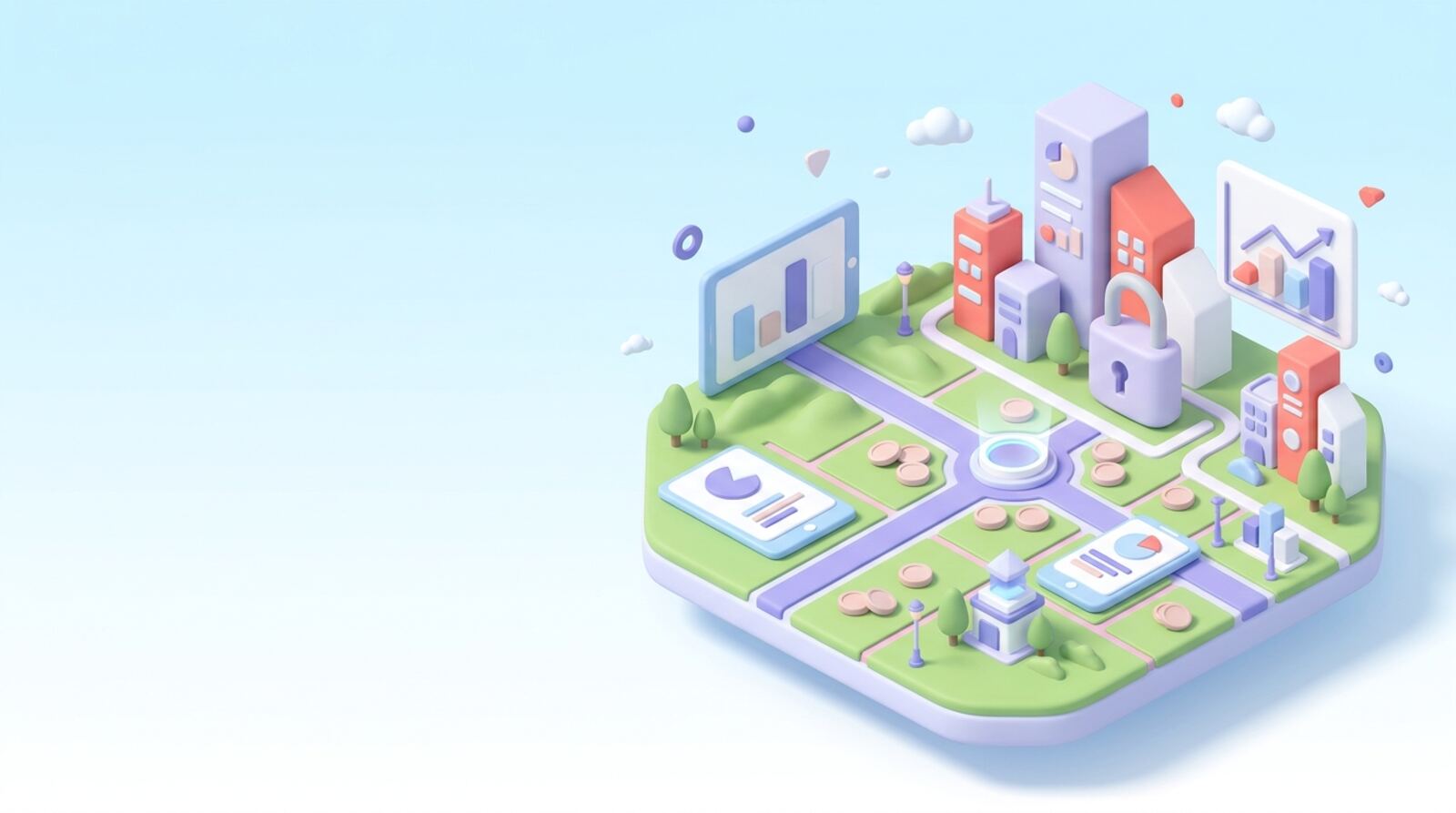
“Crypto land” most often means a plot in a digital world represented by a non-fungible token (NFT). The token can identify a particular parcel and may be transferable on a blockchain. It is not automatically a deed, a building or a claim on physical property.
The phrase is also used loosely for other things, including cryptocurrencies connected to virtual worlds and tokens associated with real estate projects. Those are not interchangeable. A token’s name or marketing does not tell you what legal rights it grants.
Before you consider a purchase, identify which of these you are looking at:
- Virtual land: a digital parcel governed by a specific virtual-world project.
- A project token: a fungible crypto asset that may be used for payments, governance or other functions.
- Tokenized real estate: a token that may represent an interest related to physical property, subject to its legal structure.
For most buyers asking “what is land crypto?”, the relevant asset is virtual land. Its value and use depend heavily on the project’s rules, software, community and continued operation.
How does a virtual land NFT work?
A virtual-world project divides its digital space into parcels and links each parcel to a token, commonly an NFT. The blockchain can record which wallet holds that token and whether it has been transferred. The project’s software determines how the parcel appears and what an owner can do with it.
That distinction matters: the blockchain record and the virtual experience are separate parts of the product. A token may remain visible in your wallet even if the world’s servers, app or community become inactive. The token does not necessarily contain the plot’s scenery or guarantee that the project will keep displaying it.
Depending on the project, a parcel might let you place digital objects, create an experience, host an event or access a feature. Some projects offer little beyond collecting and trading. Rules can change, and tools or services may require additional tokens or fees.
Check the project’s documentation for the parcel’s identifier, supported network, permitted uses and any limits. Confirm that the NFT belongs to the official collection, not a lookalike listing. If you cannot establish what the token represents or how the parcel is used, do not treat it as property just because it is called “land.”
What rights do you get when you own the NFT?
Holding a land NFT generally means your wallet controls a token recorded on a blockchain. What else you can claim depends on the project’s terms. The token may give access to certain in-world features, but it does not automatically grant copyright, a share of company revenue, a right to vote or control over the underlying software.
Read the project’s terms and NFT rights before buying. Look for answers to these questions:
- Does ownership permit you to build, display or host content on the parcel?
- Can the project change access, features or parcel boundaries?
- Do you receive any rights to the artwork or content placed on the land?
- Are there rules on commercial use, resale or transferring the NFT?
- Does access depend on an account, a service or an active project?
A marketplace listing is not a substitute for those terms. It may show a token ID and sale price without explaining the practical rights attached to it. If you are buying for a particular use—such as hosting an event—confirm that the use is allowed and technically possible now. Do not assume that a land NFT guarantees permanent access or future income.
How can you assess a virtual land plot?
Treat a plot as a project-specific digital collectible, not a generic parcel of real estate. Compare it with other plots in the same world and check whether the world is still being maintained. A scarce parcel has little practical value if nobody uses the project or its advertised features are unavailable.
Use this checklist before you commit money:
- Project status: Can you access the world or app, and are its core features working?
- Official collection: Does the project identify this collection and token as genuine?
- Parcel details: Do the map, coordinates, size and boundaries match the listing?
- Use and restrictions: Are building, commercial activity and transfers allowed?
- Activity: Is there evidence of ongoing development and real user participation?
- Exit options: Is there a functioning marketplace and meaningful buyer interest?
A high asking price is not proof that a plot is worth that amount. Listings can be stale, and advertised prices do not show what buyers actually paid. Look for completed transactions where available, while remembering that past sales do not guarantee future demand. If the project publishes no clear terms or the parcel cannot be independently identified, pause rather than relying on a seller’s claims.
What can crypto land cost beyond its listing price?
The purchase price is only one part of the cost. Depending on the blockchain and marketplace, you may also pay a transaction fee to transfer the NFT, a marketplace fee, a creator royalty or a currency-conversion cost. Network fees can vary, so check the total shown in your wallet before approving a transaction. A listing price does not necessarily include every charge.
There may be further costs to use the land. A project could require payment for tools, digital objects, hosting or access to particular features. These costs are project-specific; do not assume that building or hosting is free just because the NFT has already been purchased. If the project does not clearly publish its charges, budget cautiously and avoid committing money you cannot afford to lose.
To compare two plots, write down the full amount you expect to spend:
| Cost | What to check |
|---|---|
| NFT price | Currency, token ID and whether the listing is current |
| Transaction | Network fee shown before signing |
| Marketplace | Any sale or service fee |
| Use | Extra costs to access the features you want |
Crypto prices can move between viewing a listing and completing a transaction. Check the amount and network in the final wallet prompt, not just the marketplace page.
What should you do before buying crypto land?
If you decide to buy, take the steps in order. A familiar marketplace does not remove the need to verify the project, NFT and transaction details yourself.
- Confirm the project is active. Check that its official app or world works and that the parcel has a use you actually want.
- Verify the collection and token. Match the marketplace listing to the collection identified by the project. Check the network and token ID.
- Read the terms. Confirm transfer rules, usage rights and any extra costs.
- Review the full transaction. Check the price, fees, wallet address and network. Do not sign a prompt you cannot understand.
- Keep your wallet secure. Use a wallet you control, protect its recovery phrase offline and never share it with a seller or support account.
- Confirm receipt. After the transaction, check that the NFT appears in the correct wallet and that its token details match the purchase.
On a marketplace such as OpenSea, check the blockchain and collection carefully; similar names can be used by unofficial collections. Never connect a wallet or approve a transaction just because a listing claims a parcel is scarce or time-sensitive.
What mistakes should you avoid with virtual land?
The main risk is that the token can outlast the experience it was meant to represent. A project may lose users, stop maintaining its app or close parts of its service. In that case, you could still hold an NFT but find that its intended use has disappeared. Selling may also be difficult if there are few interested buyers.
Other common mistakes include:
- Confusing an NFT with a property deed. A virtual parcel is not automatically a legal claim to physical land.
- Buying from a lookalike collection. Confirm the official collection and token identifier.
- Assuming scarcity means demand. Limited supply does not create a buyer or a useful experience.
- Relying on projected income. Virtual land does not guarantee rent, rewards or resale gains.
- Ignoring total costs. Network and marketplace fees can make a small purchase more expensive.
- Signing a broad or unclear wallet approval. Read each prompt and reject anything you do not understand.
Only spend money you can afford to lose, and do not borrow or use essential savings to speculate on a plot. If a seller pressures you to act immediately, promises guaranteed returns or asks for your recovery phrase, stop. Those are reasons to step away, not reasons to rush.
Is virtual land the same as tokenized real estate?
No. Virtual land is a digital asset within a virtual-world project. Tokenized real estate is a separate category that may use blockchain tokens to represent rights or interests connected to physical property. The legal structure, issuer and applicable rules determine what a real-estate token actually represents; a token alone does not prove you own a building or a piece of land.
Check the documents for any real-estate token to identify the issuer, asset, ownership structure, fees, transfer limits and how you could claim or sell your interest. If those rights are unclear, do not treat the token as a substitute for a conventional property deed or investment agreement.
Project status matters in both categories. Landshare announced that its dApp and ecosystem had ceased operations, while its real-estate business continued separately. That does not make every real-estate token or virtual-world project inactive, but it shows why you should verify the exact product and service before paying. A functioning business, an active app and a transferable token are different things; check each one rather than relying on a shared brand name.
Frequently asked questions
Does a virtual land NFT mean I own real land?
Usually, no. A virtual land NFT represents a digital plot within a particular project, and its usefulness depends on that project’s rules and continued operation. It does not by itself give you rights to physical land.
Can I resell crypto land?
A land NFT may be transferable if the project and marketplace support transfers, but that does not guarantee a buyer or a particular price. Check the exact collection, blockchain and token terms before listing or buying.
Can virtual land earn money?
Sometimes. A project may let owners build, host experiences or access features, but those permissions vary and may depend on its software and policies. Owning the NFT alone does not guarantee income or a working plot.
Is crypto land the same as tokenized real estate?
They are different categories. Tokenized real estate aims to represent an interest connected to physical property, while virtual land is a digital asset in a virtual world. For either, read the legal rights carefully rather than relying on the token’s name.
Is the Landshare app still operating?
Landshare announced that its dApp and ecosystem had ceased operations, while its real-estate business continued separately. Treat that as a warning to check whether any project’s app, marketplace and support are still active before buying its tokens or assets.
Mentioned in this guide
dApps in this guide
OpenSea is an NFT marketplace for buying, selling and offers; check the chain, fees and wallet prompt before approving a transaction.
Crypto.com offers broad crypto access and EUR deposits, but check spreads, fees and withdrawal terms before funding an account.
Match-Trader sells trading software to brokers and prop firms; get a full quote and verify security details before choosing it.
Keep reading
Related guides
NFT · Explainer
How to Value Hashmasks NFTs in 2026
A Hashmasks NFT’s value depends on recent comparable sales, its specific traits and name, and what buyers will actually pay—not a headline sale or a rarity score alone. Use this guide to estimate a defensible price and check your costs before buying or selling.
NFT · Explainer
Will Uniswap NFTs Change Crypto? A 2026 Guide
Uniswap may make NFTs easier to trade or use as collateral, but it does not make them automatically liquid, interchangeable or valuable. Here’s what its NFT-related tools can mean for you in 2026—and what to check before you connect a wallet or sign a transaction.
NFT · Explainer
How to Choose a Metaverse Avatar NFT in 2026
An avatar NFT is only useful if the virtual world supports it and its rights fit your plans. Check compatibility, costs and ownership terms before you mint or buy.
NFT · Explainer
How to Verify the 85,000 Colonize Mars NFT Card Sale
A claim that a Colonize Mars NFT card sold for 85,000 is not verifiable without the currency, date and on-chain transaction. Here’s how to check what the figure means, whether the sale is real, and what ownership of the card would—and would not—give you.
NFT · Explainer
What Is CryptoCats? How to Identify the Right Project
“CryptoCats” can describe different cat-themed crypto projects, not one clearly identifiable NFT collection. Before you treat it as an asset, identify the exact project, blockchain and contract.
NFT · Explainer
What Is Bullrun Babes? How to Verify the NFT Project
Bullrun Babes is not identifiable as a specific NFT project from its name alone. Learn what to verify before you connect a wallet, mint or buy an item using that name.
NFT · Explainer
What Is NFT Mining? A Practical Guide
“NFT mining” can mean a token tied to real cryptocurrency mining—or a project’s own reward feature. Learn how to tell the difference, what costs to check and how to spot misleading earnings claims before you pay.
NFT · Explainer
What Is Bored Ape Yacht Club? A Practical Guide
Bored Ape Yacht Club is a collection of 10,000 ape-themed NFTs on Ethereum. Here’s what the tokens represent, what ownership may let you do, and what to check before buying one.