Blockchain · Explainer
How to assess SKALE’s hybrid modular scaling model
SKALE’s hybrid design aims to scale Ethereum-oriented apps by running multiple EVM-compatible chains rather than routing every app’s activity through one shared chain. Learn how that model works, where its costs and trade-offs sit, and what to check before choosing it.
By the SkyBitcoins editorial team · Updated
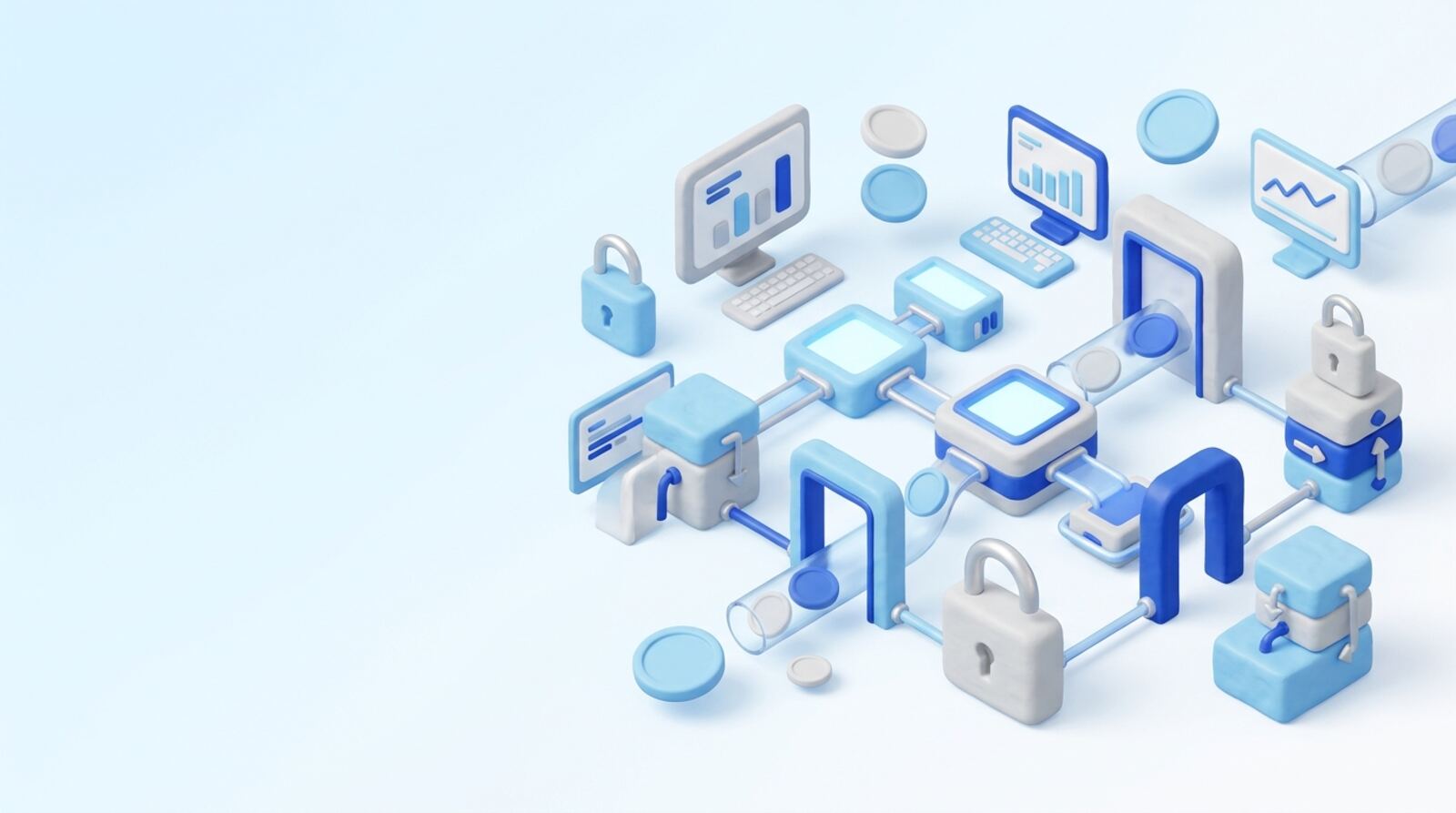
What makes SKALE a hybrid modular Layer 1?
SKALE stands out by organizing activity across multiple EVM-compatible chains instead of making every application compete for space on one general-purpose chain. That can give an app its own execution environment and a user experience designed around lower friction, including transactions that do not charge users conventional gas fees.
The “hybrid modular Layer 1” label needs context. SKALE is a network of chains connected to Ethereum’s ecosystem, not a single chain that processes every app’s transactions directly on Ethereum. Its design combines app-focused execution with Ethereum-related network coordination and economic mechanisms. That is different from a typical rollup, which posts transaction data or proofs to Ethereum as part of its security model.
The practical distinction is where work happens and what assumptions secure it. SKALE can offer developers separate chain environments, while Ethereum remains relevant to the broader network design. You should evaluate the individual SKALE chain and its app rather than treating the label “Layer 1” or “Ethereum-connected” as a complete security assessment.
How do SKALE chains and Ethereum fit together?
A simplified way to understand SKALE is to separate the app’s execution from the network’s coordination and resource model. Applications can run on dedicated SKALE chains, where smart-contract transactions are processed. The network uses validator infrastructure to support those chains, while Ethereum is part of SKALE’s staking and coordination framework.
This creates a multi-chain arrangement: applications can have distinct environments rather than sharing one execution lane with every other application. EVM compatibility means developers can work with many familiar Ethereum contract patterns and tools. It does not mean that every Ethereum feature, contract dependency, or wallet integration automatically behaves identically on SKALE.
When you assess an app, identify the exact chain it uses and how assets enter or leave it. A wallet may support several networks, but balances and contracts on different chains are not interchangeable just because they use EVM-compatible addresses. Check the network name before sending funds, and verify the asset’s route and withdrawal process before relying on it.
Why can SKALE reduce friction and scale app activity?
The main scalability idea is to distribute application activity across multiple chains. If an app has its own environment, its transactions do not have to compete in the same way with unrelated apps using a single shared execution layer. This can make performance and user experience easier to tailor to an application’s needs.
SKALE also aims to remove the familiar per-transaction gas payment from the user experience. That matters for apps where repeated small actions would otherwise require users to hold a native fee token and approve a separate fee each time. The app or chain operator still has to account for network resources, however. “Gas-free for users” is not the same as “free to build and operate.”
Do not treat these design goals as a guarantee of unlimited capacity or uninterrupted service. Actual performance depends on the chain, its configuration, its contracts and demand. Before committing an app or funds, look for current performance measurements, service expectations and outage procedures specific to that chain. Compare those with what your application needs, rather than relying on broad claims about scalability.
What should developers check before deploying on SKALE?
For a developer, SKALE’s appeal is the possibility of deploying an EVM-oriented app in a dedicated chain environment and avoiding a direct gas charge to each end user. Familiar tools may make the transition easier than building for a completely different virtual machine, while a separate chain can give an app more control over its environment.
A practical evaluation should start with the application’s requirements:
- List the contracts, oracles, indexing services, wallets and other integrations the app depends on.
- Confirm that each dependency supports the target SKALE chain, not merely Ethereum or EVM in general.
- Estimate chain-resource and operational needs, including how the app will cover them.
- Test deployments, upgrades, monitoring and recovery procedures before moving users.
- Document how users will bridge or otherwise move assets, and who supports failed or delayed transfers.
For an existing Ethereum app, compatibility can reduce rewriting, but it does not eliminate migration and testing. Contract addresses differ across networks, liquidity may be separate, and a familiar interface can still conceal a different trust model. Start with a limited deployment and a clear rollback plan rather than assuming a copy of the Ethereum deployment is ready for production.
What should users verify before using a SKALE app?
As a user, begin by checking which network an app actually uses. Confirm the chain in your wallet, the token contract and the app’s instructions before signing a transaction. If you need to move assets, inspect the bridge or other transfer route, including the supported tokens, expected steps and what happens if a transaction stalls.
SKALE’s user-facing gas model may mean you do not need to keep a fee token for each action. You may still need the app’s supported asset, and the app can impose its own costs or conditions. Do not assume that a token shown under the same symbol on Ethereum and SKALE is the same asset or has the same liquidity. Check the exact network and contract address.
Before depositing meaningful value, try a small transaction and confirm that the resulting balance appears on the intended chain. Keep enough time to understand withdrawal and bridge procedures; cross-chain transfers can involve separate systems and additional risks. If an app does not explain its network, asset route, or recovery process clearly, pause rather than signing based on a wallet prompt alone.
What security assumptions should you check?
SKALE’s architecture is not a shortcut around security analysis. A dedicated chain can separate an app’s activity, but users and developers still need to understand its validator arrangements, smart contracts, administrative controls and bridge dependencies. Connection to Ethereum does not, by itself, prove that every transaction on a SKALE chain has Ethereum’s security guarantees.
The risk also depends on what you do. A simple app interaction, a token deposit and a bridge transfer expose you to different combinations of contract, operational and market risk. If assets are held or moved through a bridge, examine the bridge’s design, custody or verification assumptions, supported routes and incident process. Check whether the app can pause contracts, change permissions or upgrade code.
Look for independent security reviews of the relevant contracts and infrastructure, and read their scope and date. An audit is not a guarantee, and a review of one contract does not cover the entire chain, app or bridge. For an application that holds valuable assets, also assess monitoring, incident communication and how users can withdraw if the app’s normal interface becomes unavailable.
Who pays for SKALE if users do not pay gas?
The cost comparison is more nuanced than “SKALE has no fees.” A user may not pay a conventional gas charge for each transaction, but the chain still consumes infrastructure and has network economics. SKL has a role in staking and in the system used to support chain resources. The actual operating arrangement can differ by project, so ask who pays for the chain and what happens if that arrangement changes.
For an app team, compare the full operating picture: chain resources, deployment and maintenance work, bridge costs, indexing and monitoring, and any third-party services. For users, check whether the app charges fees of its own and whether moving assets in or out incurs costs elsewhere. Those costs can be separate from an on-chain transaction fee.
Do not infer a project’s cost from the absence of a gas prompt, and do not assume SKL is needed for every user action. Check the current requirements of the app and chain before acquiring tokens or budgeting a deployment. If published terms do not make the payer, resource limits or renewal conditions clear, treat the cost as unresolved until the operator confirms it.
When does SKALE make sense, and what mistakes should you avoid?
SKALE may suit applications that want EVM-compatible tooling, a separate chain environment and a low-friction transaction experience. It may be a weaker fit if an app depends on deep liquidity on Ethereum, requires a particular rollup security model, or cannot tolerate separate bridge and chain assumptions. The best choice depends on the application and the risks it can accept, not the architecture’s label.
Avoid these common mistakes:
- Treating “hybrid” as proof that SKALE inherits all of Ethereum’s security.
- Assuming EVM compatibility means every contract and service works unchanged.
- Confusing a user gas-free experience with zero operating or transfer costs.
- Sending assets before confirming the exact network and supported route.
- Relying on an audit as a guarantee or as coverage of the entire system.
Before choosing SKALE, compare it with the other network options your users and integrations already support. For Ethereum context, review how Ethereum itself handles execution and fees, then compare the specific security, liquidity and operational trade-offs of the app’s target chain. Make the decision around verifiable requirements—capacity, cost responsibility, integrations and recovery—not a promise of scalability alone.
Frequently asked questions
Is SKALE a Layer 1 or a Layer 2?
SKALE is a network of EVM-compatible chains designed to support applications with separate execution environments. It is often described as a hybrid modular Layer 1 because it combines multiple app-focused chains with a connection to Ethereum’s ecosystem; it is not simply one Ethereum rollup.
Are transactions on SKALE really gas-free?
SKALE is designed so users can transact without paying a conventional per-transaction gas fee. That does not mean operating a SKALE chain or application has no cost: chain resources and network participation have their own economics, including the role of SKL.
Can Ethereum apps move to SKALE?
SKALE chains are EVM-compatible, so developers can use familiar Ethereum smart-contract tools and workflows. Compatibility can reduce migration work, but it does not guarantee that every contract, dependency, wallet, or integration will work without changes.
Does SKALE inherit Ethereum’s full security?
SKALE’s architecture uses validator infrastructure and Ethereum-related network coordination, but it does not make every SKALE transaction equivalent to an Ethereum transaction. Assess the chain’s validator and bridge assumptions, and the consequences of an outage, for the specific app you plan to use.
Do I need SKL to use a SKALE app?
You may not need SKL just to make a user transaction on a SKALE app, but SKL has a role in the network’s staking and resource economics. Check the app’s requirements before acquiring a token; never assume that a token is required—or risk-free—without verifying its current use.
Mentioned in this guide
dApps in this guide
Ethereum is an open blockchain for ETH and apps; check variable gas costs and wallet risks before using it.
Keep reading
Related guides
Blockchain · Explainer
Why Ethereum Layer 2 Scaling Matters: A Practical Guide
Ethereum Layer 2 networks move much of the transaction activity away from Ethereum’s main chain, helping apps handle more users and often lowering costs. Here’s how they work, what they improve and what risks you should check before using one.
Blockchain · Explainer
How to Assess Horizen’s Scalability Trade-Offs
The scalability trilemma describes the trade-offs blockchains face when trying to scale without weakening security or decentralization. Learn what it means for Horizen, what its Base-based direction may change, and what to check before using a Horizen app.
Blockchain · Explainer
How to Assess Private Messaging on Oasis Sapphire
Oasis Sapphire adds confidential execution to an EVM-compatible chain, which can support private messaging apps. It does not make every message, user detail or transaction invisible by default.
Blockchain · Explainer
Is Radix Engine a Better Model for Enshrinement?
Radix Engine makes asset handling and transaction behavior part of a resource-oriented execution environment. That can make some DeFi rules easier to express, but it does not make every application feature safer or remove the need to assess contracts and network risks.
Blockchain · Explainer
How to Evaluate SKALE’s $100 Million Incentive Program
SKALE’s $100 million incentive program is presented as a way to support ecosystem expansion, but its practical value depends on terms SKALE has not published here. Learn what developers and users should verify before treating the headline figure as available funding.
Blockchain · Explainer
How to Assess Ronin’s Validator Expansion in 2026
Adding validators can reduce dependence on a small group of network operators, but it does not remove bridge, wallet or smart-contract risk. Here’s how to judge Ronin’s security changes and protect your assets when using the chain in 2026.
Blockchain · Explainer
How to assess SKALE’s multichain future in 2026
SKALE’s multichain approach gives developers a way to build EVM-compatible chains for specific applications. Learn what that means for users, what to check before moving assets, and how to judge whether the network’s trade-offs fit your needs in 2026.
Blockchain · Chain guide
How to Use Ronin Network: A Practical Guide
Ronin is an EVM-compatible blockchain built around games and digital assets, with RON used for transaction fees. Learn how to choose a wallet, move assets carefully and check costs and risks before using the network.