


Ethereum has always been more than a blockchain. It is an evolving experiment in open coordination, decentralized finance, and programmable money—guided by a community and repeatedly refined through engineering breakthroughs. At the center of this evolution is Vitalik Buterin, whose vision and research-driven approach continue shaping how Ethereum scales while staying true to its core principles. If Bitcoin was designed to be immutable digital gold, Ethereum was designed to be a living, upgradeable network that can support a global economy. The challenge, however, has always been scaling: how can a blockchain support millions of users without becoming centralized or insecure?
That question leads directly to the infamous blockchain trilemma, the idea that a blockchain can only optimize two out of three properties: security, decentralization, and scalability. Many networks have tried to “solve” this by sacrificing decentralization—relying on a small number of validators—or reducing security guarantees to increase throughput. Vitalik Buterin has repeatedly argued that Ethereum’s path must be different: scale through layered design, cryptography, and data availability innovations rather than shortcuts.
Today, Ethereum’s plan to break the blockchain trilemma is becoming clearer. Two of the most important components of that plan are ZK-EVMs and PeerDAS. ZK-EVMs—zero-knowledge Ethereum Virtual Machines—promise massive efficiency gains and stronger privacy-preserving verification through zero-knowledge proofs. PeerDAS—Peer Data Availability Sampling—aims to make data availability scalable and cheap, a foundational requirement for rollups and sharded systems. Together, they represent a powerful approach: Ethereum scales by pushing execution to rollups while keeping verification and data availability anchored to the base layer.
In this article, we’ll explore how Vitalik Buterin frames the problem, why Ethereum’s roadmap centers on rollups, and how ZK-EVMs and PeerDAS can help Ethereum break the blockchain trilemma in a way that remains open, resilient, and truly decentralized.
Understanding the Blockchain Trilemma Through Vitalik Buterin’s Lens
The blockchain trilemma is often treated like a law of nature: if you want more throughput, you must accept fewer nodes or weaker security. But Vitalik Buterin sees it less as an unbreakable rule and more as a design constraint that can be navigated with the right architecture. The key insight is that scalability doesn’t have to come from making the base chain do everything. Instead, scalability can come from making the base chain do the most important things extremely well: finality, consensus, security, and data availability.
For Vitalik Buterin, the base layer should be optimized for what it can uniquely guarantee. A decentralized network with thousands of independent validators is incredibly valuable, but it cannot also be responsible for executing every transaction for every user worldwide at high speed. If Ethereum tried to scale purely by increasing block sizes dramatically, node requirements would rise, and decentralization would erode. That would be a trilemma loss.
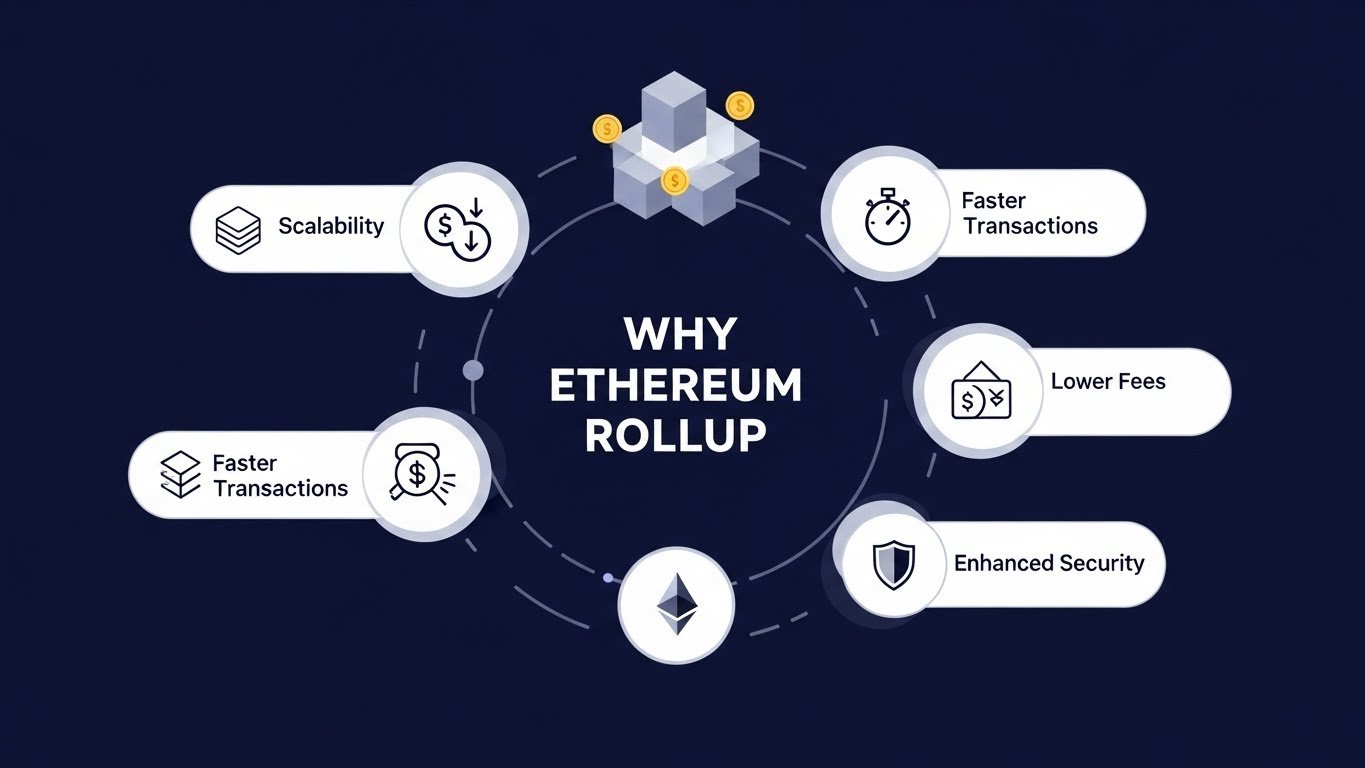
This is why Ethereum embraced a modular approach. The base layer provides strong security and decentralization, while execution and high-throughput transaction processing move to Layer 2 rollups. Rollups compress transactions and post proofs or commitments to Ethereum, inheriting base-layer security while dramatically increasing scalability. In this model, Ethereum doesn’t “ignore” scalability; it enables scalability through composable layers. Vitalik Buterin has consistently emphasized that this is how Ethereum can avoid the common pitfall of centralizing the validator set.
Why Ethereum’s Rollup-Centric Roadmap Changes Everything
Ethereum’s rollup-centric roadmap is not a small tweak—it’s a fundamental shift in how blockchain scaling works. Under this roadmap, Ethereum becomes the settlement layer for a massive ecosystem of rollups. That means users can transact on specialized rollups—optimized for DeFi, gaming, payments, or enterprise use—while still relying on Ethereum for security guarantees.
Vitalik Buterin supports this approach because it aligns with Ethereum’s decentralization values. Instead of increasing throughput by reducing node counts, Ethereum increases throughput by using cryptography and smart protocol design. Rollups are not just sidechains; they’re systems designed to inherit Ethereum’s security.
However, rollups require two key things to work at global scale. First, they need efficient verification—this is where ZK-EVMs become transformative. Second, they need cheap, reliable data availability, because users must be able to reconstruct rollup state and verify correctness. This is where PeerDAS becomes essential.
When Vitalik Buterin discusses scaling, he repeatedly comes back to these bottlenecks. Execution is easy to outsource to rollups. Verification and data availability are the hard parts. If Ethereum solves those, it can break the blockchain trilemma without compromising the network’s ethos.
What Are ZK-EVMs and Why Vitalik Buterin Cares About Them
A ZK-EVM is a system that can prove Ethereum-compatible computation using zero-knowledge proofs. In simpler terms, it allows a rollup or chain to execute EVM transactions and produce a cryptographic proof that the computation was correct. Ethereum can verify that proof on-chain, quickly and cheaply, without re-running the full computation.
Vitalik Buterin values ZK-EVMs because they compress trust. Instead of trusting an operator to execute correctly, users trust math. A ZK-rollup generates proofs that Ethereum verifies. This creates a powerful security model: even if the rollup operator is malicious, they cannot forge a valid proof for incorrect state transitions.
ZK-EVMs also reduce the need for long challenge windows found in optimistic rollups. Optimistic rollups assume transactions are valid unless challenged, which introduces delays for withdrawals and finality. ZK-rollups can provide faster finality because validity is proven directly.
The result is a scaling strategy that supports security and scalability simultaneously. And because verification is cheap and doesn’t require heavy hardware, it supports decentralization too. This is a major reason Vitalik Buterin often highlights ZK technology as a cornerstone of Ethereum’s long-term future.
How Zero-Knowledge Proofs Strengthen Ethereum’s Security Model
Zero-knowledge proofs are more than a scaling trick. They fundamentally upgrade verification. Instead of nodes validating each transaction by re-executing it, nodes validate by verifying a proof. Proof verification is computationally efficient, making it feasible for many validators and even light clients.
From Vitalik Buterin’s viewpoint, this helps preserve decentralization. If verification becomes lighter, more participants can validate the system without needing enterprise-grade resources. This is a direct attack on the trilemma: stronger security and broader decentralization at the same time.
ZK proofs also allow for advanced cryptographic possibilities such as privacy-preserving compliance, identity systems, and selective disclosure. While Ethereum’s primary use case remains open finance and smart contracts, Vitalik Buterin has long discussed privacy as an important layer of human freedom. ZK-EVMs make it easier to build privacy-preserving applications without turning Ethereum into a closed network.
ZK-EVM Compatibility: Why It Matters for Developers and Adoption
One of the biggest reasons Ethereum succeeded was developer adoption. The EVM became a standard for smart contract development. Vitalik Buterin understands that scaling solutions must respect this ecosystem. ZK-EVMs matter because they aim to preserve EVM equivalence or high compatibility, allowing existing contracts, tooling, and developer workflows to migrate with minimal friction.
This is important because a scaling solution that breaks compatibility often fractures the ecosystem. Ethereum’s path depends on composability and a strong developer community. By enabling existing applications to run inside ZK-rollups with proofs, ZK-EVMs help Ethereum scale without losing its network effects.
In trilemma terms, compatibility becomes part of decentralization too—because decentralization is not only about validators, but also about who can build and participate. Vitalik Buterin frequently ties decentralization to accessibility, and accessibility includes developer accessibility.
What Is PeerDAS and Why It’s a Breakthrough for Data Availability
If ZK-EVMs improve verification, PeerDAS improves data availability. Data availability is the requirement that transaction data must be accessible so that anyone can independently verify rollup correctness and reconstruct state. Without data availability, a rollup could publish proofs or commitments while withholding the underlying data, trapping users and preventing verification.
PeerDAS—Peer Data Availability Sampling—allows nodes to sample pieces of data rather than downloading everything. If enough independent nodes sample data successfully, the network can be confident the full data is available. This is crucial because downloading full data at scale becomes expensive and pushes node requirements upward, threatening decentralization.
Vitalik Buterin cares deeply about this because data availability is one of the last major bottlenecks for rollups. Ethereum can outsource execution, but it cannot outsource data availability if it wants rollups to inherit Ethereum’s security. PeerDAS provides a way for Ethereum to handle massive data throughput while keeping node overhead manageable.
How PeerDAS Supports Danksharding and Ethereum’s Scalability
PeerDAS is often discussed alongside Danksharding, Ethereum’s modern approach to sharding optimized for rollups. Rather than splitting execution across shards, Ethereum focuses on sharding data availability. The goal is to let rollups post large amounts of data cheaply to Ethereum, enabling many rollups to scale simultaneously.
In this model, Ethereum’s base layer becomes a highly decentralized data availability and settlement system. Vitalik Buterin has helped popularize this direction because it aligns with Ethereum’s strengths: a robust validator set and strong consensus. With PeerDAS, validators and nodes do not need to process all shard data, but can still be confident it exists.
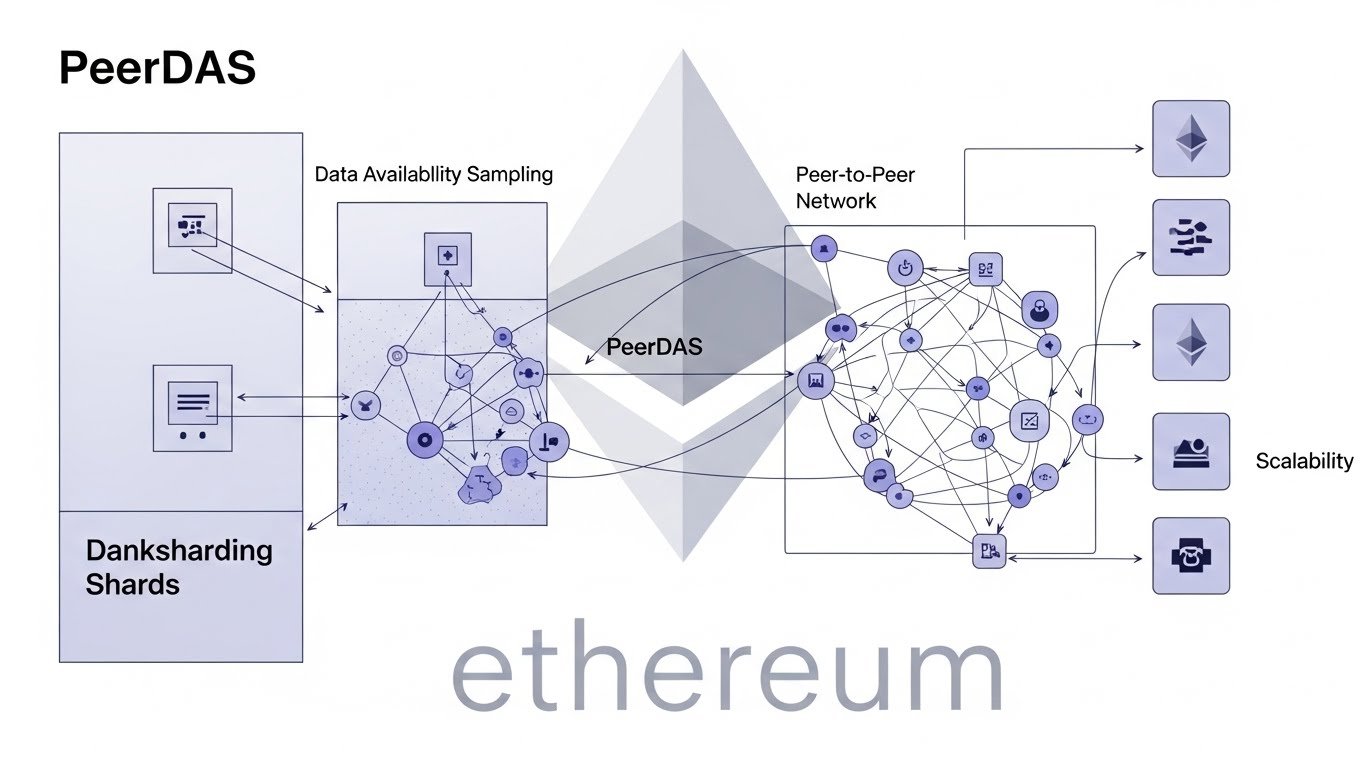
This makes scalability more achievable without turning Ethereum into a “data center blockchain.” PeerDAS enables high throughput while keeping participation open—an essential requirement for breaking the blockchain trilemma.
Why Data Availability Is the Real Bottleneck for Rollups
Many people assume rollups are “done” once they can execute cheaply. But Vitalik Buterin repeatedly points out that the cost of posting data to Ethereum is a major limiting factor. Rollups need to publish enough data so that users can verify and exit safely. If data posting is too expensive, fees rise, and scalability gains shrink.
PeerDAS changes the economics. By supporting a system where the network verifies availability through sampling, Ethereum can support much larger data blobs per block without every node downloading every byte. This allows rollups to post more transaction data at lower cost, which translates into cheaper user fees and higher throughput.
If ZK-EVMs provide provable correctness, PeerDAS provides provable availability. Together, they cover the two key requirements for secure scaling.
How ZK-EVMs and PeerDAS Work Together to Break the Trilemma
The most exciting part of Ethereum’s roadmap is how these technologies complement each other. Vitalik Buterin often emphasizes that scaling is not a single invention, but a stack of improvements. ZK-EVMs and PeerDAS are two major pillars in that stack.
ZK-EVMs reduce verification costs and increase security by enabling validity proofs. PeerDAS reduces data availability costs and supports massive throughput. When combined, they enable a world where most user activity happens on ZK-rollups, with Ethereum acting as the secure backbone.
This combination attacks the blockchain trilemma directly. Scalability comes from rollups and sharded data availability. Security comes from validity proofs and Ethereum’s consensus. Decentralization is preserved because node requirements remain manageable and the validator set remains broad.
Instead of choosing two properties, Ethereum engineers the system so that the base layer can maintain security and decentralization, while rollups provide near-unlimited scalability. That is why Vitalik Buterin believes Ethereum can break the blockchain trilemma—not by ignoring it, but by redesigning the system around it.
Vitalik Buterin’s Broader Vision: A Scalable, Decentralized World Computer
Beyond the technical details, Vitalik Buterin sees Ethereum as infrastructure for global coordination. Scaling is not only about lower fees; it’s about enabling millions—or billions—of people to interact economically and socially without gatekeepers. If Ethereum becomes scalable, secure, and decentralized, it can support financial access, censorship resistance, and new forms of community governance.
ZK-EVMs and PeerDAS are not the final destination, but they are crucial steps. They enable Ethereum to scale in a way that does not compromise the qualities that make public blockchains meaningful. Vitalik Buterin has consistently warned against scaling approaches that centralize power, whether in validator sets, sequencers, or governance structures.
The long-term vision is an Ethereum ecosystem where users can verify everything, exit safely from any rollup, and rely on cryptographic security rather than institutional trust. That is the philosophy behind using zero-knowledge technology, data availability sampling, and rollup-centric scaling.
Challenges and Trade-Offs Ethereum Must Still Solve
Even with ZK-EVMs and PeerDAS, Ethereum’s path is not effortless. ZK-EVM systems are complex, and proving can be computationally heavy, requiring specialized hardware and engineering optimization. While verification is cheap, proof generation can be expensive, and this creates market pressures around who can run provers.
Vitalik Buterin recognizes these issues and often discusses decentralizing the proving ecosystem over time. Innovations in prover efficiency, specialized circuits, and competitive markets can reduce centralization risks. Similarly, PeerDAS requires careful protocol design to ensure sampling remains reliable even under adversarial conditions.
Another challenge is rollup fragmentation. As the number of rollups grows, user experience can become confusing, liquidity can fragment, and composability can weaken. Ethereum’s ecosystem is actively developing interoperability standards, shared sequencing concepts, and bridging improvements to reduce friction. Vitalik Buterin has highlighted that scaling must include user experience and safety, not just throughput.
Yet, these challenges are engineering challenges, not philosophical dead ends. The roadmap remains coherent: scale through rollups, secure through proofs, and enable through data availability. That is exactly how Ethereum aims to break the blockchain trilemma.
Conclusion
The blockchain trilemma has haunted the crypto industry for years, and many projects have “solved” it by quietly compromising decentralization or security. Vitalik Buterin has taken a different approach: treat the trilemma as a systems design problem, and solve it with layered architecture, cryptographic proof systems, and scalable data availability.
ZK-EVMs bring provable execution correctness, faster finality, and stronger security guarantees for rollups. PeerDAS brings scalable and affordable data availability, enabling rollups to post the data they need without forcing every node to download everything. Together, they support Ethereum’s rollup-centric roadmap and give Ethereum a credible path to break the blockchain trilemma.
If this strategy succeeds, Ethereum will not just scale—it will scale while remaining open, verifiable, and decentralized. And that is the kind of breakthrough Vitalik Buterin has been working toward since Ethereum began.
FAQs
Q: Why does Vitalik Buterin focus so much on the blockchain trilemma?
Vitalik Buterin focuses on the blockchain trilemma because it explains why many scaling attempts weaken decentralization or security. His approach is to solve scalability through rollups and cryptography rather than reducing validator participation.
Q: Are ZK-EVMs better than optimistic rollups?
ZK-EVMs can be better in terms of faster finality and provable correctness, because they use zero-knowledge proofs instead of challenge games. However, optimistic rollups are currently simpler and widely used, and both approaches can coexist as Ethereum evolves.
Q: What problem does PeerDAS solve for Ethereum?
PeerDAS solves the data availability bottleneck by enabling nodes to verify that rollup data is available through sampling instead of downloading all data. This improves scalability without raising node requirements too much.
Q: How do ZK-EVMs and PeerDAS work together?
ZK-EVMs prove rollup execution is correct, while PeerDAS ensures the underlying transaction data is accessible. Together, they enable secure, low-cost, high-throughput rollups that still inherit Ethereum’s security.
Q: Will Ethereum fully “break” the blockchain trilemma?
Ethereum’s strategy aims to effectively break the blockchain trilemma by keeping the base layer decentralized and secure while offloading execution to rollups and scaling data availability with PeerDAS. While trade-offs always exist, Vitalik Buterin believes Ethereum can achieve strong results across all three dimensions through modular design.
Also More: Altcoin Stability The Key to Crypto Payroll Success?
