



The Fear and Greed Index has a way of summarizing what traders feel before they can explain it. When the number is high, markets feel unstoppable. When the number is low, every dip feels like the start of something worse. Today, the Fear and Greed Index is flashing a familiar warning: Bitcoin is back in “Extreme Fear,” and that emotional shift matters because sentiment often changes before price does. Recent market coverage highlights that the Fear and Greed Index has spent roughly 30% of the past year in “Fear,” a sign that anxiety has been more than a short-lived mood—it has been a recurring regime.
If you’re new to the metric, the Fear and Greed Index is a simplified gauge of market sentiment that tries to answer one question: are investors acting fearful or greedy right now? In crypto, the best-known version is the Crypto Fear & Greed Index popularized by Alternative.me, which assigns a score from 0 to 100 and labels the mood from Extreme Fear to Extreme Greed. The idea is not that the index predicts the future perfectly, but that it captures crowd psychology—something that can become extreme at turning points.
This matters even more when Bitcoin back in extreme fear becomes the headline, because crypto markets are reflexive. Price drops trigger fear, fear triggers selling, selling pushes price lower, and the feedback loop reinforces itself until sellers exhaust. In those moments, the Fear and Greed Index becomes a lens for reading the crowd: are we seeing healthy caution, or full-blown panic selling?
In this article, we’ll break down what it means that the Fear and Greed Index has been in fear about 30% of the past year, why Bitcoin is back in extreme fear, and how you can use the Fear and Greed Index as a contrarian indicator without falling into the trap of relying on a single number. We’ll also cover the index’s methodology, real-world limitations, and what to watch next—especially if you’re trying to make sense of a market that feels emotionally heavy.
What the Fear and Greed Index Measures in Crypto
The Fear and Greed Index in crypto is designed to compress a messy reality—thousands of coins, millions of traders, and nonstop news—into a single score. That simplicity is the point. It gives you a quick read on whether the market is leaning toward risk-taking or risk-avoidance.
Alternative.me’s Crypto Fear & Greed Index is one of the most referenced versions, and it explicitly frames the tool as an overview of the current sentiment of the Bitcoin and crypto market. It’s widely used because it updates frequently and shows historical context, allowing traders to compare today’s emotional state with prior peaks of fear or greed.
How the Crypto Fear & Greed Index is typically interpreted
When the Fear and Greed Index is low, it suggests fear is dominant. When it’s extremely low, it signals Extreme Fear, implying investors may be overly pessimistic. Many traders treat that as a possible “oversold” sentiment condition—though it is not a guaranteed buy signal.
When the Fear and Greed Index is high, it implies greed is dominant. When it becomes Extreme Greed, it can suggest euphoria, crowded long positioning, and vulnerability to sudden corrections.

The index is popular precisely because it translates investor psychology into a consistent scale. But to use the Fear and Greed Index well, you need to understand what drives it.
What inputs usually feed the Fear and Greed Index
Different providers compute the Fear and Greed Index differently. In the crypto version, the score commonly blends signals such as volatility, momentum, trading volume, and social signals. Alternative.me’s index is the best-known reference point in crypto discussions, and many sites mirror or chart it to visualize sentiment changes alongside price action.
Because inputs can vary by provider, the safest approach is to treat the Fear and Greed Index as a “temperature check,” not as a precise scientific measurement. It tells you how the crowd feels, not what the crowd should do next.
Fear 30% of the Past Year: Why This Detail Matters
Saying the Fear and Greed Index has been in fear about 30% of the past year isn’t just a fun statistic. It suggests something deeper: fear hasn’t been a rare event. It has been a recurring part of the market’s character.
According to recent reporting, the Fear and Greed Index being in “Fear” for a significant portion of the year aligns with a choppy cycle where bullish bursts were repeatedly interrupted by sharp drops, uncertainty, and liquidation events. In practical terms, that kind of environment trains investors to expect pain. They sell faster, trust rallies less, and demand stronger proof before they re-enter. That’s how fear becomes sticky.
A fear-heavy market changes behavior
When the Fear and Greed Index spends a lot of time in fear, traders tend to become defensive. They reduce leverage, demand confirmation, and hesitate to buy dips. This can suppress upside momentum because the “fast money” stays cautious, and even long-term investors may pace their buying.
But there’s another side. When fear becomes the default mood, it can set up strong rebounds once the pressure eases. In other words, a fear-heavy year can create conditions where relief rallies become violent—because positioning gets too conservative and then has to unwind.
That’s why the Fear and Greed Index matters even when you don’t trade actively. It gives context for why the market feels the way it does.
Bitcoin Back in Extreme Fear: What’s Driving the Mood?
When Bitcoin returns to Extreme Fear, it usually isn’t caused by one single headline. It’s more often a combination of price action, macro uncertainty, leverage flushes, and narrative fatigue.
Recent market commentary notes that Bitcoin’s sentiment turned sharply fearful again, with technical signals like a “death cross” being discussed and prior cycle patterns being compared. Whether you believe in those technical signals or not, they influence how people feel—and feelings influence positioning.
The role of volatility and drawdowns
Bitcoin doesn’t need to “crash” to trigger Extreme Fear. It just needs to fall fast enough to break confidence. When traders see a quick drawdown, they start imagining deeper downside. That creates capitulation behavior: holders sell not because they want to, but because they’re afraid of what happens if they don’t.
In fear regimes, the Fear and Greed Index becomes extremely reactive because volatility spikes and momentum turns negative. This is one reason the index can remain depressed even if price stabilizes—people are still emotionally bruised.
Leverage liquidations amplify fear
Crypto is uniquely prone to liquidation cascades. When price drops, leveraged longs are forced out, which pushes price lower, which forces more liquidations. That mechanical selling can drag the Fear and Greed Index into Extreme Fear quickly, even if the fundamental story hasn’t changed.
This is also why “Bitcoin back in extreme fear” can happen suddenly. The mood shift is not always gradual; it can be a cliff.
Narrative exhaustion and attention cycles
Another driver is narrative fatigue. During long sideways periods, investors stop believing rallies. Social media becomes more negative. Headlines turn doom-heavy. In that environment, even small drops feel catastrophic.
The Fear and Greed Index captures this because it’s indirectly measuring what the crowd is doing: pulling back, hesitating, and reacting emotionally.
How to Use the Fear and Greed Index Without Overreacting
The biggest mistake people make with the Fear and Greed Index is treating it like a trading signal on its own. A better approach is to use the Fear and Greed Index as context—one layer in a decision framework.
The Fear and Greed Index as a contrarian indicator
Many investors treat the Fear and Greed Index like a contrarian indicator. When fear is extreme, the thinking goes, selling may be overdone. When greed is extreme, the thinking goes, buying may be crowded.
That logic can be useful because markets are often mean-reverting emotionally. But contrarian doesn’t mean automatic. Extreme fear can persist, especially in macro-driven downturns. The right takeaway is not “buy immediately,” but “pay attention—conditions may be shifting.”
Combining sentiment with structure
A more robust way to use the Fear and Greed Index is to pair it with market structure signals like trend direction, volatility compression, or evidence of selling exhaustion. If the Fear and Greed Index is in extreme fear while price is stabilizing and volatility is cooling, that combination can be more meaningful than the index alone.
This approach helps you avoid a common trap: buying just because the index is low, while the market is still actively breaking down.
Using timeframes to reduce noise
The Fear and Greed Index can swing quickly. Short-term readings can be noisy, especially around major news events. Looking at the index over weeks and months can provide better context.
That’s especially relevant when you consider the claim that the Fear and Greed Index was in fear for around 30% of the past year. A longer lens tells you whether fear is a temporary spike or a persistent regime.
Why Extreme Fear Can Be a Setup for Opportunity
This is where the Fear and Greed Index becomes genuinely useful. Extreme fear is painful, but it can also mark the point where weak hands are forced out and long-term buyers quietly step in.
Capitulation and selling exhaustion
In many cycles, the sharpest selling happens near the emotional bottom. That’s when the Fear and Greed Index tends to print extreme fear readings. People sell because they can’t tolerate uncertainty anymore. That’s what capitulation looks like.
If selling exhausts itself, price can stabilize, and sentiment can recover surprisingly fast. This is why some of the strongest rallies begin when the Fear and Greed Index still looks terrible.
Accumulation often happens in silence
While the crowd panics, patient capital often starts accumulation. Not all at once, and not loudly. It’s gradual. Extreme fear becomes the environment where disciplined buyers can find better entries—assuming they manage risk and don’t try to call the exact bottom.
The index doesn’t confirm accumulation by itself, but it can highlight when the crowd is emotionally one-sided.
The Limits of the Fear and Greed Index
A strong SEO article about the Fear and Greed Index should be honest about its weaknesses. The metric is useful, but it’s not magic.
It measures emotion, not fundamentals
The Fear and Greed Index doesn’t tell you whether Bitcoin adoption is rising, whether miners are healthy, or whether macro liquidity is tightening. It tells you how traders feel today.
That means it can be wrong for long stretches. In a deep bear market, the index can stay fearful for months. In a late-stage bull market, it can stay greedy longer than most expect.
Different “Fear and Greed Index” versions can confuse readers
There’s also confusion because the phrase “Fear and Greed Index” is used in traditional markets too, often referring to CNN’s stock-focused index. Investopedia, for example, explains CNN’s Fear & Greed Index as a way to interpret sentiment in equities using multiple market indicators.
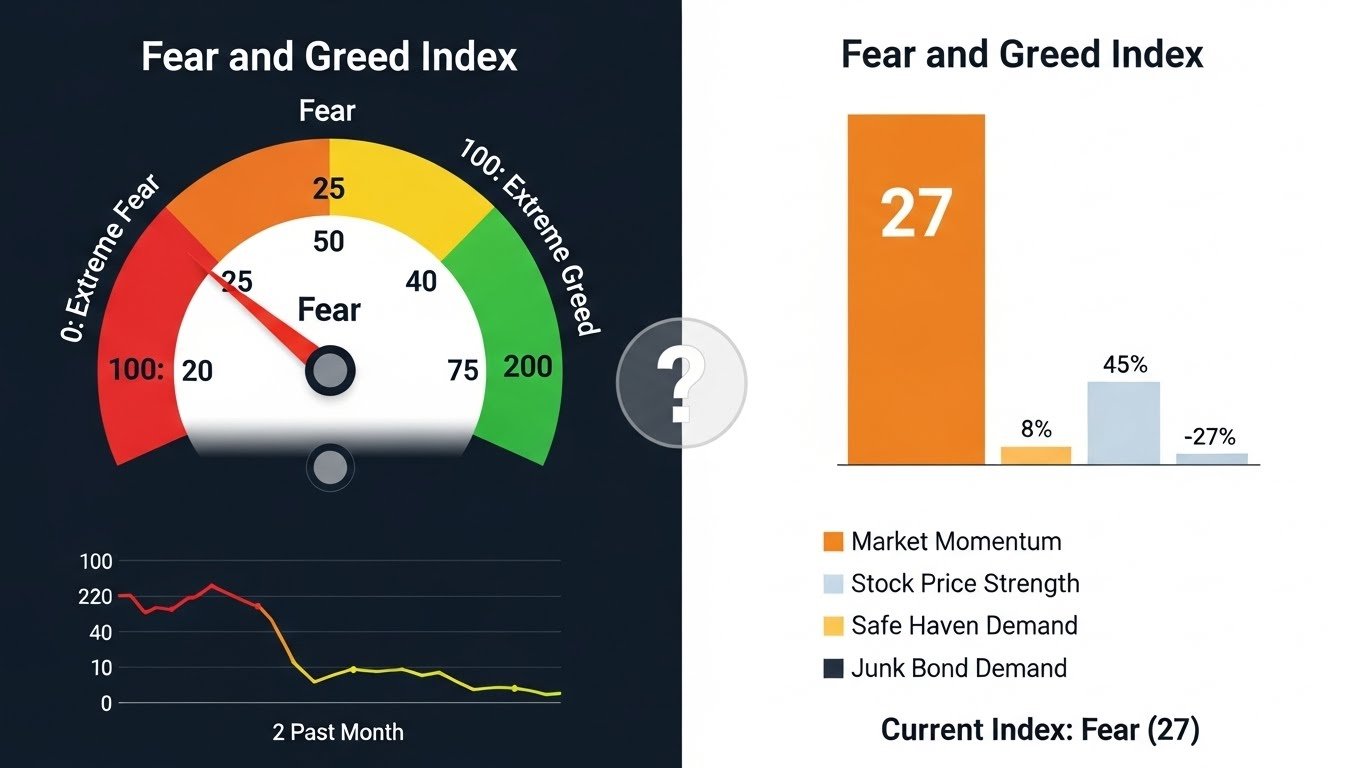
That doesn’t mean the stock index and the crypto index are the same. They’re different tools with different inputs. The important thing is to know which one you’re looking at when you read “fear” or “extreme fear” headlines.
It can encourage emotional trading if misused
Ironically, a tool designed to measure emotion can fuel emotion. If traders obsess over daily changes in the Fear and Greed Index, they can end up chasing the crowd rather than observing it.
The healthiest mindset is to use the Fear and Greed Index as a mirror: “This is how the market feels.” Then you step back and decide what you think.
What to Watch Next If Bitcoin Is in Extreme Fear
When Bitcoin is back in extreme fear, the next phase usually depends on whether fear is being driven by a short-term shock or a longer-term macro shift.
Watch whether fear starts to fade even if price doesn’t surge
One of the more interesting signals is when the Fear and Greed Index begins to recover while price remains flat. That can mean selling pressure is easing and the crowd is slowly regaining confidence.
Watch for volatility changes
Extreme fear often comes with high volatility. If volatility starts to compress, it can signal that the market is transitioning from panic to consolidation. This doesn’t guarantee upside, but it changes the texture of the market.
Watch for narrative shifts
Sentiment changes when the story changes. That could be a macro catalyst, a regulatory headline, ETF-related flows, or simply time healing investor confidence. In crypto, attention is a form of fuel. When the story stops being “how much lower can this go?” and starts being “what could turn this around?” the Fear and Greed Index often rises before price fully reacts.
Conclusion
The Fear and Greed Index being in fear for about 30% of the past year tells a clear story: the market has been living with recurring uncertainty, not just brief dips. With Bitcoin back in extreme fear, the emotional pressure is rising again—often a sign of volatility, defensive positioning, and shaken confidence.
But the Fear and Greed Index is most valuable when you treat it as context, not a command. Extreme fear can signal panic selling and possible capitulation, yet it can also persist if the underlying environment remains weak. The smart move is to use the Fear and Greed Index alongside risk management, price structure, and a clear time horizon—so you’re observing the crowd, not being controlled by it.
As always, this is educational content, not financial advice. The goal isn’t to predict the next candle—it’s to understand the emotional regime you’re trading or investing in, and to make better decisions because of it.
FAQs
Q: What is the Fear and Greed Index in crypto?
The Fear and Greed Index in crypto is a sentiment gauge that scores the market from 0 to 100, labeling it from Extreme Fear to Extreme Greed. One of the most referenced versions is provided by Alternative.me.
Q: Why does Bitcoin entering extreme fear matter?
When Bitcoin is back in extreme fear, it often reflects heightened uncertainty, volatility, and risk-off behavior. It can sometimes align with oversold sentiment, but it is not a guaranteed bottom signal.
Q: Is the Fear and Greed Index a reliable buy signal?
Not by itself. The Fear and Greed Index measures emotion, not fundamentals. It’s best used as a contrarian indicator in combination with other tools and risk controls.
Q: What does it mean that the index was in fear 30% of the past year?
It suggests fear has been a recurring regime rather than a rare event, shaping behavior like faster selling, cautious dip-buying, and lower confidence during rebounds.
Q: What’s the difference between the crypto index and CNN’s index?
CNN’s Fear & Greed Index is commonly used for stock market sentiment, while the crypto Fear and Greed Index uses different inputs and focuses on Bitcoin/crypto conditions.
Also Read: Best Crypto To Buy Now as “Stealth QE” Hits
