


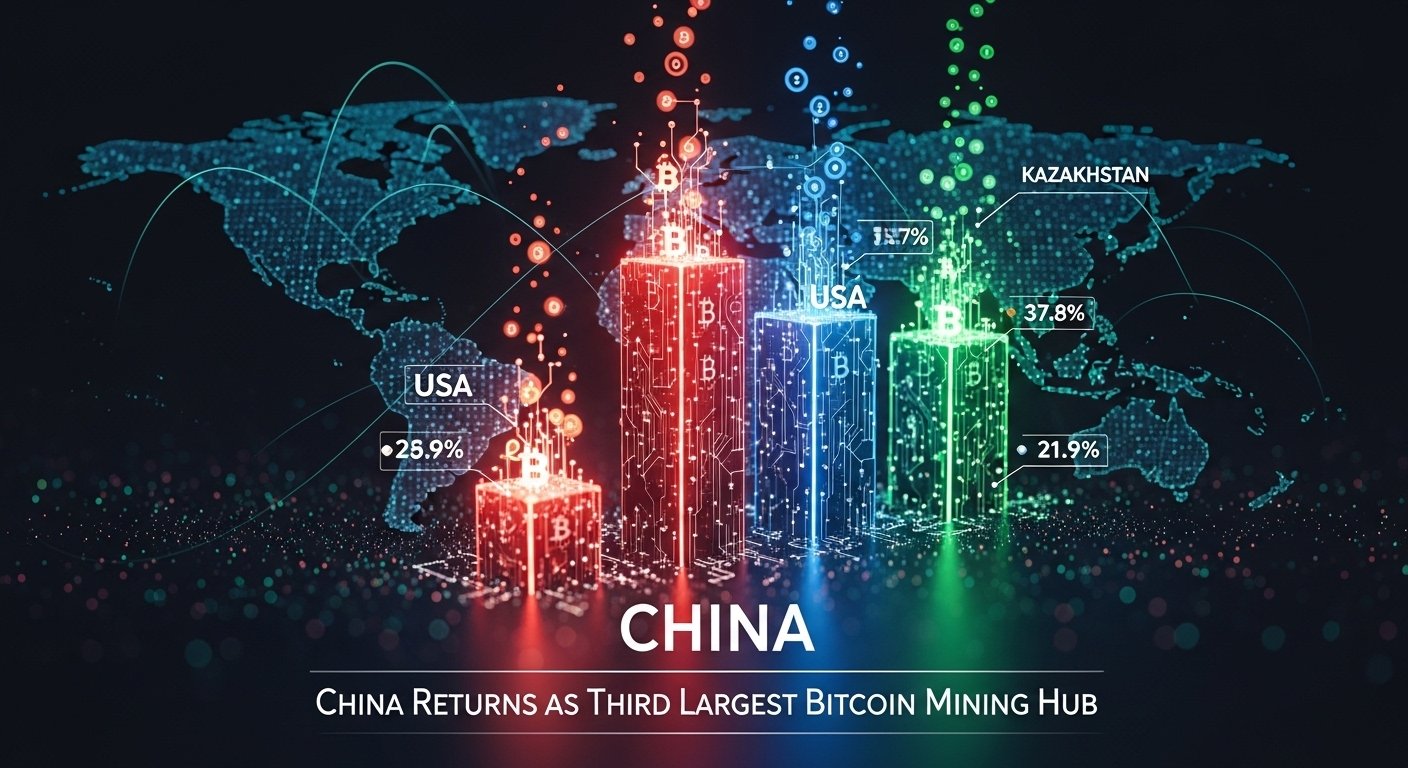
This development marks a dramatic comeback for a country that had previously imposed sweeping crackdowns on cryptocurrency mining activities. After years of regulatory uncertainty and industry migration, China’s re-emergence signals a powerful transformation in global Bitcoin mining distribution, hash rate dominance, and digital asset geopolitics.
For investors, miners, and blockchain analysts, the resurgence of Chinese mining activity introduces both opportunity and risk. It raises critical questions about regulatory enforcement, decentralized security, energy consumption, and the evolving role of nation-states in shaping the crypto economy. As China Returns as Third Largest Bitcoin Mining Hub, the implications ripple far beyond its borders, reshaping the global crypto mining map.
China Returns as Third Largest Bitcoin Mining Hub With 14% Share
The headline development that China Returns as Third Largest Bitcoin Mining Hub comes as a surprise to many industry observers. Following its 2021 ban on cryptocurrency mining and trading, China’s share of global hash rate plummeted to near zero. Major mining operations relocated to jurisdictions perceived as more crypto-friendly, particularly the United States, Kazakhstan, and Russia. Yet new data suggests that China now accounts for approximately 14% of global Bitcoin hash rate, making it the third-largest contributor worldwide. This resurgence highlights the resilience of mining networks and the decentralized nature of Bitcoin’s infrastructure.
Several factors have fueled this comeback. Mining operations may be operating discreetly under local arrangements, leveraging regional energy surpluses or small-scale facilities that avoid centralized scrutiny. In addition, advancements in mining hardware efficiency and distributed node configurations make it easier for operators to function below regulatory radar.The return of Chinese hash power signals a subtle but significant shift in the balance of mining influence.
Global Bitcoin Mining Distribution
To grasp the significance of China Returns as Third Largest Bitcoin Mining Hub, it’s important to understand how global mining distribution works. Bitcoin mining relies on computational power, known as hash rate, to validate transactions and secure the network. Countries with large shares of hash rate influence the geographic decentralization of Bitcoin’s infrastructure. After China’s 2021 crackdown, the United States emerged as the dominant mining hub, absorbing a significant portion of relocated hardware. The rapid shift illustrated how flexible and mobile mining operations can be when regulatory pressure intensifies.
Now, with China reclaiming a 14% share, the global distribution becomes more diversified again. While the United States remains the largest mining center, China’s renewed presence alters risk assessments related to regulatory control, energy markets, and geopolitical tensions. The data referenced by Reuters is based on research from the Cambridge Centre for Alternative Finance, which tracks mining activity using geolocation and IP analysis methodologies. Although such measurements are estimates, they provide critical insight into hash rate flows and regional mining clusters.
Why China’s Bitcoin Mining Comeback Matters
When China Returns as Third Largest Bitcoin Mining Hub, it sends a powerful signal to the global crypto community. The implications are multi-layered and impact investors, regulators, and miners alike. First, it demonstrates that mining bans do not necessarily eliminate activity entirely. Instead, they can push operations underground or redistribute them across smaller, decentralized facilities. Second, China’s re-entry influences market sentiment. Cryptocurrency markets are highly sensitive to regulatory signals from major economies. A partial resurgence suggests that enforcement may not be as absolute as initially perceived.
Third, the development reinforces the adaptability of the Bitcoin network. Even after one of the largest mining crackdowns in history, hash rate recovered and redistributed efficiently. Now, the partial return of Chinese mining capacity adds further resilience. This shift also affects discussions around Bitcoin decentralization, a core principle of the network. Greater geographic distribution is generally viewed as beneficial for network security, provided no single region gains excessive control.
Energy, Infrastructure, and Hash Rate Growth
A key driver behind China’s renewed mining activity may be energy economics. Bitcoin mining requires significant electricity consumption, making energy cost a primary determinant of profitability. Historically, Chinese mining thrived due to access to low-cost hydroelectric and coal-based power, particularly in provinces with seasonal energy surpluses. While national policies restricted crypto mining, local variations in enforcement may have allowed smaller operators to continue. As China Returns as Third Largest Bitcoin Mining Hub, analysts are evaluating whether renewable energy sources are contributing to this growth. Hydropower, solar, and wind infrastructure in certain regions provide cost-effective electricity that miners find attractive.
At the same time, global competition for energy-efficient mining continues to intensify. The evolution of ASIC mining hardware improves hash efficiency, allowing miners to produce more computational output per watt consumed. This technological evolution makes it easier for regions with moderate energy costs to compete. China’s return suggests that infrastructure capacity, rather than formal regulatory endorsement, plays a critical role in mining geography.
Regulatory Landscape and Enforcement Questions
The resurgence raises questions about regulatory enforcement in China. Officially, cryptocurrency mining remains restricted. However, the reappearance of a 14% global share suggests that enforcement may vary across regions or that miners have found innovative ways to operate. When China Returns as Third Largest Bitcoin Mining Hub, it challenges assumptions about the effectiveness of outright bans in decentralized systems. Bitcoin mining does not rely on centralized servers or government approvals. Instead, it operates through distributed computational power that can relocate or fragment rapidly.
This situation underscores the tension between state-level financial control and decentralized digital assets. Governments can restrict exchanges and corporate operations, but controlling private mining activity across vast territories presents logistical challenges. For policymakers worldwide, China’s resurgence may prompt a reassessment of regulatory strategies. Instead of blanket bans, some jurisdictions might explore licensing frameworks or taxation policies to harness mining activity rather than eliminate it.
Impact on Bitcoin Price and Market Sentiment
Whenever significant developments occur in mining distribution, the cryptocurrency market reacts. The news that China Returns as Third Largest Bitcoin Mining Hub has implications for price stability, investor confidence, and long-term adoption. Mining concentration in any single region introduces potential geopolitical risks. Investors monitor hash rate distribution to ensure that no country holds excessive influence over transaction validation.

However, a diversified top-three structure—led by the United States, followed by other nations including China—may actually enhance overall network resilience. Instead of dominance by a single jurisdiction, a multi-polar mining landscape spreads operational risk. Historically, Bitcoin has demonstrated remarkable recovery following regulatory shocks. The 2021 mining ban initially triggered volatility, yet the network adapted quickly. Today, the re-emergence of Chinese mining power reflects that adaptability and underscores the robustness of the blockchain protocol.
Global Competition for Mining Leadership
As China Returns as Third Largest Bitcoin Mining Hub, competition among nations for mining leadership intensifies. Countries view crypto mining as both an economic opportunity and a strategic technological advantage. Mining operations create demand for energy infrastructure, data centers, and hardware manufacturing. They also generate tax revenue and stimulate local employment in technology sectors.
The United States continues to dominate global mining, but China’s comeback narrows the gap and reinforces Asia’s role in the digital asset ecosystem. Kazakhstan and Russia also remain relevant players, particularly in regions with abundant fossil fuel or hydroelectric resources. This competitive dynamic may accelerate innovation in energy optimization, cooling systems, and grid integration. Nations seeking to attract mining investments must balance energy sustainability with economic incentives.
Bitcoin Decentralization and Network Security
One of the central debates in cryptocurrency revolves around decentralization. When China Returns as Third Largest Bitcoin Mining Hub, critics question whether mining concentration undermines the security model of Bitcoin. However, a 14% share, while significant, does not approach majority control. Bitcoin’s proof-of-work consensus mechanism requires over 50% hash power to manipulate the network successfully. The current distribution remains far from that threshold.
Moreover, miners operate independently even within the same country. Geographic concentration does not necessarily equate to coordinated control. The return of Chinese hash rate may actually enhance resilience by increasing diversity among large mining hubs. Instead of heavy reliance on a single jurisdiction, the network benefits from distributed participation across continents.
Technological Evolution Behind the Comeback
Technology plays a vital role in explaining how China Returns as Third Largest Bitcoin Mining Hub despite regulatory barriers. Modern mining operations are more compact, efficient, and modular than earlier industrial-scale farms. Smaller mining units can be integrated into warehouses, industrial zones, or even repurposed facilities. Cloud mining models and distributed pools allow operators to contribute hash power without centralized mega-farms that attract regulatory scrutiny.
Additionally, firmware optimization and hardware upgrades enable miners to maximize output while minimizing visibility. This technological agility illustrates why decentralized networks are difficult to suppress completely. Even when governments impose restrictions, innovation finds alternative pathways.
Environmental Considerations and ESG Debate
Environmental concerns remain central to discussions about Bitcoin mining. As China Returns as Third Largest Bitcoin Mining Hub, critics revisit questions about carbon emissions and sustainability. China’s energy mix includes both renewable and fossil fuel sources. The environmental impact depends heavily on which regions host mining activities. Hydropower-rich provinces present a lower carbon footprint compared to coal-dependent areas. Globally, the crypto industry is increasingly adopting renewable energy and carbon offset strategies. Institutional investors demand ESG transparency, pushing miners toward cleaner operations. China’s renewed participation may influence global ESG metrics and reporting standards, depending on how its mining energy sources are structured.
What This Means for the Future of Crypto Mining
The fact that China Returns as Third Largest Bitcoin Mining Hub highlights the cyclical nature of crypto regulation and innovation. Mining activity flows toward economic efficiency and technological feasibility, sometimes independent of policy intent.
Looking ahead, global mining distribution will likely continue evolving in response to energy markets, regulatory frameworks, and hardware advancements. China’s 14% share may grow or fluctuate depending on enforcement, economic incentives, and international developments. Regardless, its comeback reinforces a crucial lesson: decentralized systems adapt rapidly to change.
Conclusion
The headline that China Returns as Third Largest Bitcoin Mining Hub with a 14% share marks a defining moment in the evolution of global cryptocurrency infrastructure. It demonstrates the resilience of Bitcoin mining, the adaptability of decentralized systems, and the ongoing competition among nations for digital asset leadership.
See more: Bitcoin Mining How It Works & How to get started in 2025
