


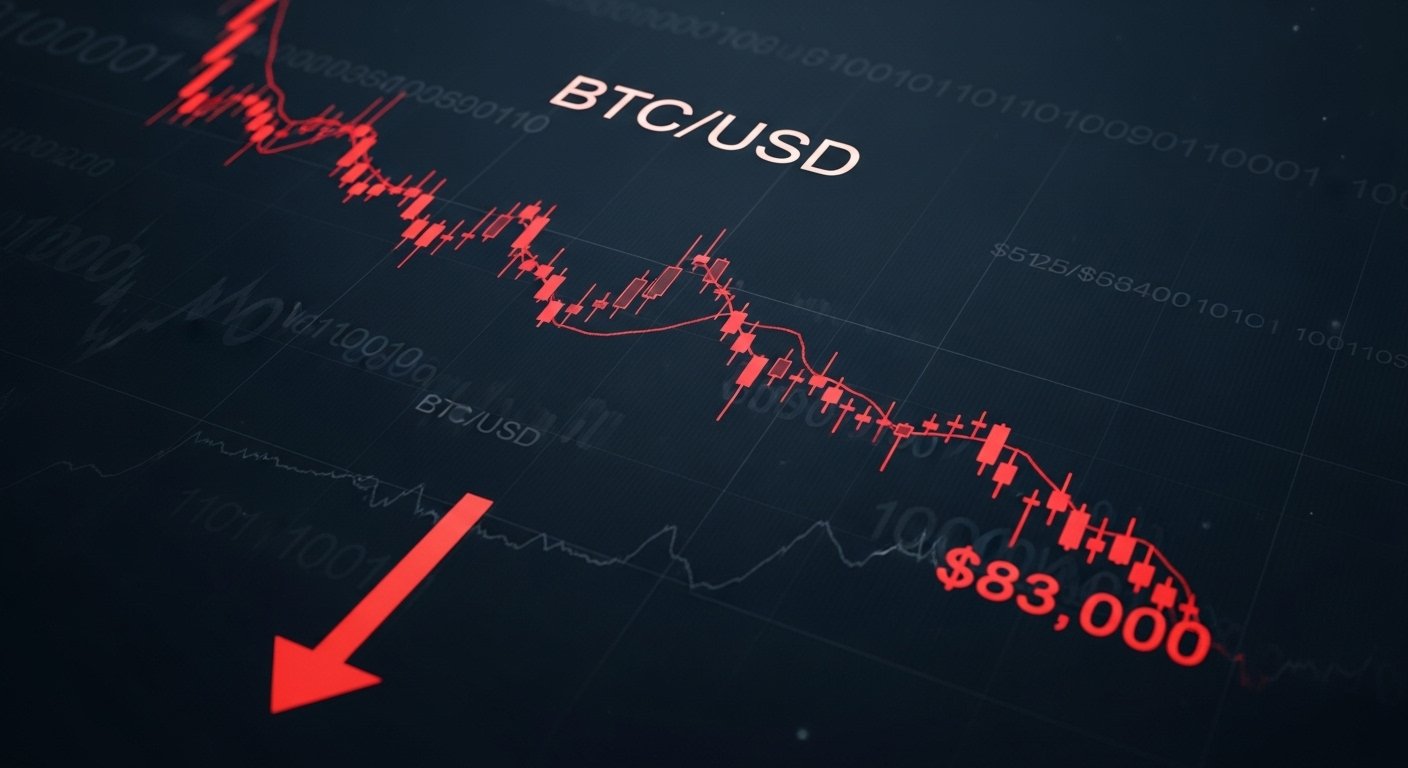
Bitcoin price slipping to two-month lows near $83,000 has sparked intense debate across the crypto market. For many investors, the move felt sudden and aggressive, especially after weeks of relatively stable trading. However, when Bitcoin price action is examined more closely, the decline becomes easier to understand. It was not driven by a single headline or isolated crypto event, but rather by a convergence of macroeconomic pressure, policy uncertainty, weakening institutional demand, and structural market mechanics unique to digital assets.
Bitcoin price has increasingly behaved like a high-beta risk asset in recent years, meaning it reacts strongly to changes in global liquidity, interest rate expectations, and investor sentiment. When risk appetite weakens, Bitcoin price often feels the impact faster than traditional markets. The drop toward $83K reflected this reality, as traders stepped back, leveraged positions were unwound, and confidence temporarily faded.
This article explores in depth why Bitcoin price just hit two-month lows near $83K, breaking down the macro forces, technical factors, institutional behavior, and market psychology behind the move. By understanding these elements together, readers can gain clearer insight into what happened—and what could happen next.
Understanding the significance of Bitcoin price hitting two-month lows
A two-month low is more than just a number on a chart. In market terms, it signals that recent buyers are underwater and that momentum has shifted away from bullish control. When Bitcoin price revisits levels not seen in weeks, it often reflects a pause—or reset—in conviction.
Bitcoin price near $83K marked a breakdown from a previously defended trading range. For short-term traders, this was a signal to reduce exposure or flip bearish. For long-term investors, it raised questions about whether broader conditions still support higher prices in the near term.

Importantly, two-month lows often trigger emotional responses. Fear of further downside can push hesitant holders to sell, while sidelined capital waits for confirmation before re-entering. This dynamic can temporarily suppress Bitcoin price even without worsening fundamentals.
Macro uncertainty and its impact on Bitcoin price
Risk-off sentiment weighs heavily on Bitcoin price
One of the strongest contributors to Bitcoin price weakness was a shift toward risk-off sentiment across global markets. When investors become uncertain about economic growth, inflation, or geopolitical stability, they tend to reduce exposure to volatile assets. Bitcoin price, despite its long-term narrative as digital gold, often trades in line with other speculative assets during these periods.
As uncertainty rises, capital flows toward safer instruments such as cash, short-term bonds, or commodities. This shift leaves fewer buyers willing to step in when Bitcoin price dips, allowing declines to extend further than expected.
Bitcoin price still reacts to global market fear
Although Bitcoin was designed as an alternative financial system, it has not yet fully decoupled from global macro trends. Large investors, hedge funds, and institutions treat Bitcoin price exposure as part of a broader portfolio. When they de-risk, Bitcoin is often one of the first assets trimmed due to its liquidity and volatility.
This behavior explains why Bitcoin price weakness often coincides with nervous equity markets and declining risk appetite, even in the absence of negative crypto-specific news.
Federal Reserve expectations and Bitcoin price pressure
Interest rate outlook shapes Bitcoin price direction
Expectations surrounding interest rates play a critical role in determining Bitcoin price trends. When markets anticipate lower rates, liquidity conditions improve, borrowing becomes cheaper, and speculative assets often benefit. Conversely, when rate cuts are delayed or uncertainty rises, Bitcoin price can struggle.
In this case, fading optimism around near-term rate cuts reduced the perceived liquidity tailwind for crypto markets. As expectations shifted, traders adjusted positioning, leading to selling pressure across digital assets.
Uncertainty can be more damaging than bad news
Bitcoin price is particularly sensitive to uncertainty rather than outright negative decisions. When traders lack clarity about future policy direction, they often choose caution. This “wait and see” attitude reduces buying pressure and can leave Bitcoin price vulnerable to downside moves triggered by relatively small sell orders.
Fed leadership uncertainty and market confidence
Why leadership changes affect Bitcoin price
Beyond interest rates themselves, confidence in central bank leadership influences market stability. When leadership direction is unclear, investors may worry about abrupt policy changes, reduced transparency, or inconsistent messaging. These concerns can ripple through all risk assets, including Bitcoin price.

Even speculation about leadership transitions can create unease, prompting traders to hedge or reduce exposure. Bitcoin price, being highly sentiment-driven in the short term, often reflects these shifts quickly.
Confidence matters more than ideology
Markets are less concerned with whether a central banker is perceived as hawkish or dovish and more concerned with predictability. When predictability weakens, volatility rises. The dip toward $83K reflected this dynamic, as confidence took a temporary hit.
Weak spot Bitcoin ETF demand and its role
Why spot Bitcoin ETFs matter for Bitcoin price
The introduction of spot Bitcoin ETFs transformed how institutional capital accesses Bitcoin. These products created a consistent source of demand during periods of strong inflows, helping support Bitcoin price during pullbacks.
However, when ETF inflows slow or turn negative, the effect can reverse. Without steady institutional buying, Bitcoin price must rely more heavily on retail demand and organic spot market activity.
ETF outflows amplify bearish sentiment
Even modest ETF outflows can influence market psychology. Traders interpret outflows as a signal that large investors are stepping back. This perception alone can discourage dip-buying and reinforce bearish momentum, pushing Bitcoin price lower.
In periods of uncertainty, ETF flows often become a leading indicator of confidence—or lack thereof—in Bitcoin’s near-term outlook.
Derivatives market liquidations accelerate Bitcoin price drops
Leverage magnifies Bitcoin price volatility
The crypto market’s heavy use of leverage plays a major role in sharp Bitcoin price declines. When prices fall below key levels, leveraged long positions are forced to close automatically. This creates sudden selling pressure that has nothing to do with fundamentals.
As Bitcoin price dipped toward $83K, cascading liquidations intensified the move. Each forced sell pushed prices lower, triggering more liquidations in a feedback loop.
Liquidations distort short-term price discovery
During liquidation-driven moves, Bitcoin price can overshoot fair value. These events are mechanical rather than emotional, driven by exchange algorithms closing positions. Once liquidations subside, Bitcoin price often stabilizes—but not before significant damage is done to sentiment.
Technical breakdowns and trader psychology
Key support levels failed
Technical traders closely watch support and resistance zones. When Bitcoin price breaks below a well-defined support level, it often becomes a self-fulfilling event. Stop-loss orders are triggered, short sellers gain confidence, and momentum accelerates.
The move to two-month lows signaled to many traders that the prior range was no longer valid, encouraging further selling.
Two-month lows affect market psychology
Printing a two-month low carries psychological weight. It suggests that recent bullish narratives failed to hold. For some investors, this invalidates short-term bullish theses and encourages caution until Bitcoin price proves strength again.
Correlation with traditional markets resurfaces
Bitcoin price correlation rises during stress
While Bitcoin sometimes trades independently, correlations tend to increase during periods of market stress. When equities sell off and volatility rises, Bitcoin price often moves in the same direction as investors unwind risk across the board.
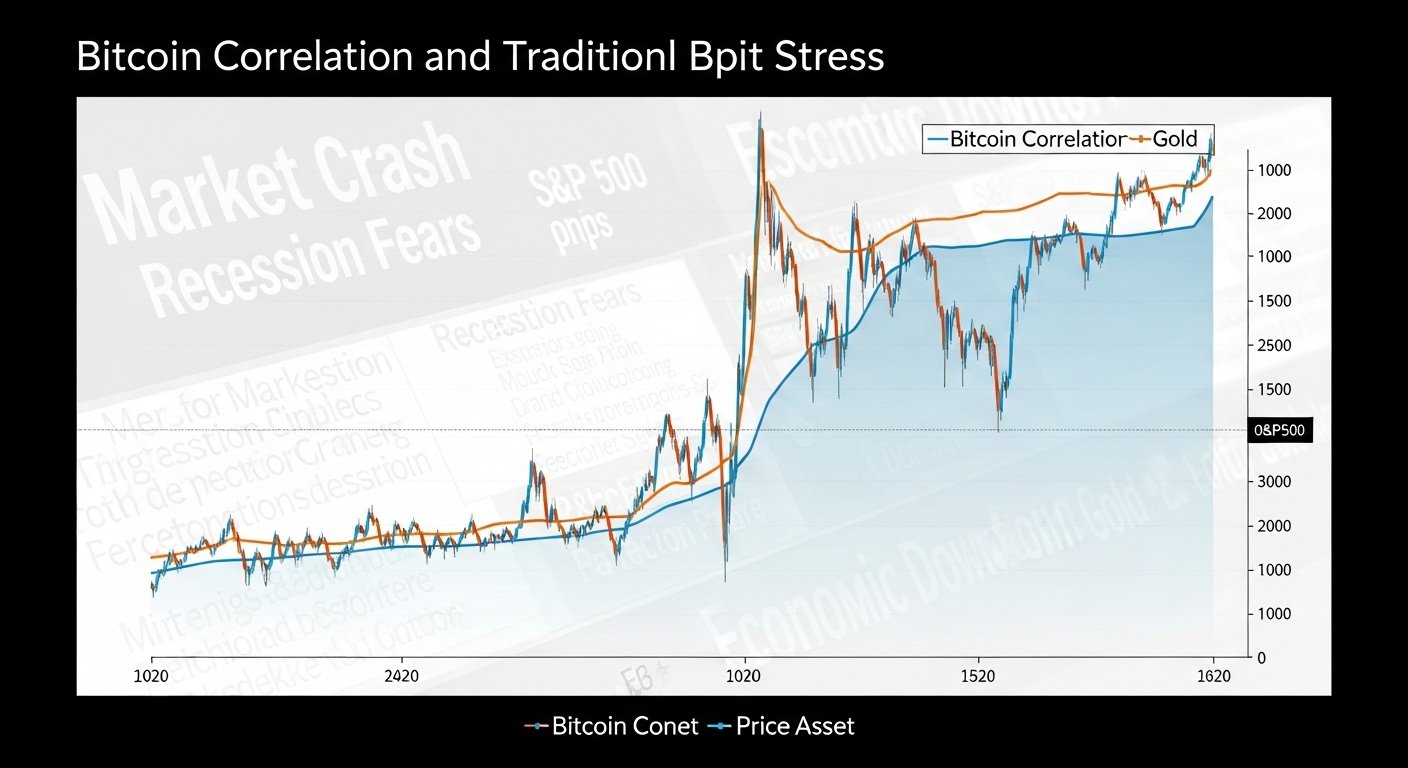
This correlation undermines the narrative of Bitcoin as a safe haven in the short term, even if the long-term thesis remains intact.
Diversification benefits shrink temporarily
During calm markets, Bitcoin can provide diversification benefits. During stress, those benefits often disappear. This reality contributed to Bitcoin price weakness as broader markets turned cautious.
Why buyers hesitated at $83K
Lack of strong conviction buying
One reason Bitcoin price did not immediately rebound from $83K was hesitation among buyers. Many investors preferred to wait for confirmation that selling pressure had exhausted itself before stepping in.
This buyer’s strike allowed Bitcoin price to linger near lows longer than expected, reinforcing bearish sentiment.
Investors waiting for macro clarity
With multiple uncertainties unresolved, from policy outlooks to institutional flows, many market participants chose patience. This reduced demand prevented a swift recovery.
What could help Bitcoin price recover from two-month lows
Improved macro sentiment
A shift back toward risk-on conditions could quickly lift Bitcoin price. If economic fears ease and confidence returns, capital may flow back into crypto markets.
Stronger spot Bitcoin ETF inflows
Renewed inflows into spot Bitcoin ETFs would provide tangible evidence of institutional confidence. This could stabilize Bitcoin price and attract additional buyers.
Reduced leverage and healthier market structure
Once excessive leverage is cleared from the system, Bitcoin price tends to behave more rationally. A market built on spot demand rather than borrowed capital is more resilient.
What to watch next for Bitcoin price direction
Policy signals and economic data
Future guidance on interest rates and monetary policy will remain critical. Clear, predictable messaging could reduce volatility and support Bitcoin price.
Institutional behavior
ETF flows, custody activity, and on-chain accumulation by large holders will offer clues about whether confidence is returning.
Technical reclaim levels
If Bitcoin price can reclaim former support zones and hold them, it may signal that the worst of the correction is over.
Conclusion
Bitcoin price hitting two-month lows near $83K was not the result of a single failure or flaw. It was the product of macro uncertainty, shifting interest rate expectations, leadership concerns, weakening institutional demand, and the structural realities of leveraged crypto markets. Together, these forces created the conditions for a sharp but understandable pullback.
While the move shook confidence in the short term, it also reset positioning and cleared excess leverage. If macro conditions stabilize and demand returns—particularly through spot Bitcoin ETFs—Bitcoin price could recover faster than many expect. As always, patience and perspective remain essential in navigating Bitcoin’s inherently volatile cycles.
FAQs
Q: Why did Bitcoin price fall to $83K?
Bitcoin price fell due to a combination of macro uncertainty, fading rate-cut expectations, weak institutional demand, and liquidation cascades in the derivatives market.
Q: Does hitting a two-month low mean Bitcoin price will keep falling?
Not necessarily. Two-month lows often mark periods of capitulation. Bitcoin price may stabilize or rebound if selling pressure exhausts and sentiment improves.
Q: How important are spot Bitcoin ETFs for Bitcoin price?
Spot Bitcoin ETFs play a major role by channeling institutional demand. Strong inflows can support Bitcoin price, while outflows can increase downside pressure.
Q: Is Bitcoin price still influenced by the Federal Reserve?
Yes. Liquidity conditions and policy expectations strongly affect Bitcoin price, especially during periods of uncertainty.
Q: What should investors watch next?
Investors should monitor macro sentiment, ETF flows, leverage levels, and whether Bitcoin price can reclaim key technical levels.
See More: Bitcoin Risks Fourth Monthly Loss as Market Pressure Builds
