


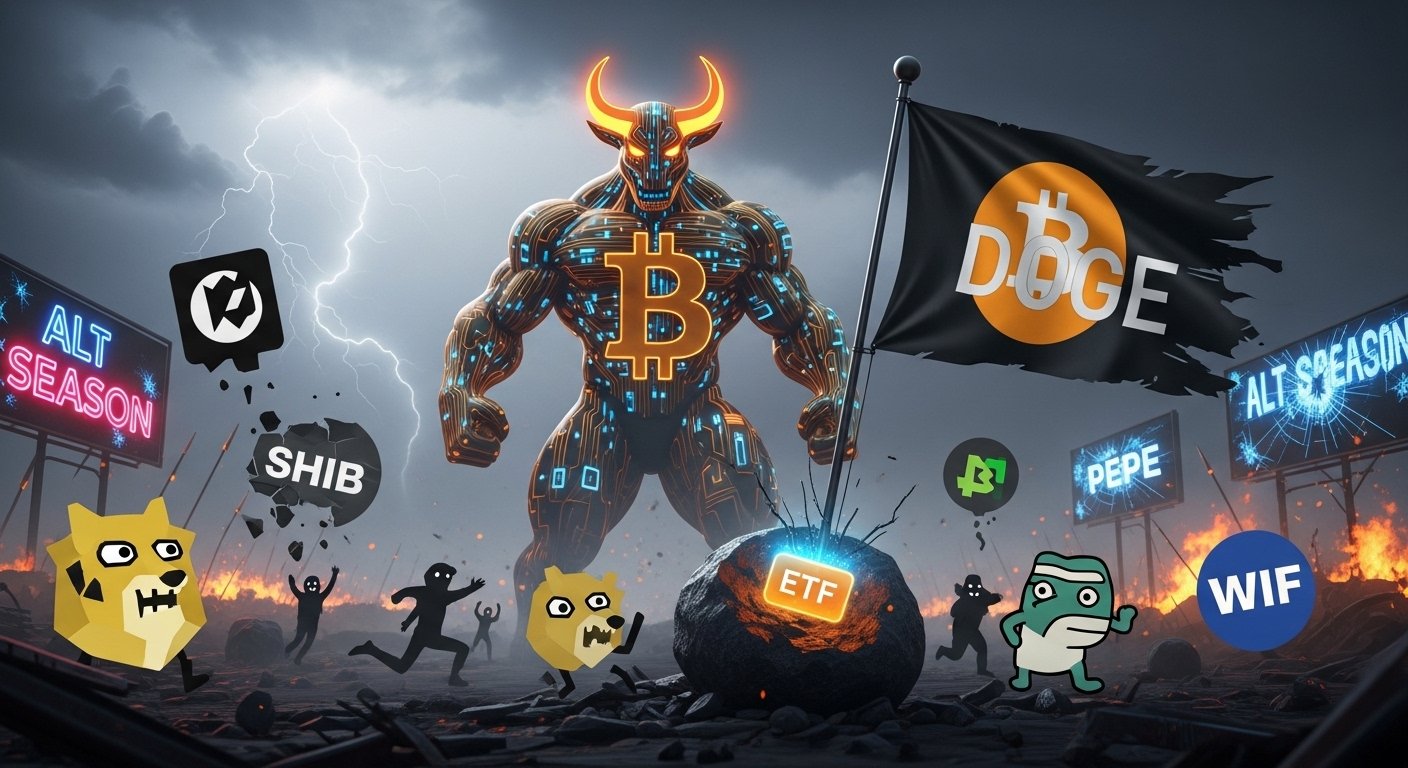
The crypto market just delivered one of its cruelest plot twists yet. Bitcoin massacres meme coins across the board, and not even the highly anticipated DOGE ETF news was enough to save them. While investors expected the Dogecoin ETF headline to ignite a meme coin rally, the market responded with indifference — and then pain. Red candles lit up every major meme token from Dogecoin to Shiba Inu to Pepe Coin, while Bitcoin quietly marched higher, absorbing liquidity and leaving speculative altcoins gasping for air. If you’ve been holding meme coins expecting a breakout, this article is the wake-up call you didn’t know you needed.
Why Bitcoin Massacres Meme Coins Even During Positive News Cycles
To understand what’s happening right now, you need to understand the relationship between Bitcoin dominance and the meme coin market. Bitcoin dominance — the percentage of total crypto market cap held by BTC — is the single most powerful indicator of where altcoin momentum is headed. When Bitcoin dominance rises, capital flows out of speculative assets and into BTC. Meme coins, being the most speculative layer of the crypto ecosystem, always feel this pain first and hardest.
In 2025, Bitcoin dominance has been climbing steadily toward multi-year highs, and that climb is directly responsible for the carnage being inflicted on meme tokens like DOGE, SHIB, FLOKI, WIF, BONK, and PEPE. Even as retail sentiment remains cautiously optimistic and the broader narrative around crypto regulation has improved, meme coins continue to underperform. This is not a coincidence — it is the market telling you exactly where institutional money is flowing.
The uncomfortable truth is that Bitcoin massacring meme coins during a positive news cycle is actually more bearish for meme tokens than if the news had never existed. The DOGE ETF headline should have been rocket fuel. It wasn’t. That failure to respond to bullish catalysts is one of the most bearish signals a technical or fundamental analyst can observe.
The DOGE ETF News: What It Means and Why It Didn’t Help
The DOGE ETF news refers to the filing and regulatory discussion around a spot Dogecoin exchange-traded fund in the United States. Asset managers, emboldened by the success of the spot Bitcoin and Ethereum ETFs approved in 2024, have begun pushing for broader crypto ETF products, including one tied to Dogecoin — the world’s largest meme cryptocurrency by market capitalization.
On paper, a Dogecoin ETF approval would be a significant milestone. It would open DOGE investment to a new class of retail and institutional investors who prefer regulated financial products over direct cryptocurrency exposure. It would bring Dogecoin out of the realm of internet jokes and place it — at least symbolically — alongside Bitcoin and Ethereum in the investment world’s vocabulary.
So why didn’t the DOGE ETF news pump the price? Several forces are at work.
Macro pressure is dominating everything. When Bitcoin is in a liquidity-absorption phase, even the most compelling altcoin catalysts struggle to generate sustained buying. The broader risk-off sentiment in traditional markets is bleeding into crypto, and meme coins — perceived as the riskiest of the risky — are the first assets investors shed when uncertainty rises.
Buy the rumor, sell the news. The DOGE ETF discussion had been circulating for months before any formal headline hit mainstream outlets. Traders who anticipated the news had already positioned themselves, and when the announcement arrived, the obvious move was to take profits. This classic trading dynamic drained whatever upward momentum the news might have otherwise created.
DOGE lacks the institutional narrative that made the Bitcoin ETF so transformative. Bitcoin had years of Wall Street lobbying, a “digital gold” macro thesis, and documented institutional demand before ETF approval. Dogecoin, despite its loyal community, still carries the cultural baggage of being a joke coin — and that perception makes institutional adoption a much longer, harder road.
The Meme Coin Market in 2025: A Brutal Landscape
The meme coin crash of 2025 has been gradual but devastating. Unlike the explosive collapses of 2022, this downturn has been slow and grinding — the kind that demoralizes holders more than a sharp drop because it offers false hope with every minor bounce before resuming its downtrend.
Dogecoin (DOGE) remains the most recognized name in the meme coin space, but its price action has been deeply disappointing relative to Bitcoin’s performance. While BTC has posted significant gains year-to-date, DOGE has struggled to maintain even its previous support levels.
Shiba Inu (SHIB) burned through billions of tokens in its deflationary protocol efforts, yet the price has barely responded. The fundamental tokenomics narrative — widely promoted by the SHIB community — has not translated into sustained buying pressure.
WIF (dogwifhat) and BONK, the Solana-based meme coins that exploded in the last cycle’s mania phase, have both seen dramatic contractions from their peaks. These tokens rode the Solana ecosystem wave at exactly the right moment, but with that wave subsiding, they are reverting toward levels that better reflect their actual utility — which, for most meme tokens, remains minimal.
Pepe Coin (PEPE) briefly enjoyed a cultural renaissance thanks to renewed meme virality on social media platforms, but even cultural momentum cannot override macro market forces when Bitcoin dominance is this aggressive.
The pattern across all of these assets is the same: Bitcoin massacres meme coins not through any single dramatic event, but through sustained, relentless capital reallocation. Every dollar that flows into BTC is a dollar that is not sitting in DOGE, SHIB, or PEPE.
Bitcoin Dominance: The Hidden Killer of Meme Coin Seasons
Bitcoin dominance is the metric that meme coin holders need to watch more closely than any other indicator — more than social media sentiment, more than influencer calls, and more than news headlines. When BTC dominance rises above 55–60%, historical data consistently shows that meme coins and small-cap altcoins suffer disproportionate losses.
In the current market environment, Bitcoin dominance has been holding at elevated levels, reflecting a market that has matured in certain ways since the speculative mania of 2021. Institutional capital has entered the space through Bitcoin ETFs, and that capital behaves differently than retail money. Institutions don’t chase meme coin narratives. They buy Bitcoin, and they hold it. This structural shift in the composition of crypto capital is one of the key reasons why meme coin seasons are becoming shorter, less intense, and harder to profit from for the average retail trader.
The implication is significant: the era of simply buying any meme token and watching it 10x may be behind us. The next wave of meme coin outperformance — if it comes — will likely require either a dramatic pullback in Bitcoin dominance or a macro shift that sends risk appetite surging across the entire market.
Could the DOGE ETF Eventually Change the Game?
Despite the short-term disappointment, the long-term implications of a Dogecoin ETF approval should not be dismissed entirely. If regulators eventually approve a spot DOGE ETF, it would represent a formal acknowledgment that Dogecoin has achieved a level of mainstream legitimacy that few cryptocurrencies outside BTC and ETH have reached.
The operational reality of a DOGE ETF would also create structural buying pressure. ETF issuers must purchase the underlying asset to back the shares they issue, which means consistent, demand-driven buying of DOGE regardless of retail sentiment swings. This is exactly the dynamic that supported Bitcoin’s price following the spot BTC ETF approvals in early 2024.
However, the path to DOGE ETF approval faces real obstacles. Regulators remain cautious about applying the ETF framework to assets that originated as jokes and lack clear fundamental use cases. The SEC’s analytical framework for evaluating cryptocurrency ETFs centers on market integrity, liquidity, and investor protection — areas where Dogecoin’s case is significantly weaker than Bitcoin’s was.
The most realistic scenario is that a Dogecoin ETF gets approved only after the market has demonstrated sustained demand and regulatory agencies feel confident in surveillance and fraud-prevention mechanisms for the DOGE markets. That timeline likely stretches beyond 2025, which means the current DOGE ETF news cycle is more about narrative-building than imminent price catalysts.
What Should Meme Coin Investors Do Right Now?
Understanding that Bitcoin massacres meme coins in the current macro environment is not an invitation to despair — it is an invitation to be strategic. Here is how experienced traders are thinking about this landscape.
Watch Bitcoin dominance as your primary signal. When BTC dominance peaks and begins to turn down, that is historically the moment when altcoins — and meme coins — begin to outperform. Trading against Bitcoin dominance instead of chasing individual meme coin narratives is a more disciplined approach to navigating this market cycle.
Be skeptical of news-driven pumps. The DOGE ETF news is a perfect case study in how positive headlines can fail to generate sustained price action when macro conditions are unfavorable. Before buying any meme coin rally triggered by news, ask yourself whether the macro environment supports that rally or whether you are walking into a liquidity trap for early sellers.
Size positions according to volatility. Meme coins can move 50–80% in either direction within days. If you are going to participate in this space at all, position sizing that accounts for extreme downside is not optional — it is survival.
Follow on-chain data, not social media. The crypto meme token space is dominated by social media hype cycles, influencer promotions, and coordinated community pumps. On-chain metrics — wallet concentration, transaction volume, developer activity — paint a more honest picture of whether a meme coin has genuine traction or is simply living off borrowed narrative time.
The Bigger Picture: Is Meme Coin Season Over?
The question every holder of speculative crypto meme tokens is silently asking is whether the era of meme coin explosions is simply over. The honest answer is: not necessarily, but the game has changed.
Meme coin mania in past cycles was largely a function of retail speculation running ahead of institutional adoption. Now that institutions have arrived — in Bitcoin — the speculative overflow into meme tokens is slower to materialize and quicker to reverse. The altcoin bleed of 2025 reflects a market finding its equilibrium after years of excess speculation.
This doesn’t mean meme coins are dead. It means that the conditions required for the next major meme coin season are more specific and harder to engineer. The crypto market will need a period where Bitcoin has already made its run, dominance has peaked, and retail capital is looking for the next exciting trade — that window still opens, but it opens less frequently and closes faster.
Stay Informed, Stay Disciplined
Bitcoin massacres meme coins — and the DOGE ETF news moment has shown us exactly how brutal that dynamic can be when macro forces align against speculative assets. The lesson for every meme coin investor is clear: headlines don’t move markets when Bitcoin is in control of the narrative.
The next opportunity in meme coins will come, but it will come on the market’s terms, not yours. Use this period of pain to study Bitcoin dominance cycles, understand the structural changes that ETF inflows have introduced to the crypto ecosystem, and build the analytical framework that will allow you to move with conviction when the next meme coin season genuinely arrives.
If you want to stay ahead of the next meme coin surge — and avoid being wrecked by the next Bitcoin dominance spike — subscribe to our newsletter, bookmark this page, and follow our real-time crypto market analysis. The edge in meme coin trading is always information, timing, and discipline. Start building all three today.
See more: Riot Wallet Outflow Adds to Selling Wave Among Listed Bitcoin Miners
