



Exchange-traded funds have become the fastest, cleanest on-ramp for mainstream crypto exposure. For much of the past year, the story was straightforward: big-ticket inflows concentrated in Bitcoin and Ether ETFs, reinforcing the idea that institutions prefer the two largest networks when they want crypto beta. But flows don’t move in straight lines. As the market entered a new phase—shaped by shifting rate expectations, changing volatility, and a growing menu of crypto investment products—ETF investors pull back from Bitcoin and Ether as altcoin funds buck trend has emerged as the more accurate headline.
This rotation doesn’t necessarily mean investors are “done” with the majors. Instead, it signals a repricing of what investors want from crypto exposure right now. When momentum stalls in large caps, traders often rotate toward assets with higher beta. When macro uncertainty rises, allocators may trim positions that already had big runs and redeploy into themes that feel under-owned. And when product availability expands—more venues, more wrappers, more benchmarks—flows can scatter into new pockets of demand.
Recent reporting and fund-flow research captures this push and pull. CoinShares’ weekly fund-flow tracking has repeatedly highlighted periods where Bitcoin and Ethereum investment products see net redemptions while a “wide selection” of altcoins attracts inflows, including names like XRP and Solana. Meanwhile, market coverage has noted meaningful day-to-day outflows from U.S. spot Bitcoin ETFs during risk-off stretches, even as investors keep trading activity high. Put simply: Bitcoin and Ether ETFs are still the center of gravity—but capital is clearly rotating at the margins, and sometimes not so marginally.
In this article, we’ll unpack why Bitcoin and Ether ETFs can face outflows even when the broader crypto narrative stays alive, why altcoin funds can buck the trend, and what investors should watch next if they’re trying to position sensibly in a rapidly evolving ETF market.
The New Reality: Crypto ETF Flows Are Cyclical, Not Linear
The earliest wave of crypto ETF adoption was dominated by a “quality first” mindset. Institutions and large advisors leaned into Bitcoin and Ether ETFs because they offered the most liquidity, the clearest narratives, and (comparatively) the least operational risk. Those arguments still matter. Yet once an asset class becomes accessible and liquid, it starts behaving like every other liquid market: flows become tactical.
That’s why it’s possible to see Bitcoin and Ether ETFs weaken at the same time the crypto complex remains active. In practice, flows reflect positioning decisions more than ideological belief. Allocators may reduce exposure after sharp price moves, rebalance risk budgets at month-end, or cut volatility ahead of macro catalysts. Barron’s, for example, described significant net outflows in U.S. spot Bitcoin ETFs during a short risk-off window as markets awaited a major jobs report—exactly the sort of macro event that can trigger temporary de-risking.
At the same time, fund-flow researchers like CoinShares have documented how investor demand can split: some money exits large-cap products, while selective altcoin products draw inflows. This is the hallmark of a maturing market. Investors aren’t just “buying crypto.” They’re expressing views on relative performance, network usage, narrative leadership, and risk premiums—all through exchange-traded wrappers.
Why “Pull Back” Doesn’t Always Mean “Bearish”
When headlines say investors are pulling back from Bitcoin and Ether ETFs, it’s easy to interpret that as a bearish verdict. Often, it’s more mechanical than emotional. ETF flows can turn negative because of:
- Price-driven rebalancing after large moves
- Tax or calendar-driven selling around year-end
- Risk limits tightening as volatility rises
- Rotation into different segments of the same asset class
CoinShares’ reporting has also shown that sentiment can pivot quickly—one month featuring heavy inflows into Ethereum products and net outflows from Bitcoin products can be followed by a reversal when macro conditions change. The point is not that Bitcoin and Ether ETFs are “broken.” The point is that they’re now part of a broader toolkit, and flows are increasingly tactical.
What’s Driving Outflows From Bitcoin and Ether ETFs?
To understand why Bitcoin and Ether ETFs can face redemptions, it helps to separate structural demand (longer-term allocation) from tactical demand (shorter-term positioning). The structural demand story—especially for spot Bitcoin ETFs—still rests on convenience, custody simplification, and portfolio construction. But the tactical story changes week to week.
One clear catalyst is macro uncertainty. When rates or risk assets wobble, high-volatility exposures are often trimmed first. News coverage in early January highlighted how crypto prices and ETF flows can respond to profit-taking and shifting expectations around Federal Reserve policy. In that environment, Bitcoin and Ether ETFs can become a source of liquidity: easy to reduce, easy to re-enter later.
Another catalyst is narrative fatigue. Ethereum ETFs can be especially sensitive when market participants debate fee dynamics, network activity, and the pace of ecosystem upgrades. Cointelegraph coverage has linked Ethereum price stagnation and weaker ETF conviction to factors like subdued network fees and lack of strong directional leverage demand. Whether or not every investor agrees with that framing, it captures the reality that flows often reflect perceived momentum and narrative leadership.
The Role of Profit-Taking and “Crowded Trades”
Whenever Bitcoin and Ether ETFs absorb large inflows over extended periods, the trade can become crowded. Crowding doesn’t mean the thesis is wrong—it means many investors are already positioned. When that happens, it takes less negative news to spark outflows, because investors would rather lock in gains than sit through drawdowns.
This is one reason outflow streaks can appear even without a major fundamental shock. If Bitcoin rallied strongly into a prior quarter and then stalls, some holders will reduce exposure simply because their risk-return looks less attractive at the margin. Add in year-end tax planning and the effect can intensify.
Why Altcoin Funds Can Buck the Trend
When ETF investors pull back from Bitcoin and Ether as altcoin funds buck trend, the obvious question is: why would investors add risk while trimming the “blue chips”? The answer lies in what altcoins represent during different market regimes.
Altcoins often act like a levered expression of crypto risk appetite. When investors think the market is entering a risk-on phase, they rotate into higher beta. When they believe a particular narrative—payments, scaling, staking, interoperability, tokenization—will outperform, they use altcoins as targeted exposure. And when they think majors are fully priced, they hunt for the next pocket of asymmetry.
CoinShares’ flow data has repeatedly illustrated this phenomenon, with periods where inflows broaden beyond Bitcoin into assets like XRP and Solana. Decrypt similarly reported that altcoin-linked products posted substantial growth over 2025, reflecting a notable shift in appetite beyond Bitcoin.
“Selective Risk-On” Is the Key Phrase
It’s not that investors are indiscriminately buying everything. The pattern is closer to selective risk-on. Capital rotates into altcoin funds that have:
- Strong liquidity and recognizable benchmarks
- Clear narratives tied to adoption or ecosystem growth
- Catalysts such as network upgrades, regulatory clarity, or new product access
This is why altcoin ETPs and altcoin-oriented funds can see inflows while Bitcoin and Ether ETFs see outflows. Investors aren’t abandoning crypto; they’re adjusting their mix.
How Product Design and Market Structure Influence Flow Rotations
Another driver of flow divergence is product structure itself. Investors don’t buy “crypto” in the abstract. They buy a specific vehicle with specific trading characteristics, fees, holdings mechanics, and tax considerations. As more products arrive—spot, futures, single-asset, multi-asset, yield-enabled variations—capital naturally experiments.
For example, CoinShares has documented month-to-date periods in which Ethereum investment products captured meaningful inflows while Bitcoin products experienced net outflows, suggesting that investors were expressing a relative-value view rather than exiting the asset class. In another window, CoinShares-reported weekly outflows across digital asset products reflected broader caution, even as rotation into select altcoins persisted.
Bitcoin and Ether ETFs Liquidity, Fees, and “Ease of Rebalancing” Matter
ETFs are built for rebalancing. That’s a feature, not a bug. When the market mood changes, Bitcoin and Ether ETFs are typically the easiest dials to turn because they’re liquid and widely held. Altcoin funds, meanwhile, can capture “fresh money” from investors seeking targeted exposure—even if those positions are smaller in size.
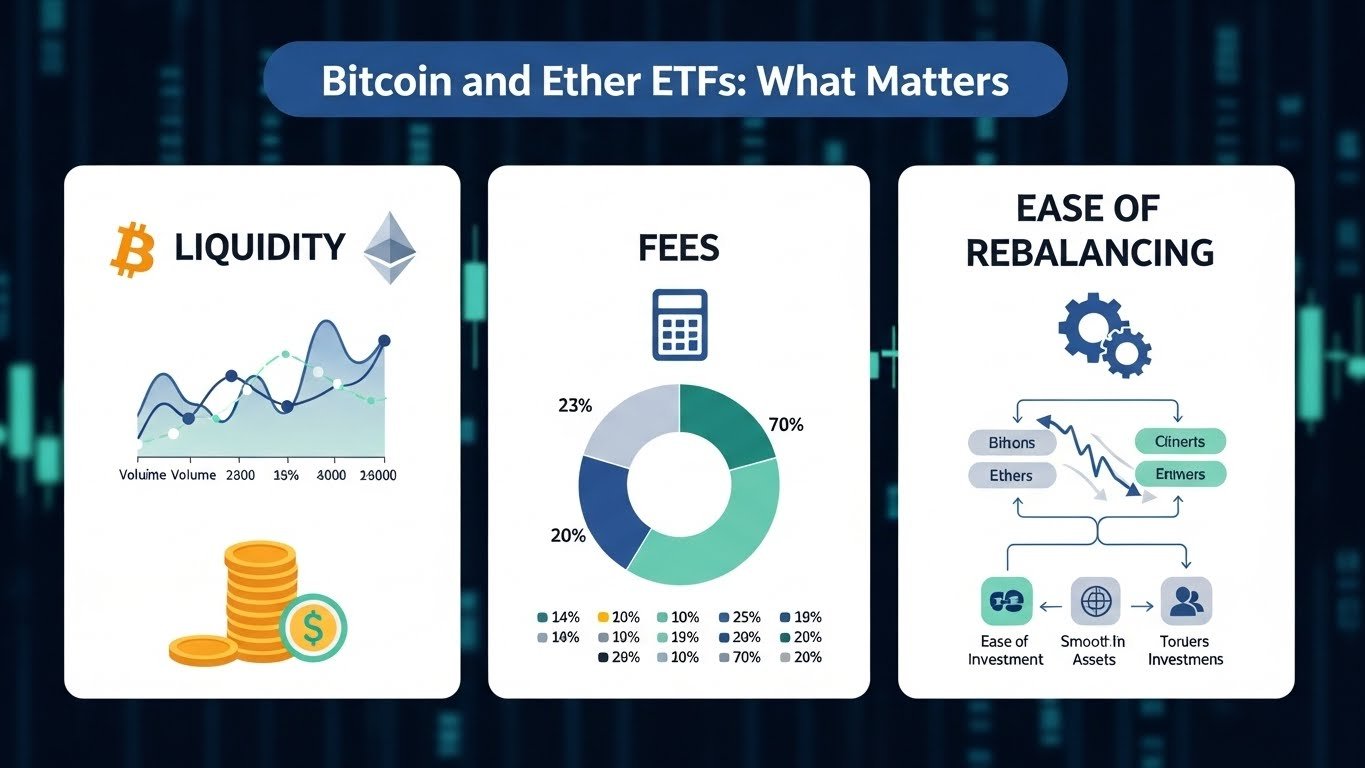
This liquidity dynamic can exaggerate headlines. You may see sizable outflows from Bitcoin and Ether ETFs because that’s where the bulk of assets sit, while altcoin inflows look dramatic on a percentage basis because they start from a smaller base.
Institutional Psychology: Benchmarking, Career Risk, and “Explaining the Trade”
Institutional investing is not only about returns; it’s also about explainability. Bitcoin and Ether ETFs remain the easiest allocations to justify in an investment committee setting. But once a baseline allocation exists, the next question becomes: “Where do we find incremental return?”
That’s when altcoin funds become attractive. If a manager already owns the majors through Bitcoin and Ether ETFs, adding a small sleeve of Solana, XRP, or other thematic exposure can feel like a controlled way to seek upside without radically changing the portfolio’s core stance. It’s the same logic that leads equity managers to add small-cap or sector tilts after they’ve established a large-cap benchmark.
The Macro Backdrop: Rates, the Dollar, and Risk Appetite
Crypto has matured into a macro-sensitive asset class. The days when it moved in a totally isolated bubble are largely gone—especially for ETF flows, which are dominated by allocators who also trade equities, bonds, and commodities.
When rate-cut expectations rise, risk assets often benefit. When rates look “higher for longer,” high-volatility exposures can suffer. This is why ETF flows can swing around macro events. Barron’s coverage of Bitcoin price declines alongside notable spot Bitcoin ETF outflows during a macro-sensitive news window underscores how quickly sentiment can flip.
At the same time, these macro waves can create windows where investors decide the majors are “macro proxies,” while altcoins are “idiosyncratic alpha.” In that framing, investors may trim Bitcoin and Ether ETFs for macro risk control but keep or add small altcoin positions based on catalysts.
What This Means for Investors: Signals to Watch
If you’re trying to interpret the headline—ETF investors pull back from Bitcoin and Ether as altcoin funds buck trend—the best approach is to treat flows as signals, not commandments. A single week of outflows doesn’t invalidate the long-term case for Bitcoin and Ether ETFs. But persistent rotation can reveal what the market is pricing next.
Here are the most important signals embedded in this flow regime:
First, watch whether outflows from Bitcoin and Ether ETFs coincide with falling prices or rising prices. Outflows during price strength may signal profit-taking and rotation rather than panic. Outflows during sharp declines can signal risk aversion.
Second, track whether altcoin inflows are broad-based or concentrated. Concentrated inflows suggest narrative leadership, while broad inflows can indicate speculative overheating.
Third, monitor whether flow leadership changes after major reports from established trackers. CoinShares’ weekly flow commentary is often cited because it aggregates investment product activity across regions and issuers, providing context for whether moves are isolated or systemic.
Portfolio Construction Takeaways
For long-term investors, Bitcoin and Ether ETFs still function as the core allocation for crypto exposure because of liquidity, recognition, and market depth. Altcoin funds, by contrast, behave more like satellites—higher volatility, potentially higher upside, but also greater drawdown risk.
If your goal is to avoid emotional rotation, the discipline is to predefine ranges. For example, you might decide your crypto sleeve has a core position in Bitcoin and Ether ETFs and a smaller tactical sleeve for altcoins that you rebalance on a fixed schedule. The market’s current rotation is a reminder that the easiest way to lose money in crypto is to chase what just outperformed without a plan.
Outlook: Will Bitcoin and Ether ETFs Regain Flow Leadership?
It would be a mistake to assume the current pattern is permanent. In crypto, leadership rotates quickly. All it takes is one catalyst—regulatory clarity, a macro pivot, a major adoption headline, or a sharp price breakout—for Bitcoin and Ether ETFs to reassert dominance.
We’ve already seen how fast sentiment can reverse around the new year, with reports noting bursts of inflows on strong sessions even after late-year weakness. That’s why the smartest interpretation is not “investors are leaving.” It’s “investors are repositioning.”
In the near term, flow leadership likely depends on three variables:
- Macro conditions and rate expectations
- Whether Bitcoin resumes clear trend leadership
- Whether Ethereum regains narrative momentum through ecosystem activity and investor conviction
If those factors align, Bitcoin and Ether ETFs can return to net inflows quickly—especially because institutions tend to rebuild exposure through the most liquid vehicles first.
Conclusion
The headline trend—ETF investors pull back from Bitcoin and Ether as altcoin funds buck trend—is less about rejection and more about rotation. In a maturing market, Bitcoin and Ether ETFs are no longer the only way investors express crypto views. They remain the core, but they’re also the most common source of liquidity when risk budgets tighten or when investors want to rotate into higher beta themes.
Altcoin fund inflows, meanwhile, reflect selective risk-on behavior: investors seeking targeted narratives, higher volatility upside, and potentially under-owned exposure while the majors consolidate. CoinShares’ ongoing flow tracking has repeatedly captured this pattern of divergence, where capital exits one pocket of crypto exposure and re-enters another.
For investors, the actionable takeaway is straightforward: treat flows as information, not instructions. If you rely on Bitcoin and Ether ETFs as your core allocation, define a rebalancing plan that keeps you from chasing rotations. If you use altcoin funds tactically, size them as satellites and assume volatility will be higher than you expect. In a market where product choice keeps expanding, discipline matters more than ever.
FAQs
Q: Are outflows from Bitcoin and Ether ETFs always bearish?
Not necessarily. Outflows from Bitcoin and Ether ETFs can reflect profit-taking, rebalancing, or short-term macro risk reduction rather than a long-term bearish view. Short windows of outflows have occurred alongside macro uncertainty and event risk..
Q: Why do altcoin funds sometimes rise when Bitcoin and Ether ETFs fall?
Altcoin funds can attract inflows during “selective risk-on” periods when investors seek higher beta or want targeted exposure to specific narratives. CoinShares has documented episodes where inflows broaden into assets like XRP and Solana even as Bitcoin flows soften.
Q: What’s the best way to use Bitcoin and Ether ETFs in a portfolio?
For many investors, Bitcoin and Ether ETFs work best as a core allocation within a defined risk sleeve, rebalanced on a schedule. This helps avoid emotional chasing and keeps exposure aligned with long-term goals.
Q: Do crypto fund-flow reports reliably predict price direction?
They’re useful context, not a crystal ball. Fund flows can sometimes lead price, but they can also lag. Weekly flow data is best used to understand positioning and regime shifts—like rotation from majors into selective altcoins—rather than to make single-point predictions.
Q: What could bring investors back to Bitcoin and Ether ETFs?
A clearer macro tailwind (such as improving rate-cut expectations), renewed price momentum, or a stronger Ethereum narrative (network activity and investor conviction) can drive Bitcoin and Ether ETFs back into net inflows.
Also More: Bitcoin Eyes $94,000 as Crypto Gains Extend in U.S.
