


Crypto cycle has a moment when the conversation shifts. At first, the market talks almost entirely about Bitcoin. Then Ethereum starts to move with more confidence. And finally, the spotlight widens: smaller caps heat up, narratives multiply, and traders begin hunting for the next breakout. That final phase is what many call altseason—a period when a broad basket of altcoins begins outperforming Bitcoin, often in waves that can feel sudden, chaotic, and extremely profitable.
But altseason isn’t magic, and it isn’t random. A true altcoin run typically follows recognizable market rhythms: liquidity conditions loosen, risk appetite improves, capital rotates from large caps into mid and small caps, and on-chain activity accelerates. The most useful thing you can do as a trader or long-term investor is learn the key market patterns that repeatedly show up before a meaningful altcoin run begins. Those patterns don’t guarantee a straight line up, but they can help you distinguish between a short-lived bounce and a structural shift toward altcoin outperformance.
This article breaks down the signals that often point to altseason in sight, explains why they matter, and shows how the market’s internal mechanics—dominance, momentum, volume, volatility, narratives, and liquidity—tend to align before a sustained altcoin run. You’ll also learn what can invalidate the setup, why many “mini altseasons” fail, and how to approach positioning without getting trapped by hype. Throughout, we’ll naturally weave in related LSI keywords such as altcoin season index, Bitcoin dominance, Ethereum strength, market rotation, risk-on sentiment, crypto liquidity, on-chain activity, and bull market cycle so you can better understand the full picture.
What altseason really means (and what it doesn’t)
The term altseason is often used loosely, but in practice it describes a specific market condition: a period where a large percentage of altcoins outperform Bitcoin over a sustained window. It’s not simply “alts are green today,” and it’s not limited to one sector pumping because a single narrative goes viral. In a true altcoin run, strength spreads across categories—smart contract platforms, DeFi, gaming, AI, infrastructure, memecoins, and sometimes even older “legacy” coins—because capital is flowing outward from the most liquid assets into riskier bets.
Altseason is a rotation event, not a single pump
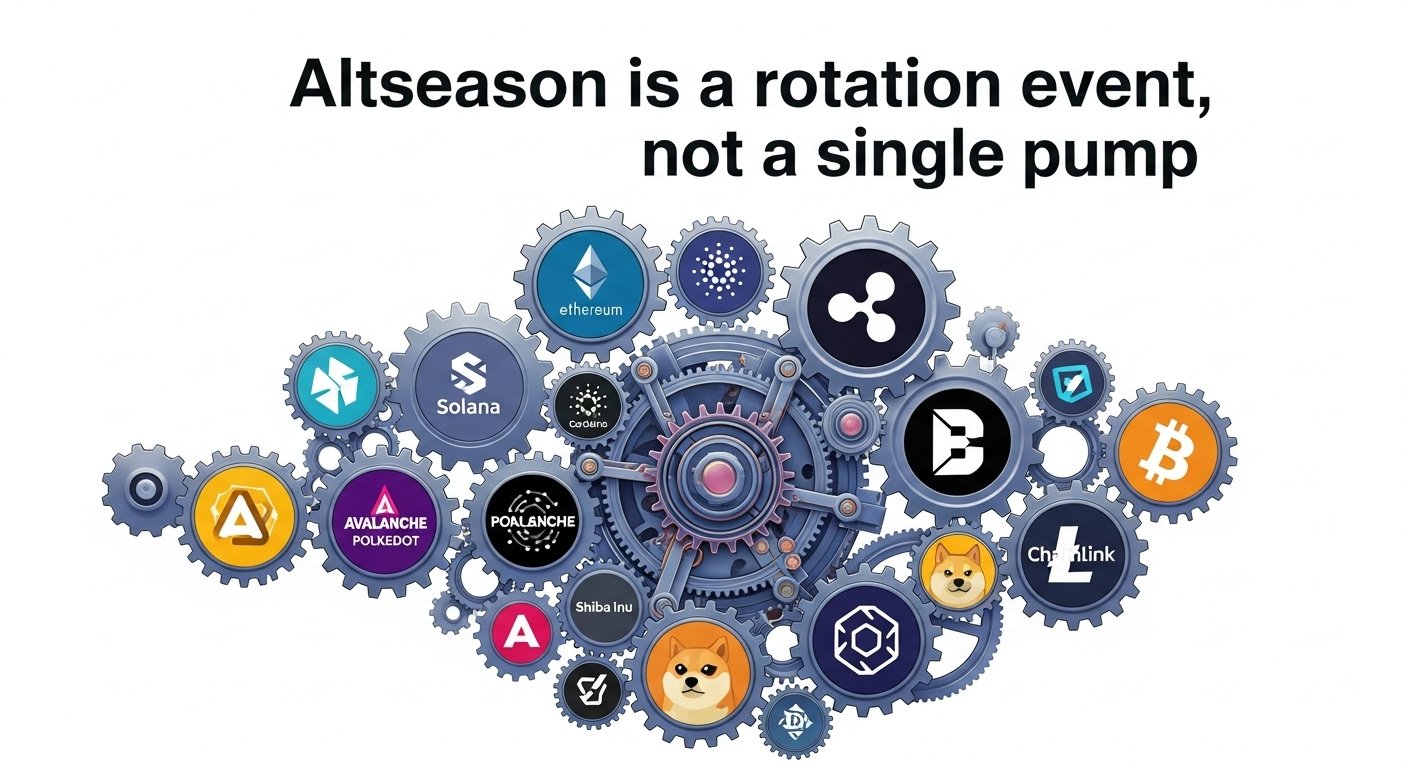
At its core, altseason is a rotation. The market does not wake up one morning and decide to buy everything. Instead, money typically moves in stages: Bitcoin leads, then Ethereum confirms, then large-cap alts follow, and only later do mid-caps and small-caps explode. That step-down progression reflects market participants gradually increasing risk exposure as confidence rises.
Key difference between a “mini altseason” and a real altcoin run
A mini altseason is short, narrow, and often driven by leverage or news-driven hype. A real altcoin run is broader and usually supported by improving liquidity, expanding volume, and stronger “market internals” like breadth and relative strength. If you want to know whether altseason in sight is more than just a slogan, you have to watch the internal signals.
Bitcoin dominance is the classic altseason tell
If there’s one metric that traders reference more than any other when discussing altseason, it’s Bitcoin dominance—the share of total crypto market value held in BTC. While dominance isn’t perfect, it often captures a simple truth: when Bitcoin is the only asset people trust, dominance tends to rise; when risk appetite expands, money spreads into altcoins and dominance tends to fall.
Why falling dominance can signal an altcoin run
A sustained decline in Bitcoin dominance often indicates investors are willing to move beyond BTC into higher beta assets. That’s a common precondition for altcoin outperformance. However, the most useful clue isn’t a single red candle on dominance—it’s a pattern of lower highs and lower lows on a meaningful timeframe, paired with rising altcoin volume and improving market breadth.
When dominance signals can be misleading
Dominance can fall for “bad” reasons too—like Bitcoin dumping faster than alts during a market-wide crash, which isn’t bullish at all. For altseason in sight to be a constructive signal, you want to see dominance easing while total market capitalization is stable or rising, and while key altcoin leaders (often Ethereum) are showing strength.
Ethereum strength often precedes broad altcoin season
In many cycles, Ethereum acts as the bridge between Bitcoin and the rest of the altcoin market. When traders feel comfortable moving risk-on, they frequently rotate first into ETH before venturing into smaller assets. That’s why ETH’s relative performance can be a valuable altseason indicator.
ETH/BTC trend changes are a powerful clue
One widely watched pattern is the ETH/BTC ratio. When ETH starts making higher lows against Bitcoin, it can suggest capital is warming up to altcoin exposure. This doesn’t automatically launch a full altseason, but it often precedes a wider altcoin run if liquidity and sentiment remain supportive.
Network activity and narrative alignment
Ethereum strength isn’t only price-based. Rising on-chain activity, improving fee dynamics, and renewed attention to scaling, restaking, or DeFi growth can provide fundamental tailwinds that attract capital. When price action and fundamentals align, markets often broaden out into altcoins that benefit from Ethereum’s ecosystem momentum.
Liquidity conditions decide whether altseason can sustain
Altcoins thrive on liquidity. When money is cheap and market participants are eager to take risk, smaller assets can surge because marginal inflows push prices dramatically. When liquidity tightens, altcoin rallies become fragile. That’s why liquidity is one of the most important key market patterns behind a durable altcoin run.
Why “risk-on” liquidity fuels altcoin season
During risk-on periods, traders move down the risk curve. They don’t just buy “blue chip” crypto; they chase growth stories, new ecosystems, and high-volatility opportunities. This is where crypto liquidity shows up as expanding spot volume, healthier order books, and sustained inflows into exchanges, on-chain protocols, and ETFs or funds where applicable.
The difference between real liquidity and leverage-driven heat
A market can look strong while being dangerously over-leveraged. In that scenario, altcoins pump fast but unwind faster. For altseason in sight to be meaningful, you typically want to see organic participation: spot buying, steady accumulation, and improving depth—rather than only a surge in perpetual futures open interest with funding rates going extreme.
Market breadth and volume reveal whether the rally is “wide” enough
A genuine altseason is broad. That means many coins participate, not just a handful. Breadth is the market’s way of answering: “Is this rally healthy, or is it being carried by a few names?”
Breadth expands before the strongest phase of an altcoin run
As altseason approaches, you often see more altcoins breaking key resistance levels, reclaiming moving averages, and holding higher lows. Volume tends to expand across multiple sectors. This is an important pattern because it suggests the market is rotating into a larger set of assets rather than concentrating in the safest corners.
Volume confirms intent
Price can move on thin liquidity, but those moves don’t usually last. A sustained altcoin run tends to show rising volume on breakouts, constructive pullbacks on lower volume, and follow-through buying after retests. When volume supports price structure, it’s harder for the rally to fade quickly.
Volatility shifts can hint that the market is ready for higher beta
Altcoins are high beta by nature. When the market is calm and confidence is building, traders often become comfortable taking more volatility. Ironically, the early stages of altseason can occur when volatility is compressing in majors—because the calm invites risk-taking.
Compression in majors, expansion in alts
A common pattern is Bitcoin and Ethereum entering a consolidation phase after a strong move, while selected altcoins begin breaking out. This can be the market “making room” for rotation. When majors stop absorbing all attention and capital, traders look elsewhere, and a broader altcoin run can start to unfold.
Volatility as a warning sign
If volatility is expanding because of fear—sharp downside moves, sudden liquidations, and unstable funding—then it can damage altseason prospects. Healthy altseason behavior often looks like controlled pullbacks, quick recoveries, and dips being bought rather than cascading.
Narrative rotation is the “human layer” of altseason
Even though markets are driven by liquidity and structure, narratives matter because they coordinate attention. When a narrative catches fire—AI, DeFi, gaming, layer-2 scaling, memecoins, RWA, modular chains—capital can flood into related tokens. In a true altseason, narratives rotate in waves, and each wave pulls new participants deeper into the altcoin market.
How narratives spread during an altcoin run
Narratives typically start with a few leaders, then expand to infrastructure plays, then to smaller “beta” versions, and eventually to long-tail speculation. This is where market rotation becomes visible in real time: money moves from the most obvious winners into laggards and then into microcaps as traders chase higher upside.
The risk of narrative-only altseasons
Narratives without structure fade fast. If the broader market isn’t supportive—if Bitcoin is breaking down, if liquidity is tightening, or if risk appetite is fragile—then narrative pumps can turn into painful reversals. The best key market patterns are the ones that align narrative excitement with supportive market conditions.
On-chain signals that often strengthen the altseason case
Price tells you what’s happening. On-chain data can hint at why. While you don’t need to be an on-chain analyst to navigate altseason, a few broad signals often show up when a real altcoin run is developing.
Rising activity and usage in key ecosystems
When users are actually transacting, bridging, swapping, and providing liquidity, it can indicate that demand is not purely speculative. Increased on-chain activity across major ecosystems can support the idea that altcoins are entering a more durable phase of interest, which makes altseason in sight more than a chart meme.
Stablecoin dynamics and deployable capital
Stablecoins are often viewed as “dry powder.” Growth in stablecoin supply or rising stablecoin velocity can suggest capital is preparing to enter risk assets. While interpretation depends on context, stablecoin behavior often becomes more important as the market transitions from Bitcoin-led strength into a broader altcoin run.
Key price structures that frequently appear before altcoin season
Technical structure doesn’t predict the future, but it can reveal a market’s posture. Before strong altseason phases, many altcoins shift from downtrends into basing patterns, then into higher highs.
Higher lows across multiple timeframes
One recurring pattern is higher lows forming across daily and weekly charts, especially after a long accumulation period. When many alts begin holding support zones and reclaiming major moving averages, it can suggest that sellers are exhausted and buyers are stepping in with more conviction.
Breakout, retest, continuation
A healthier altcoin run often features breakouts that retest prior resistance as support, followed by continuation. This structure matters because it indicates demand is not just chasing candles—it’s willing to buy pullbacks. When you see that pattern repeating across multiple sectors, altseason becomes more plausible.
What can delay or cancel altseason even when patterns look good
Markets love to trap certainty. Even if several key market patterns point to altseason in sight, there are common failure modes that can flip the script.
Bitcoin volatility spikes and risk-off shocks
A sharp Bitcoin drawdown can pull liquidity out of altcoins quickly. In risk-off moments, traders often sell alts first because they’re less liquid and more volatile. That’s why many altcoin runs pause or reset when Bitcoin experiences sudden instability.
Overheated leverage and crowded positioning
If the altcoin market becomes crowded—funding rates soar, open interest balloons, and everyone is positioned the same way—then small dips can trigger chain liquidations. A sustainable altseason tends to breathe; a leverage-driven one tends to snap.
Macro liquidity tightening
Even in crypto, broader liquidity matters. If global conditions shift toward tighter financial environments, speculative assets can struggle. Altcoins, as the highest beta segment, are usually the first to feel it. That doesn’t mean altseason can’t happen, but it can become choppier and more selective.
Putting it together: a practical “altseason checklist” mindset
Instead of looking for one magic indicator, it’s better to think in clusters. Altseason becomes more likely when multiple supportive signals align: Bitcoin dominance rolling over constructively, Ethereum showing relative strength, liquidity improving, breadth expanding, and narratives rotating on top of stable market structure.
When you combine these pieces, you’re not trying to predict a perfect top or bottom. You’re evaluating probability. A high-probability altcoin run environment typically looks like this: Bitcoin is not collapsing, Ethereum is holding strength, total market value is steady or rising, and many altcoins are forming higher lows with increasing volume. If that’s the environment, then yes—altseason in sight may be more than a headline. It may be a developing regime shift.
The most important part is staying flexible. Altseason doesn’t arrive in one clean wave. It pulses. Some sectors lead while others lag, and leadership changes fast. If you approach altseason as a rotation cycle rather than a one-time event, you’ll be better prepared to ride the parts that trend and step aside when conditions deteriorate.
Conclusion
A meaningful altseason is usually the result of alignment: liquidity supports risk-taking, Ethereum confirms broader appetite, Bitcoin dominance trends lower for constructive reasons, and market breadth expands as capital rotates into a wide set of altcoins. When those key market patterns line up, an altcoin run can become self-reinforcing as attention and momentum spread.
But altseason isn’t guaranteed, and it isn’t a single switch. The market can tease a breakout, then reset. It can deliver mini rotations that look like altseason but fade quickly. The best approach is to track the big signals—dominance, ETH strength, liquidity, breadth, and volume—while staying disciplined. If you do, you’ll be able to recognize when altseason in sight is a real transition and when it’s just noise.
FAQs
Q: What is the best indicator that altseason is starting?
There isn’t one perfect indicator, but a constructive drop in Bitcoin dominance combined with improving Ethereum relative strength and expanding altcoin market breadth is one of the most reliable early combinations for altseason.
Q: Does Ethereum always lead an altcoin run?
Not always, but ETH often acts as a bridge between Bitcoin and smaller assets. When ETH begins outperforming BTC and the broader market is stable, it frequently supports the case for altseason in sight.
Q: Can altseason happen if Bitcoin is falling?
It can happen briefly, but it’s usually unstable. A durable altcoin run typically needs Bitcoin to be steady or trending up, because severe BTC downside often triggers risk-off selling in altcoins.
Q: How long does altseason usually last?
Altseason duration varies by cycle. Sometimes it’s a few intense weeks; other times it’s several months of rotating leadership. The key is that altseason often arrives in waves rather than one continuous move.
Q: What’s the biggest mistake people make during altseason?
The biggest mistake is chasing late-stage pumps without watching liquidity and positioning. When leverage becomes crowded and funding overheats, the market can reverse sharply. Staying focused on key market patterns helps avoid buying the peak of a fading narrative.
Also More: Altseason Is Dead Why 2025 Broke the Cycle
