


Crypto traders treated altseason like a law of nature. Bitcoin would run first, headlines would explode, retail would pour in, and then capital would rotate outward into Ethereum and the rest of the market—small caps, memes, DeFi, gaming tokens—until everything felt euphoric and irrational. In that old script, altseason wasn’t just a possibility; it was the payoff for surviving the boredom and volatility of earlier phases.
That’s why the “2025 cycle” carried so much emotional weight. Many investors entered the year expecting a familiar rhythm: Bitcoin strength, then a broad-based surge across altcoins, followed by a dramatic blow-off top. But the market didn’t deliver the classic pattern. Instead of a clean, market-wide altseason, 2025 produced a messier story—rotations that didn’t stick, pumps that were narrow and short-lived, and long stretches where Bitcoin’s gravitational pull refused to loosen.
Even the narratives that usually ignite altseason felt muted. Traders watched Bitcoin dominance behave differently than expected, liquidity conditions remain selective, and institutional flows reshape where risk capital went. Some analysts argued that altseason was “delayed,” not dead, but by the end of 2025 the uncomfortable conclusion grew harder to avoid: the cycle so many people expected simply never happened in the way it used to.
This article unpacks what really changed. Not the memes, not the influencer takes, not the day-to-day drama—but the structural shifts that quietly killed the old altseason playbook. And if you’re trying to position for the next cycle, understanding why 2025 failed is more valuable than any single price prediction.
Why “Altseason” Used to Be Predictable
The Classic Rotation Model: Bitcoin First, Altcoins Second
Historically, altseason followed a psychological and mechanical sequence. Bitcoin would rally, pulling attention and new money into the market. Once Bitcoin cooled off—often consolidating near highs—traders would search for higher beta opportunities. That’s when Ethereum and major altcoins would catch a bid, and then capital would trickle into mid caps and finally small caps. The late phase of altseason was typically the wildest, as liquidity chased narratives faster than fundamentals.
This model worked because crypto markets used to be simpler. There were fewer tokens, fewer venues, fewer competing liquidity sinks, and fewer sophisticated players hedging exposure. In that environment, when risk appetite increased, capital had fewer places to go—so it spilled broadly into altcoins. Altseason wasn’t magic; it was a liquidity event.
Altseason Was Also a Social Phenomenon
Another reason altseason felt inevitable is that it was reinforced by collective behavior. As charts went vertical, social media rewarded bold predictions and viral wins. Retail participation increased, and portfolios became crowded with the same trending coins. That herding effect amplified momentum and made altseason feel like a single market-wide wave rather than many smaller ripples.

But social momentum depends on conditions that allow momentum to persist. When liquidity is fragmented and risk capital is cautious, the “one big wave” breaks apart into scattered moves—and altseason becomes harder to recognize, harder to trade, and easier to miss.
The Core Reason the 2025 Altseason Never Happened: Capital Became Selective
Liquidity Didn’t Expand the Way It Did in Past Cycles
The simplest explanation for a failed altseason is also the most important: liquidity did not flood the entire market. Instead, capital behaved like a spotlight, not a floodlight. Funds went into a narrower set of assets, and when they rotated, they rotated faster and with less patience.
Macro conditions mattered here. When broader markets are cautious, crypto risk appetite can still exist—but it tends to concentrate in the most liquid, most institutional-friendly assets. That means Bitcoin absorbs more attention and more capital, and a true, broad altseason struggles to ignite.
Several late-2025 commentaries argued that altcoin strength was restrained by weak macro signals and insufficient liquidity expansion, pushing expectations into 2026 rather than delivering a clean 2025 altseason.
Bitcoin Stayed “Too Important” for Too Long
In older cycles, Bitcoin often acted like a gateway drug. People bought BTC first, then got bored and chased altcoin upside. In 2025, Bitcoin was not just the gateway—it remained the destination for a much larger share of participants.
Part of this is structural. Bitcoin has become the cleanest institutional proxy for crypto exposure. When big money wants “crypto,” it often means Bitcoin first. That dynamic can slow the outward rotation that fuels altseason because the market’s marginal buyer is less likely to rotate into smaller, riskier assets.
Bitcoin Dominance and the Myth of the Guaranteed Altseason Signal
Dominance Fell Sometimes—But Altseason Still Didn’t Bloom
Many traders use Bitcoin dominance as an altseason indicator. The logic is straightforward: if Bitcoin’s share of the total market cap drops, altcoins must be gaining. But 2025 highlighted a key limitation—dominance can fall without producing the kind of broad, sustained altseason people remember.
Why? Because dominance can shift due to isolated pumps in a handful of large caps, or due to the creation of new tokens inflating altcoin market cap temporarily. That kind of dominance drop doesn’t necessarily mean healthy, market-wide demand. It can simply mean capital is rotating in tight circles.
Some 2025 coverage leaned into the “dominance dropping = altseason next” narrative, but even those pieces framed it as conditional and timing-sensitive, not inevitable.
The Altseason Index Problem: The Market Got Too Big and Too Weird
In past cycles, a large portion of altcoins moved together. In 2025, correlations were less reliable. The market was filled with sector-specific stories, region-specific liquidity, and token-specific catalysts. That makes a single “altseason index” less meaningful. Instead of one altseason, you got several mini-altseasons that rarely overlapped—and often reversed quickly.
ETFs, Institutions, and the New Map of Crypto Demand
ETF Flows Changed the Rotation Game
One of the biggest structural shifts is how crypto exposure is packaged. When access becomes easier through regulated products, demand can concentrate in whatever those products hold. That tends to favor Bitcoin and a small number of major assets rather than fueling a broad altseason across hundreds of coins.
In early 2026 reporting that reviewed 2025 flows, analysts highlighted sizable digital asset fund inflows and shifts in investor appetite among major assets—evidence that institutional channels are now a key driver of where capital goes.
“Institutional Interest in Altcoins” Was Real—but Not Broad
Yes, institutions explored more than Bitcoin. But the institutional version of altseason is not the retail version. Institutions prefer liquidity, custody clarity, and regulatory comfort. That means the set of “institutional altcoins” is small. Even when attention expanded, it didn’t automatically translate into a market-wide altseason—it translated into concentration among a few large caps.
Some coverage even suggested that institutional participation shifted in unexpected ways across 2025, but also noted that the depth of appetite for many altcoin vehicles looked limited.
The Token Supply Explosion: Too Many Coins, Not Enough Attention
Altseason Can’t Be Broad When the Market Is Overcrowded
Earlier cycles had fewer tokens competing for mindshare and liquidity. By 2025, the number of tradable assets had ballooned, and the pace of new launches stayed relentless. When supply expands faster than demand, altseason becomes mathematically harder.
In practice, this means even when capital rotates into “alts,” it doesn’t lift everything. It picks winners briefly, then moves on. The result is a market that feels active but not collectively euphoric—the opposite of the classic altseason experience.
Memecoins and Micro-Trends Fragmented the Cycle
Another 2025 characteristic was the rise of ultra-fast trend cycles. A memecoin might run hard, dominate social feeds, and then fade in days. That kind of behavior can create the illusion of altseason without producing durable, broad participation. Traders are busy, but the market isn’t uniformly expanding.
That matters because the old altseason depended on sustained enthusiasm. If attention cycles burn out quickly, the “season” never becomes a season—it becomes a series of storms.
Ethereum’s Evolving Role: From Altseason Engine to One Asset Among Many
ETH No Longer Automatically Leads Altseason
In older playbooks, Ethereum was the bridge between Bitcoin and the rest of the alt market. In 2025, Ethereum remained crucial, but it no longer functioned as a guaranteed signal that altseason had begun. Capital could flow into ETH without lighting up smaller caps, and smaller caps could pump without ETH leading the charge.
This shift reflects a more complex ecosystem: Layer 2 networks, modular stacks, app-specific chains, and alternative ecosystems competing for developers and liquidity. When the market has multiple centers of gravity, altseason becomes less unified.
The Market Started Pricing Narratives More Than Platforms
Instead of “ETH up means altseason soon,” 2025 rewarded sharper narratives: specific products, specific communities, and specific catalysts. That’s not necessarily bearish—it’s just different. But it does weaken the old idea that altseason is a single switch that flips when Ethereum starts running.
Macro Reality: Risk-On Was Conditional, Not Automatic
The Old Crypto Cycle Assumed Easy Liquidity
The classic altseason was born in eras when liquidity could expand rapidly and risk-on behavior could persist. In 2025, risk appetite felt more conditional—sensitive to macro data, rates, and broader market positioning. When risk capital is cautious, it favors liquidity and clarity, which again benefits Bitcoin and a small subset of majors.
Even mainstream market commentary late in 2025 emphasized how expectations shifted as momentum and institutional demand signals changed, reinforcing the idea that the “easy upside” assumptions weren’t holding the same way.
Bitcoin’s 2025 Performance Didn’t Trigger the Same Mania Loop
Another piece of the psychology: when Bitcoin delivers a dramatic, clean trend, it pulls in retail energy that later fuels altseason. But several year-end and early-2026 retrospectives described 2025 as choppy or underwhelming relative to the most aggressive expectations, which likely reduced the retail mania needed for a broad altseason.
So Is Altseason Actually Dead—or Just Evolving?
The “Death” Is Really the Death of the Old, Broad Altseason
If you define altseason as a period when most altcoins rise together for months, 2025 offered strong evidence that this version is fading. The market structure changed: more tokens, more sophisticated participants, more regulated access, and more fragmented liquidity.
But if you define altseason as recurring windows where altcoins outperform Bitcoin, that still happens—just in narrower, faster, more selective waves. In other words, altseason didn’t disappear; it stopped being universal.
The New Altseason Looks Like Rotations, Not a Tide
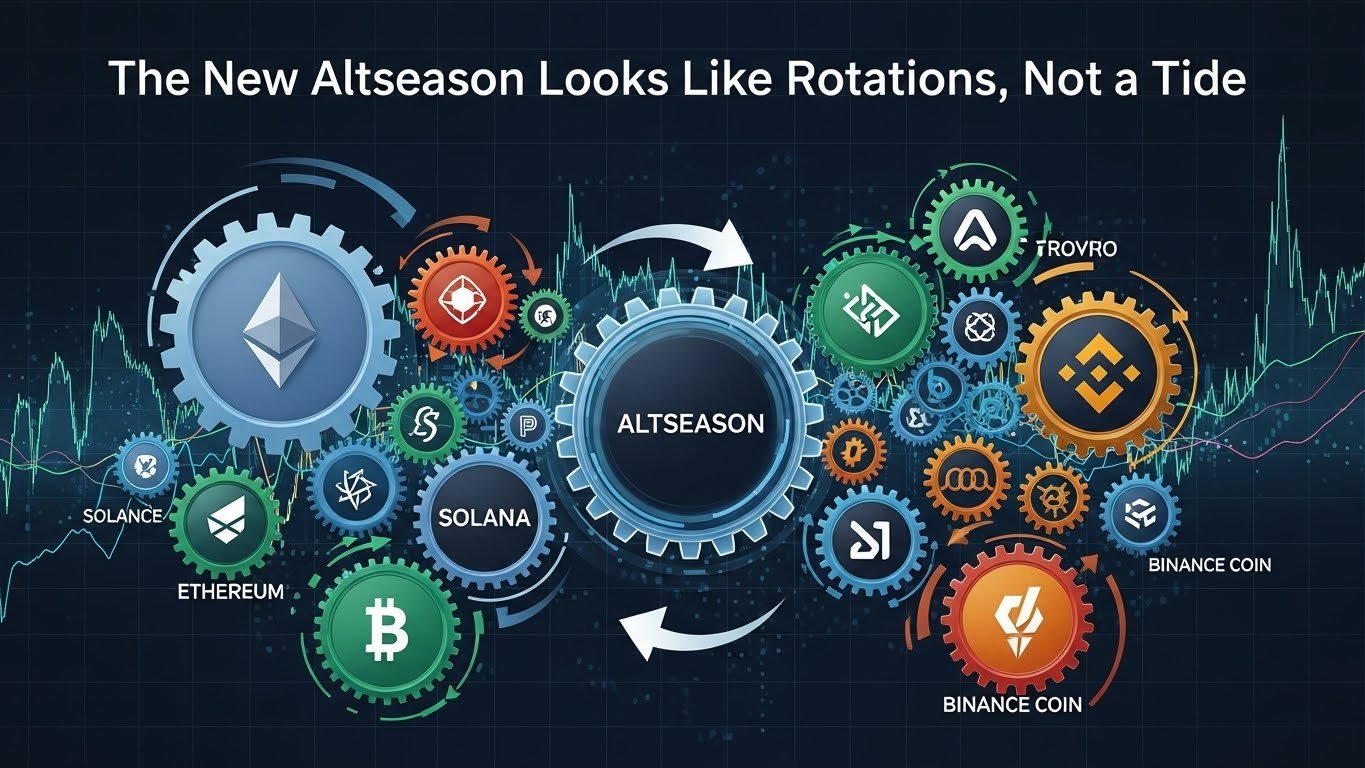
The more realistic model going forward is rotation-based. Different sectors run at different times: DeFi might lead briefly, then AI tokens, then gaming, then Layer 2, then something nobody was watching. The winners may be fewer, the timing tighter, and the drawdowns harsher. That’s not the cozy, predictable altseason people miss—but it may be the new normal.
What This Means for Traders and Long-Term Investors
Stop Waiting for “The” Altseason and Start Tracking Conditions
In a fragmented market, you don’t wait for a single signal. You watch conditions: stablecoin liquidity, exchange inflows/outflows, risk appetite, Bitcoin trend strength, and sector-specific catalysts. A modern altseason is less like summer weather and more like storm tracking.
Quality, Liquidity, and Narrative Fit Matter More Than Ever
When capital is selective, the best-positioned assets tend to be those with real liquidity, real communities, and clear narratives. That doesn’t guarantee safety, but it improves survivability. The 2025 cycle reminded many investors that “cheap and small” is not a thesis by itself—and that the broad altseason safety net is no longer reliable.
Conclusion: 2025 Didn’t Fail—Your Map Did
The 2025 cycle didn’t deliver the classic altseason because the market is no longer built for it. Liquidity became selective, institutions reshaped demand, token supply exploded, and attention fragmented into faster micro-trends. Bitcoin dominance stopped being a clean switch, Ethereum stopped being the universal bridge, and macro conditions made risk-on behavior more conditional.
So yes, you can call it “the death of the altseason.” But the more useful takeaway is this: altseason didn’t vanish—it evolved into something sharper, narrower, and harder to trade. If you keep using the old map, you’ll keep feeling like the market is broken. If you update the model, the behavior starts to make sense—and you can position for the next rotation instead of waiting for a season that may never return in its old form.
FAQs
Q: What is altseason, and why do people expect it every cycle?
Altseason is a period when altcoins collectively outperform Bitcoin, often after Bitcoin rallies and then consolidates. People expect it because earlier market cycles showed a strong pattern of capital rotation from BTC into higher-risk assets, creating broad, sustained gains across altcoins.
Q: Did altseason happen at all in 2025?
Not in the classic, market-wide sense. There were bursts of altcoin strength and sector-specific rallies, but 2025 lacked the long, broad-based altseason where “everything pumps” for months. Instead, the year looked more like fragmented rotations.
Q: Why does Bitcoin dominance matter for altseason?
Bitcoin dominance measures Bitcoin’s share of total crypto market value. When dominance falls, it can indicate capital rotating into altcoins. But 2025 showed dominance can drop without producing a broad altseason, especially when gains are concentrated in only a few large altcoins.
Q: How did ETFs and institutions affect altseason dynamics?
Regulated products can concentrate demand into a smaller set of assets—typically Bitcoin and a few major coins—reducing the broad spillover that historically fueled altseason. Institutional preferences for liquidity and clarity also make capital more selective.
Q: Can we still see altseason in future cycles?
Yes, but it may look different: shorter windows, more sector-specific runs, and fewer coins participating. A future altseason is more likely to be a series of rotations than one big, market-wide tide.
