



Altcoin Season Finally? pops up every time crypto markets start behaving in a familiar rhythm: Bitcoin runs first, liquidity follows, and then capital begins to rotate into everything else. This time, the narrative feels louder because market structure has matured, the investor base is broader, and the range of investable tokens is far bigger than in prior cycles. When traders and long-term holders notice Bitcoin dominance stalling—or even falling—while altcoins post outsized gains, speculation turns into a real question: are we entering a true altcoin season, or just experiencing a short-lived bounce?
To understand why people are asking “Altcoin Season Finally?” we need to unpack what “capital rotation out of Bitcoin” actually means. In crypto, Bitcoin is often treated as the core reserve asset. It tends to attract the first wave of new liquidity because it’s the most recognized, widely held, and liquid coin. But after Bitcoin rallies, many investors start hunting for higher beta opportunities—assets that can move faster and farther than BTC. That’s where altcoins come in. When capital rotates out of Bitcoin, it doesn’t necessarily mean investors are bearish on BTC; it often means traders are reallocating some profits into other crypto sectors to chase larger percentage gains.
Still, calling an “altcoin season” isn’t as simple as watching a couple of tokens pump. A real altcoin season implies breadth: many altcoins rising together, with a meaningful number outperforming Bitcoin over a sustained period. It also implies a shift in sentiment, liquidity, and narrative focus. In other words, “Altcoin Season Finally?” is about whether market conditions now support a broad-based rotation rather than isolated rallies.
In this article, we’ll explore how Bitcoin capital rotation works, what typically triggers a genuine altcoin season, which signals matter most, and how investors can navigate the opportunities—and risks—without getting caught chasing hype.
What Does “Capital Rotation Out of Bitcoin” Mean?
Capital rotation out of Bitcoin is the market’s way of reallocating liquidity from BTC into other crypto assets. This can happen gradually—through steady rebalancing—or suddenly, when traders take profits and redeploy them into altcoins that look undervalued or technically primed for breakouts. The process usually follows a psychological pattern: Bitcoin is perceived as “safer” within crypto, while altcoins are considered higher risk and higher reward. When confidence rises, investors take on more risk.
A key concept here is Bitcoin dominance, which measures Bitcoin’s share of the total crypto market capitalization. When BTC dominance rises, Bitcoin is absorbing most of the market’s attention and liquidity. When dominance falls, it often signals that capital begins to rotate out of Bitcoin and into altcoins. However, dominance can fall for different reasons—sometimes because altcoins are genuinely rallying, and sometimes because BTC is dropping faster than the rest of the market. That’s why it’s important to pair dominance with price action, volume, and market breadth.
Rotation also tends to follow an order. Many cycles start with BTC strength, then move into large-cap altcoins like Ethereum, and later flow into mid-caps and smaller narratives like gaming tokens, AI tokens, and DeFi names. If you’re asking “Altcoin Season Finally?” you’re really asking whether this rotation is expanding beyond a few majors into a wider set of tokens.
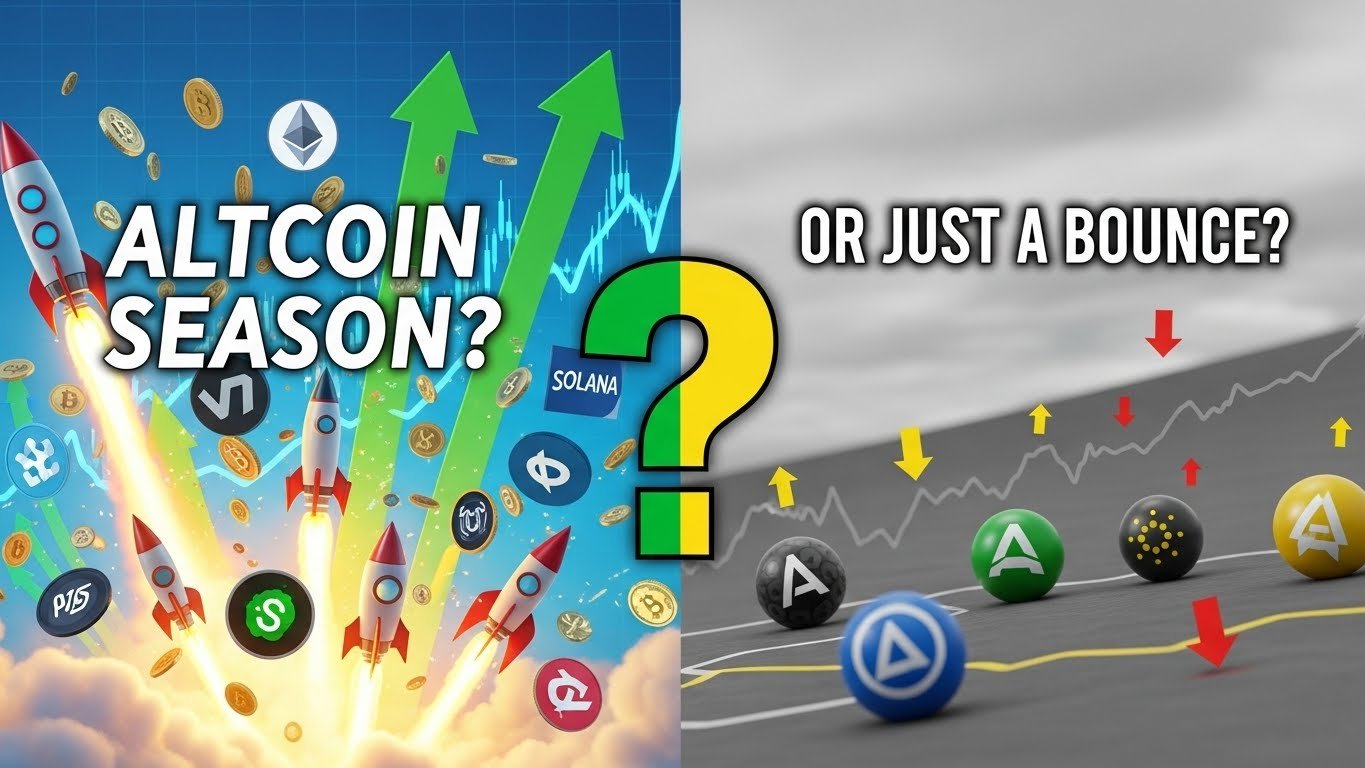
Is This Altcoin Season or Just an Altcoin Bounce?
Not every burst of altcoin gains qualifies as a true altcoin season. Many rallies are simply “relief bounces” after a market dip, or short rotations driven by a single catalyst. A real altcoin season usually includes three characteristics: duration, breadth, and consistent outperformance relative to Bitcoin.
Duration matters because altcoin seasons tend to persist long enough for capital to cycle through multiple sectors. If the rotation lasts only a week or two and then fades back into Bitcoin, that’s more likely a temporary swing. Breadth matters because a handful of tokens pumping is common even during Bitcoin-led markets. A genuine altcoin season often sees a majority of the altcoin market outperforming BTC over a rolling timeframe.
Relative strength is the third key. If Bitcoin is still outperforming most altcoins, then the market is not in a true altcoin season—no matter how loud the headlines are. The “Altcoin Season Finally?” question becomes meaningful when altcoin indexes, ETH/BTC strength, and a wide set of sectors start outperforming BTC together.
The Classic Cycle: How Altcoin Seasons Typically Start
Altcoin seasons are often a second act rather than the opening scene. The cycle usually begins when Bitcoin finds strong demand—often after a breakout, macro catalyst, or a supply/demand shift. As BTC rises, confidence returns and sidelined capital re-enters. Then, after Bitcoin prints a strong move, the market’s attention shifts toward undervalued opportunities.
Bitcoin Rally First, Then Profit-Taking
Bitcoin often acts as the market’s “risk-on switch.” Once it rallies, traders who bought early hold gains and begin to take partial profits. Some of that profit is parked in stablecoins, but a significant portion tends to rotate into altcoins—especially those with strong narratives or technical setups.
Ethereum as the Bridge Asset
In many cycles, Ethereum becomes the bridge between Bitcoin and broader altcoin markets. When ETH begins outperforming BTC—reflected in the ETH/BTC ratio—market participants gain confidence in moving further out on the risk curve. If you’re watching for “Altcoin Season Finally?” a sustained rise in ETH/BTC is often one of the earliest signs.
Sector Rotation: From Majors to Mid-Caps to Small Caps
Once large caps run, rotation can extend into mid-caps and smaller tokens. That’s when the market can feel like “everything is pumping.” But it’s also when risk rises sharply. Small caps can surge quickly, yet they can also crash just as fast when liquidity dries up.
Key Signals That Suggest Altcoin Season Finally Arriving
No single indicator guarantees an altcoin season, but several signals together can increase confidence that capital begins to rotate out of Bitcoin in a sustained way.
Bitcoin Dominance Rolling Over
When Bitcoin dominance forms a clear downtrend while the overall market is stable or rising, it often suggests altcoins are gaining share due to genuine inflows. A slow decline in dominance can indicate a measured rotation; a sharp decline can indicate speculative mania, which may be profitable—but also more fragile.
ETH/BTC Strength and Rising On-Chain Activity
ETH often reflects the market’s appetite for broader crypto risk. When ETH/BTC strengthens and Ethereum activity rises—such as increased transaction demand or higher usage of DeFi protocols—it can signal a shift away from Bitcoin’s defensive positioning.
Altcoin Market Breadth Expanding
A real altcoin season shows breadth. That means many sectors are participating: DeFi tokens, gaming, infrastructure, Layer 2, AI-related coins, and more. When gains are concentrated in only one narrative, the market may be in a sector-specific rally rather than a full altcoin season.
Funding Rates and Leverage Not Overheating
Derivatives markets can provide clues. If funding rates become extremely positive across altcoins, it can signal the market is overcrowded and vulnerable to liquidations. A healthier rotation often begins when altcoins rise with controlled leverage and steady spot buying.
Why Capital Rotates: The Psychology Behind Altcoin Season
The “Altcoin Season Finally?” narrative isn’t just technical; it’s psychological. When Bitcoin runs, it validates crypto as an asset class and pulls attention back into the market. Once investors feel confident again, they search for “the next Bitcoin,” even if that’s not rational.
This search is amplified by social media and narrative-driven investing. Traders want to believe there’s a hidden gem, a new platform, or a fast-growing ecosystem that can deliver outsized returns. Because many altcoins have smaller market caps, they can move dramatically on relatively small inflows, which creates a feedback loop: price rises attract attention, attention attracts more capital, and the cycle continues.
However, psychology cuts both ways. When the market turns, liquidity exits altcoins first. That’s why understanding rotation and risk management matters as much as spotting a trend.
Which Altcoins Tend to Lead When Bitcoin Rotation Starts?
During early rotation phases, market participants often favor liquid, established assets. That typically includes Ethereum and other large caps. As confidence grows, attention broadens to sectors with strong narratives or real usage.
Large Caps and “Blue Chip” Altcoins
Large caps tend to lead because institutions and bigger traders can enter and exit without heavy slippage. These coins also often have deeper derivatives markets, making them easier to hedge. When capital begins to rotate out of Bitcoin, it frequently flows first into these more established altcoins.
Infrastructure and Layer-2 Narratives
Infrastructure projects can benefit when on-chain activity increases. If more users are transacting, bridging, or using decentralized apps, the market often prices in higher future demand for scaling solutions. LSI phrases like network utility, on-chain adoption, and ecosystem growth tend to dominate during these phases.
DeFi, AI, and High-Beta Themes
Later-stage rotations often favor high-beta themes—tokens that can rally sharply when liquidity becomes abundant. DeFi tokens may surge as trading activity increases, while AI-related narratives may spike during periods of broader tech optimism. These moves can be powerful, but they can also be more volatile.
Why Altcoin Seasons Can Be Brutal
The upside of an altcoin season is obvious: outsized gains are possible in a short time. But the downside is just as real. When rotations reverse, altcoins often drop harder than Bitcoin due to thinner liquidity and higher speculative positioning.
A key risk is chasing what already pumped. Late entrants often buy at elevated prices, assuming the trend will continue indefinitely. Another risk is liquidity mismatch—smaller tokens can look stable during calm periods but become impossible to exit quickly during a market downturn.
There’s also the risk of narrative decay. Many altcoin rallies are fueled by stories rather than fundamentals. When the story changes—due to a macro shock, regulation headlines, or a shift in market attention—prices can fall rapidly.
If you’re asking “Altcoin Season Finally?” it’s worth remembering that a true altcoin season is not a straight line upward. It often includes sharp pullbacks, rotations between sectors, and sudden sentiment shifts.
How to Approach Altcoin Season Without Overexposure
A smart approach to altcoin season focuses on process, not hype. The goal is to participate in the upside while avoiding the common traps that wipe out gains.
One method is to track relative strength: which altcoins consistently outperform Bitcoin on pullbacks and recover faster on rebounds. Another is to focus on liquidity and quality—tokens with strong exchange support, real market depth, and ongoing development or user adoption.
It also helps to define exit plans before entering. In altcoin season, volatility can make rational decision-making difficult. Setting targets, considering partial profit-taking, and maintaining exposure to Bitcoin or stablecoins can reduce emotional trading.
Most importantly, avoid assuming that every rotation will continue indefinitely. Capital rotation out of Bitcoin can pause, reverse, or shift back into BTC if uncertainty rises.
Macro, Liquidity, and Market Structure
Altcoin seasons do not occur in a vacuum. Broader liquidity conditions, risk appetite in global markets, and crypto-specific catalysts can all influence whether rotation persists. When liquidity expands and risk markets are strong, altcoins often benefit. When liquidity tightens or uncertainty rises, Bitcoin typically regains its defensive appeal within crypto.
Market structure also matters. Today’s crypto market includes ETFs in some regions, more professional trading infrastructure, and larger pools of capital. That can make rotations faster and more complex. It can also mean that narratives spread quicker, and positioning becomes crowded sooner.
In that environment, the “Altcoin Season Finally?” question is less about a single indicator and more about a cluster of evidence: dominance trends, ETH/BTC strength, breadth, volume, and sentiment.
Conclusion: Altcoin Season Finally, or a Rotation in Progress?
So, Altcoin Season Finally? The most accurate answer is that an altcoin season is best viewed as a process rather than a single moment. When capital begins to rotate out of Bitcoin, it often starts with large caps and expands outward as confidence rises. A true altcoin season shows sustained outperformance across many altcoins, improving market breadth, and a measurable decline in Bitcoin dominance driven by altcoin strength—not just by Bitcoin weakness.
If current conditions continue to favor risk-on behavior, and if rotation remains broad rather than concentrated in a handful of tokens, the case for a genuine altcoin season strengthens. But the same volatility that creates opportunity can also punish late, over-leveraged, or undisciplined participants. The best way to navigate the next phase is to respect the signals, manage risk, and remember that crypto rotates—fast.
FAQs
Q: What is an altcoin season in simple terms?
An altcoin season is a period when a broad range of altcoins outperform Bitcoin over weeks or months, often as investors rotate profits from BTC into higher-risk crypto assets.
Q: Does capital rotating out of Bitcoin mean Bitcoin will crash?
Not necessarily. Capital rotation often means traders are reallocating some gains into altcoins while still remaining bullish on the overall crypto market.
Q: What’s the most important indicator of altcoin season?
There isn’t one perfect indicator, but Bitcoin dominance declining alongside rising altcoin prices and broad market participation is a common sign.
Q: Why does Ethereum matter in identifying altcoin season?
Ethereum often acts as a bridge between Bitcoin and smaller altcoins. When ETH shows strength versus BTC, it can signal rising risk appetite across crypto.
Q: What is the biggest mistake people make during altcoin season?
Chasing late-stage pumps without a plan. Altcoin rallies can reverse quickly, so risk management and profit-taking strategies are essential.
See More: Hidden Crypto Whale $0.003 Altcoin Could Surge 400%
