


Cardano has always been one of crypto’s most debated networks. To its supporters, it’s a methodical, research-driven blockchain built to last—an ecosystem that prioritizes security, scalability, and decentralization over hype. To its critics, it’s a slow-moving project that hasn’t delivered the bustling on-chain economy promised years ago. Recently, the conversation has intensified again because of two themes dominating social media and market commentary: Cardano whale exits and renewed ghost chain fears.
When large holders—often called whales—move coins off exchanges, on-chain analysts interpret it as accumulation. But when whales sell or shift funds into stablecoins, it can signal profit-taking or a more cautious outlook. At the same time, critics use the term “ghost chain” to describe networks with low activity, limited developer traction, or underwhelming DeFi participation compared to competitors. Cardano has repeatedly faced this label, even as its community argues that adoption is growing steadily and that the chain’s long-term design will outperform faster—but riskier—alternatives.
So what’s really happening with Cardano’s future? Is ADA being quietly abandoned by institutional players, or are these whale exits just part of normal market cycles? Are ghost chain fears justified, or are they based on selective comparisons that overlook Cardano’s unique approach? This article breaks down the biggest narratives shaping Cardano today, explores what matters most for the network’s long-term outlook, and assesses what investors and builders should watch next.
Understanding the “Whale Exits” Narrative
The phrase “whale exits” sounds dramatic, but it often describes a broad set of behaviors rather than a single event. A whale might sell ADA, move it to an exchange, transfer it into cold storage, or diversify into other assets. The market tends to react most strongly when whales appear to be selling because large sales can create short-term downward pressure and weaken investor confidence.
Why whales matter in the ADA market
In any crypto asset, whale activity can influence price action because concentrated holdings can amplify volatility. Even in networks with strong decentralization, a small percentage of wallets may still control a significant portion of supply. When whales shift positions, traders anticipate follow-through: more selling, reduced liquidity support, or a change in sentiment.
For Cardano (ADA), whale exits are especially sensitive because ADA has a large retail community. Retail investors often interpret whale selling as a sign that “smart money” is leaving. This psychological effect can create a self-fulfilling cycle: fear triggers more selling, which pushes prices down, which triggers more fear.
Are whale exits always bearish?
Not necessarily. Whale exits can mean a whale is selling, but it can also mean coins are being moved into custody solutions, DeFi protocols, or long-term staking strategies. Cardano’s staking model encourages holding rather than constant movement, and many ADA holders stake through pools without locking tokens. That means a whale can remain “inactive” while still earning yield, reducing the frequency of obvious on-chain signals.
To evaluate whale exits properly, you need to consider the broader context: exchange inflows, market conditions, macroeconomic uncertainty, and ADA’s relative performance compared to other layer-1 networks. A whale reducing exposure in a risk-off market doesn’t necessarily reflect a negative outlook on Cardano—it may simply reflect a portfolio adjustment.
The Origins of Ghost Chain Fears
Few phrases irritate Cardano supporters more than “ghost chain.” The idea suggests a blockchain with minimal real-world usage, little developer activity, and weak engagement. In reality, the definition is subjective, and the label is often used in debates to compare ecosystem activity across chains.
Why Cardano gets labeled a ghost chain
Cardano’s DeFi and NFT ecosystems grew more slowly than Ethereum, Solana, and even newer chains that prioritized rapid execution. For years, the network’s road map emphasized peer-reviewed research and careful engineering rather than aggressive feature rollouts. That pace created an opening for competitors to dominate narratives about “users,” “transactions,” and “TVL.”
Because many crypto investors measure success by metrics like total value locked (TVL), number of dApps, and daily active wallets, Cardano has often been judged through the lens of faster-moving ecosystems. This makes it easy for critics to say: “Where are the users?” even if Cardano is developing in a different direction—focusing on staking, governance, and gradual scaling.
What ghost chain fears overlook
The ghost chain argument often ignores Cardano’s strong staking participation, its high decentralization of stake pools, and its unique architecture. Cardano isn’t built like many other chains. It uses the Ouroboros proof-of-stake design, has an emphasis on formal methods, and aims for resilient governance mechanisms that can survive multiple market cycles.
Also, “activity” is more complex than raw transaction counts. Some chains inflate metrics through cheap transactions and bot activity. Others have high TVL that is concentrated in a few protocols. Cardano’s future depends not only on surface-level stats but on sustainable usage, developer retention, and successful scaling upgrades.
Cardano’s Technology: Strengths That Still Matter
To assess Cardano’s future fairly, it helps to revisit what makes the project different. Cardano is often described as a “slow builder,” but that pace is linked to its technical philosophy—building infrastructure meant to support global-scale financial and identity systems.
The proof-of-stake advantage
Cardano’s proof-of-stake system is widely considered energy-efficient and secure. Compared to proof-of-work systems, it avoids massive energy consumption. Compared to some proof-of-stake competitors, it aims for a balance between decentralization and performance. Staking is accessible, and delegators can move funds without lockups, which reduces friction.
This model supports long-term holders, which can create a more stable investor base. Even during downturns, staking incentives encourage participants to stay engaged. That is one reason why Cardano whale exits can be misinterpreted—many whales simply stake and hold rather than constantly trade.
Smart contract evolution and developer experience
Cardano’s smart contracts operate differently because of its eUTxO model, which can provide determinism and security advantages, but also introduced complexity for early developers. Over time, tools have improved, and the ecosystem has adapted. Still, developer experience remains a key battleground. If Cardano wants to overcome ghost chain fears, it needs to make building easier, faster, and more rewarding than alternatives.
This is where upgrades and community-driven tooling become critical. More accessible frameworks, better documentation, and clearer incentives can turn “slow growth” into “steady adoption.”
On-Chain Activity: Interpreting the Signals Correctly
Metrics like transaction count, active addresses, and DeFi usage matter, but they can’t be interpreted in isolation. Cardano’s on-chain economy tends to move in waves, often tied to major upgrades and market cycles.
The role of market cycles in ADA activity
Crypto markets are cyclical. When the market is bullish, more people trade, mint NFTs, use DeFi, and experiment with new protocols. During bear markets, activity drops across most chains. Ghost chain narratives tend to surface in bearish conditions because lower activity becomes an easy target.
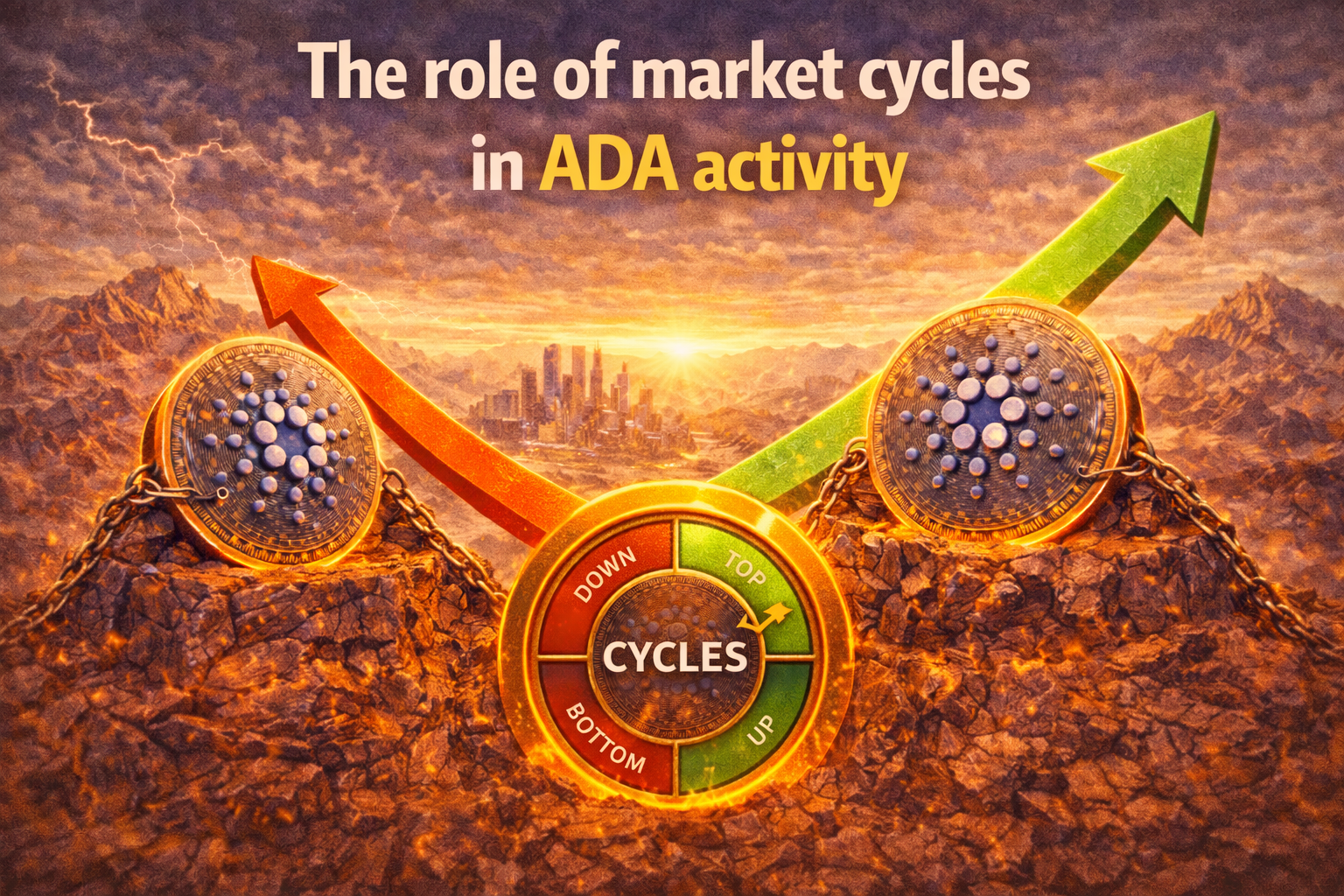
If whale exits happen during a period of market weakness, it can create a double-negative narrative: “Whales are leaving, and the chain is dead.” But in many cases, it’s simply the market contracting.
Real adoption versus speculative activity
Cardano’s future depends on real adoption, not just speculative hype. Real adoption comes from financial applications, identity solutions, enterprise partnerships, stablecoin usage, and cross-border payments. Speculative activity can inflate numbers temporarily, but long-term success is built on utility.
This is why Cardano supporters often emphasize fundamentals. If Cardano becomes a core infrastructure layer for emerging markets, decentralized identity, or resilient DeFi, the ghost chain label won’t matter.
Whale Exits vs. Whale Rotation: A More Realistic View
One of the most misunderstood aspects of whale behavior is that whales rarely “exit forever.” They rotate. They diversify. They rebalance. And sometimes they simply hedge.
Why whales might sell ADA
A whale might reduce ADA holdings due to macro conditions, regulatory uncertainty, or better short-term opportunities. They may move into Bitcoin during risk-off periods or into stablecoins to preserve capital. They may also sell after major rallies to lock in gains. None of these are unique to Cardano.
Why whales might return
Whales often return when narratives shift, liquidity improves, or when new catalysts emerge. For Cardano, catalysts might include scaling upgrades, new governance milestones, ecosystem growth, or major integrations. In other words, Cardano whale exits do not automatically mean the end of ADA’s long-term potential.
The Competitive Landscape: Where Cardano Stands
Cardano competes in the most crowded space in crypto: layer-1 blockchains. Ethereum dominates with liquidity and developer activity. Solana dominates with speed and consumer apps. New chains constantly appear with aggressive incentives.
Cardano’s unique positioning
Cardano positions itself as a resilient, decentralized platform designed for long-term evolution. Its research-driven approach appeals to builders focused on security and reliability. Its community governance ambitions also differentiate it.
But Cardano must keep proving that this philosophy can translate into mass adoption. The biggest challenge is not technology—it’s capturing developer mindshare and creating an ecosystem that feels alive every day, not only during hype cycles.
Scaling and user experience as the deciding factor
If Cardano can scale without sacrificing decentralization, it can become more attractive for DeFi and consumer applications. User experience is also key. Many users don’t care about architecture—they care about speed, low fees, and smooth apps. Cardano’s future will be determined by how effectively it can convert its technical strengths into everyday usability.
Cardano’s Future Catalysts: What Could Change the Narrative
The best way to evaluate Cardano’s future is to focus on catalysts that can shift adoption and sentiment.
Adoption catalysts
Adoption catalysts include stablecoin growth, stronger DeFi liquidity, more bridges and interoperability, and real-world partnerships. If Cardano becomes a hub for identity, payments, or regulated DeFi, the ghost chain label loses credibility.
Community and governance catalysts
Cardano has long emphasized governance. If its governance systems mature into a model that other chains copy, it could become a blueprint for decentralized coordination. This would strengthen Cardano’s long-term brand.
The impact of developer growth
Developer growth is the most direct antidote to ghost chain fears. More developers mean more apps, more experiments, and more user attraction. If Cardano improves onboarding tools and simplifies development, the ecosystem can expand faster than critics expect.
Investor Sentiment: The Psychological Battle Around ADA
Cardano has one of the most passionate communities in crypto, but passion cuts both ways. It creates resilience in bear markets, but it also fuels polarization.
Why sentiment swings so strongly
Because Cardano has been highly debated for years, sentiment is often extreme. Supporters see long-term vision and fundamentals. Critics see missed opportunities and slower adoption. Whale exit narratives add fuel to this conflict, making it harder for neutral investors to evaluate the chain calmly.
What long-term investors should watch
Long-term investors should track real metrics: adoption rates, developer activity, governance milestones, DeFi liquidity trends, and the release of meaningful scaling improvements. Price action is important, but fundamentals determine whether ADA remains relevant in the next five to ten years.
Can Cardano Escape Ghost Chain Fears?
Yes—but it requires more than arguments on social media. It requires visible, measurable ecosystem momentum.
Cardano must prove that it can host vibrant applications, attract liquidity, and retain developers. It doesn’t need to become Solana or Ethereum. It needs to become the best version of Cardano: a secure, scalable, decentralized platform with real-world utility and sustainable growth.
If Cardano succeeds, ghost chain fears will look like a temporary narrative driven by impatience and comparison culture. If it fails, critics will use those fears as evidence that the market was right. The outcome depends on execution, not ideology.
Conclusion
Cardano’s future sits at the intersection of perception and reality. Cardano whale exits may look alarming at first glance, but whale behavior often reflects broader market conditions, rotation strategies, and portfolio rebalancing rather than a final verdict on ADA. Meanwhile, ghost chain fears persist because Cardano’s ecosystem growth has been slower and more methodical than its rivals—but slow does not automatically mean dead.
The real question is whether Cardano can translate its strong foundations into sustained adoption. If it continues improving scalability, developer experience, and real-world utility, it can outlast narratives that focus only on short-term hype. Cardano has a long-term vision, and its community remains one of the most committed in crypto. In a market that often rewards speed over substance, Cardano is betting that substance will win eventually.
Whether that bet pays off depends on what happens next—not what critics or supporters say today.
FAQs
Q: Why are Cardano whale exits considered important?
Whale exits matter because large holders can influence liquidity and market sentiment. When whales sell significant ADA, it can create short-term price pressure and trigger fear among retail investors.
Q: Does whale selling mean Cardano is failing?
Not always. Whale selling can reflect broader market cycles, risk management, or diversification. It doesn’t automatically indicate that Cardano’s technology or long-term potential is weakening.
Q: What does “ghost chain” mean in relation to Cardano?
“Ghost chain” is a criticism that suggests a blockchain has low activity or weak adoption. In Cardano’s case, it’s often linked to comparisons with other layer-1 networks and metrics like DeFi usage.
Q: How can Cardano overcome ghost chain fears?
Cardano can overcome these fears by increasing developer growth, improving user experience, expanding DeFi liquidity, and delivering strong real-world adoption through partnerships and practical use cases.
Q: Is Cardano’s future still promising despite criticism?
Cardano’s future remains open. Its strengths include decentralization, proof-of-stake efficiency, and long-term governance goals. The key will be execution—scaling, ecosystem growth, and real adoption over time.
Also more: Altcoin News Alerts for Traders Real-Time Crypto Signals
