


The crypto market has seen brutal drawdowns before, but the 2025 Bitcoin crash carried a different kind of violence—fast, mechanical, and ruthlessly amplified by leverage. Traders didn’t simply panic-sell; they were forced out. Across the year, forced liquidations surged past $150 billion, a scale that reflects how deeply derivatives have reshaped crypto’s structure.
This matters because liquidations aren’t just a symptom of falling prices. They are also a cause. When the market becomes overloaded with leveraged long positions, even a modest drop can flip into a chain reaction: price dips trigger liquidations, liquidations trigger market sells, sells trigger more price dips, and the cycle keeps feeding itself until enough leverage gets wiped out.
In 2025, that feedback loop intensified for three big reasons. First, derivatives activity grew to staggering levels, creating more opportunities for liquidation cascades. Second, macro shocks repeatedly hit risk assets, pushing Bitcoin and altcoins into abrupt declines. Third, sentiment became fragile because crypto was no longer moving purely on crypto-native narratives; it was increasingly tied to global liquidity, rates, and institutional positioning through regulated venues and spot ETFs.
So when people say “$150 billion was liquidated,” they’re not talking about a single day’s event. They’re describing the cumulative forced unwinding of leveraged positions that repeatedly slammed the market in 2025—creating the conditions where Bitcoin could suddenly drop hard, shake out traders, and drag the broader crypto market with it.
What follows is a clear, detailed breakdown of how that liquidation machine worked—and why it drove one of the most dramatic Bitcoin crash dynamics the market has experienced in years.
Understanding what “$150 billion liquidated” really means
When headlines say $150 billion was liquidated from the crypto market, it’s easy to imagine $150 billion in cash leaving the ecosystem. In reality, liquidation numbers represent the notional value of leveraged positions forcibly closed by exchanges when traders can’t meet margin requirements.
In simpler terms: a trader borrows money (or uses leverage through perpetual futures), opens a large position, and if price moves against them too far, the exchange closes the position automatically. That closure often involves market orders, which can move price quickly in a thin order book. Multiply that by hundreds of thousands of traders, across Bitcoin and major altcoins, and you get the 2025 liquidation story.
CoinGlass reporting and summaries of 2025 market structure show that forced liquidations approached or exceeded $150 billion across the year, with daily liquidation averages frequently in the hundreds of millions. That scale tells you something important: crypto in 2025 didn’t just trade spot supply and demand. It traded leverage—massive leverage—and the market repeatedly paid the price for it.
leverage doesn’t look dangerous until it is
Leverage becomes most dangerous when it feels safe. This typically happens during extended rallies where volatility compresses and traders assume dips will be bought. Funding rates rise, open interest balloons, and the market becomes stacked with one-sided positioning. When a macro trigger hits—or even when a large whale sells—price slips into liquidation territory and a cascade begins.
That is why many 2025 selloffs felt sudden and “unfair.” The crash wasn’t only about fear. It was about liquidation mechanics.
How crypto derivatives fueled 2025’s liquidation cascade
If you want to understand why the Bitcoin crash in 2025 was so aggressive, you have to understand how dominant derivatives became. In 2025, crypto derivatives volume surged to tens of trillions of dollars, reflecting the institutional and high-frequency nature of modern crypto trading.

Derivatives aren’t inherently bad. They provide hedging tools and improve liquidity. But they also make it easy for traders to take huge positions with relatively small collateral. That’s where the market becomes fragile. When the market is heavily leveraged, even a 2%–4% move can wipe out crowded positions.
Perpetual futures and the “auto-sell” problem
Perpetual futures dominate crypto speculation because they offer leverage and don’t expire. But they come with a structural downside: liquidations are automated and immediate.
When Bitcoin drops quickly, leveraged long positions get liquidated, and the exchange sells into the market to close them. That selling pressure pushes price lower, liquidating more traders. In bad conditions, it becomes a waterfall. The result is a Bitcoin crash that accelerates far beyond what the original selling pressure would have produced.
Open interest: the pressure cooker indicator
One of the most reliable warning signals in 2025 was open interest—the total value of outstanding futures contracts. CoinGlass data and market commentary throughout the year repeatedly highlighted major surges in open interest, including institutional participation through regulated venues like CME.
High open interest by itself doesn’t guarantee a crash. But high open interest combined with one-sided positioning, positive funding rates, and weak spot demand creates the perfect liquidation environment.
The domino effect: why Bitcoin liquidations crash the whole crypto market
Bitcoin is the core collateral asset in crypto. When Bitcoin falls sharply, it doesn’t just hurt Bitcoin longs; it weakens collateral values across the system. Traders using Bitcoin as margin suddenly have less margin. Altcoins drop even faster because they’re thinner, more speculative, and often more leveraged.
So a Bitcoin liquidation cascade tends to spread into a market-wide deleveraging event. That’s why headlines in 2025 repeatedly described “$150 billion wiped from crypto market cap” during sharp downturns.
In some major selloffs, crypto market capitalization dropped by around $150 billion in short windows, reinforcing the idea that liquidation events don’t stay isolated. They become systemic shocks, especially when liquidity is thin and fear takes over.
Key triggers that set off liquidation waves in 2025
Liquidation cascades need a trigger. In 2025, those triggers frequently came from macroeconomic surprises and sudden shifts in risk appetite, not just crypto-native events.
Macro shocks and risk-off waves
Bitcoin’s status in 2025 increasingly resembled a high-volatility risk asset. When global markets went “risk-off,” crypto often sold off hard. Reports from late 2025 described Bitcoin dropping sharply in early Asian trading as bond yields surged and global sentiment shifted, contributing to large market cap losses.
Even when the initial move was relatively small, the leverage sitting on top of the market amplified it.
The “crowded long” problem
Many of the largest liquidations in 2025 occurred after bullish consensus built up. When everyone believes Bitcoin is going higher, leverage becomes crowded on the long side. That’s when the market is most vulnerable to a downside flush.
Major media coverage of liquidation events in 2025 repeatedly noted how overcrowded positioning left traders exposed when price slipped, producing billion-dollar liquidation days.
ETF flows and institutional positioning
Spot Bitcoin ETFs and regulated futures participation mattered because they changed the rhythm of liquidity. When ETF inflows were strong, dips were bought. But when flows weakened—or when institutions reduced exposure—crypto could suddenly feel “unsupported,” especially during macro stress.
This added another layer of fragility: the market could be highly leveraged while also relying on institutional flow stability. When either piece broke, volatility spiked.
The anatomy of a liquidation cascade: step-by-step breakdown
To see how $150 billion in liquidations could build across 2025, you have to visualize the chain reaction.
First, Bitcoin drops 1%–3% from a local high. That move seems normal. But because many traders are using 10x, 20x, or even higher leverage, their margin buffers are thin. The first wave of liquidations begins.
Second, the exchange closes positions using market sells. Liquidity thins and spreads widen. Bitcoin drops another 2%–4%.
Third, the second liquidation wave hits: larger leveraged accounts, algorithmic traders, and cross-collateral positions start to unwind. Altcoins fall harder.
Fourth, fear kicks in. Spot holders begin to sell, adding discretionary selling pressure to forced selling pressure. Fifth, volatility spikes, triggering risk controls, stop losses, and more forced closures. The market overshoots to the downside.
Then, after most of the leverage is cleared, price stabilizes. Sometimes it rebounds quickly—because forced selling ends as suddenly as it begins. But the damage is done: billions in leveraged positions are wiped out, and confidence takes time to rebuild. This pattern repeated throughout 2025, which is why annual forced liquidation totals became so enormous.
Why altcoins suffered even more than Bitcoin
Every Bitcoin crash in 2025 had a familiar side effect: altcoins bled disproportionately. That’s not just because they’re riskier. It’s because many altcoin markets have thinner spot liquidity, higher volatility, and greater leverage usage among retail traders.
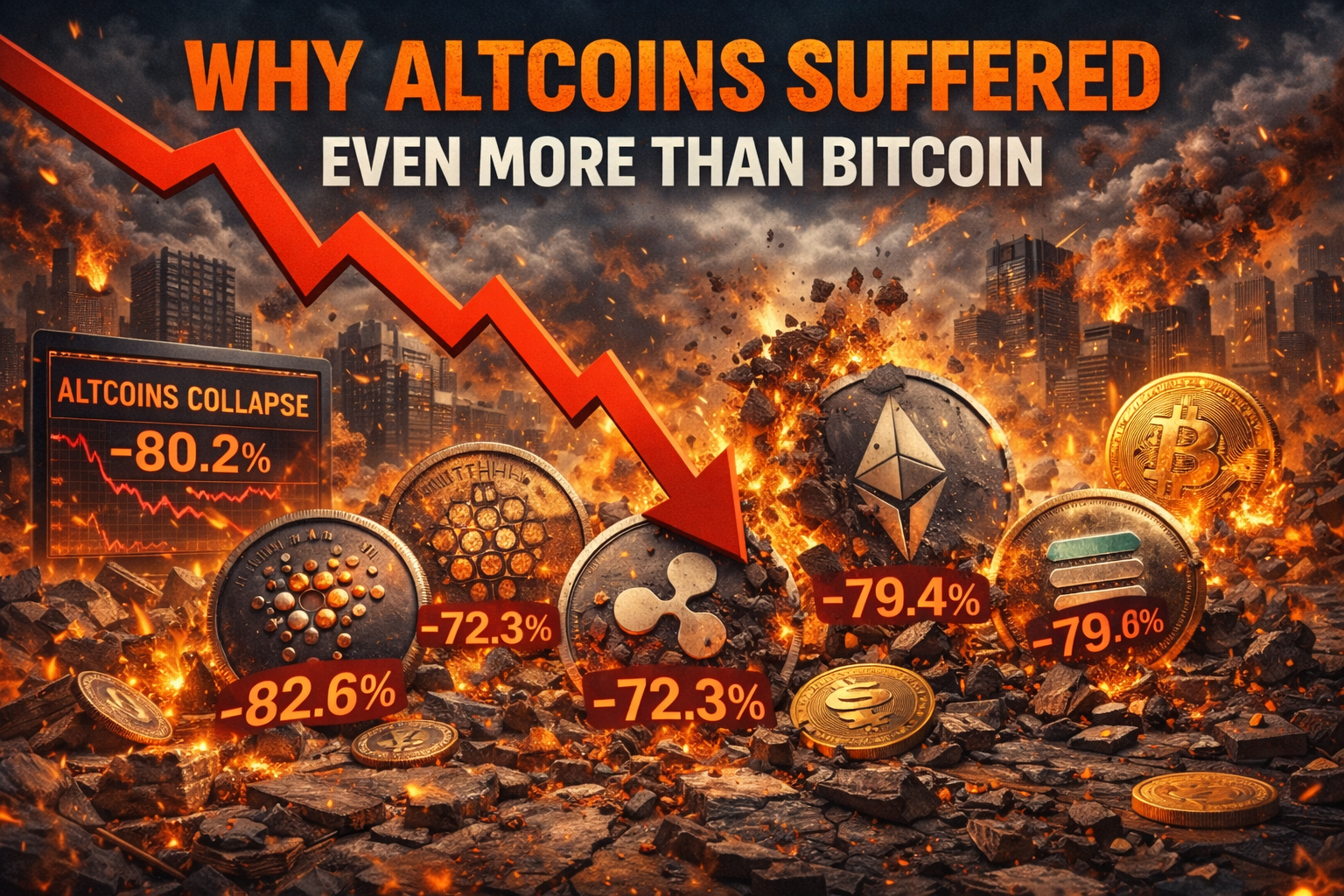
When Bitcoin falls, altcoins often drop faster because traders dump riskier assets first. Meanwhile, liquidation engines on major exchanges liquidate leveraged altcoin longs aggressively due to higher volatility thresholds. This is why a Bitcoin crash doesn’t feel like a Bitcoin event. It feels like a total market reset.
The phrase “crypto market crash” became almost synonymous with “deleveraging,” because once leverage starts unwinding, it tends to hit the entire ecosystem at once.
The psychological side: how liquidations change trader behavior
Liquidations don’t just move charts—they reshape market psychology.
After a major liquidation event, traders become more cautious. Leverage usage drops temporarily. Funding rates normalize or flip negative. But as soon as price stabilizes, speculation returns and leverage builds again. That’s why 2025 saw multiple liquidation spikes rather than a single end-of-year blowout. The market repeatedly cycled through greed, leverage build-up, a trigger, liquidation flush, and recovery.
It’s also why many long-term Bitcoin holders view liquidation-driven crashes differently than 2022-style structural collapses. In 2025, much of the volatility reflected over-leveraged speculation being forced out—not necessarily the death of the underlying asset.
Lessons from 2025: what traders and investors can take away
The biggest takeaway from the “$150 billion liquidated” story is that modern crypto price action is heavily shaped by derivatives positioning. If you’re investing long-term, it means you should expect sharp, sudden drops even in bullish cycles, because leverage will continue to create unstable conditions.
If you’re trading, it means risk management is non-negotiable. Leverage magnifies gains, but it also magnifies probability of ruin. In a liquidation cascade, even “good entries” can get wiped out simply because volatility expands beyond your margin buffer.
And for everyone watching the market, 2025 reinforced a critical truth: Bitcoin doesn’t always crash because people lose faith. Sometimes Bitcoin crashes because the market is structurally designed to force-sell when price moves the wrong way.
Conclusion
The story of how $150 billion was liquidated from the crypto market in 2025 driving Bitcoin crash is really the story of leverage, liquidity, and modern market structure. Liquidations weren’t just a consequence of falling prices—they were the engine that made drops accelerate into crashes.
Derivatives volume exploded, open interest climbed, and traders increasingly depended on leverage to amplify returns. When macro shocks hit and risk sentiment shifted, Bitcoin’s price didn’t simply decline—it cascaded through liquidation levels, forcing sells that pulled the entire market downward. Across repeated waves of deleveraging, total forced liquidations reached the $150 billion range, turning 2025 into a defining year for how brutal liquidation mechanics can be.
Ultimately, the 2025 Bitcoin crash wasn’t just a narrative event. It was a structural one. And as long as leverage remains central to crypto trading, liquidation-driven crashes will remain a recurring feature of the market.
FAQs
Q: What does it mean when $150 billion was liquidated in crypto?
It means leveraged positions worth around $150 billion in notional value were forcibly closed by exchanges due to insufficient margin. This is not the same as $150 billion leaving crypto as cash; it reflects the size of wiped-out leveraged bets.
Q: Why do liquidations cause Bitcoin to crash faster?
Liquidations often trigger market sell orders automatically. As price falls, more leveraged longs hit liquidation thresholds, creating a self-reinforcing selling loop that accelerates declines.
Q: Was the $150 billion figure from a single day in 2025?
No. In 2025, $150 billion is widely cited as an annual-scale total of forced liquidations across the derivatives market, not a single-day statistic.
Q: Why do altcoins fall more than Bitcoin during liquidation events?
Altcoins usually have thinner liquidity and higher leverage usage. When Bitcoin drops, risk-off selling and forced liquidations often hit altcoins harder, causing sharper percentage declines.
Q: How can traders reduce liquidation risk in future crashes?
Lowering leverage, using smaller position sizes, placing realistic stop-loss levels, and avoiding crowded trades during high funding/open interest periods can reduce liquidation risk. Monitoring open interest and macro risk events also helps.
Also More: Bitcoin Breaking News Push Alerts Get Instant BTC Updates
