


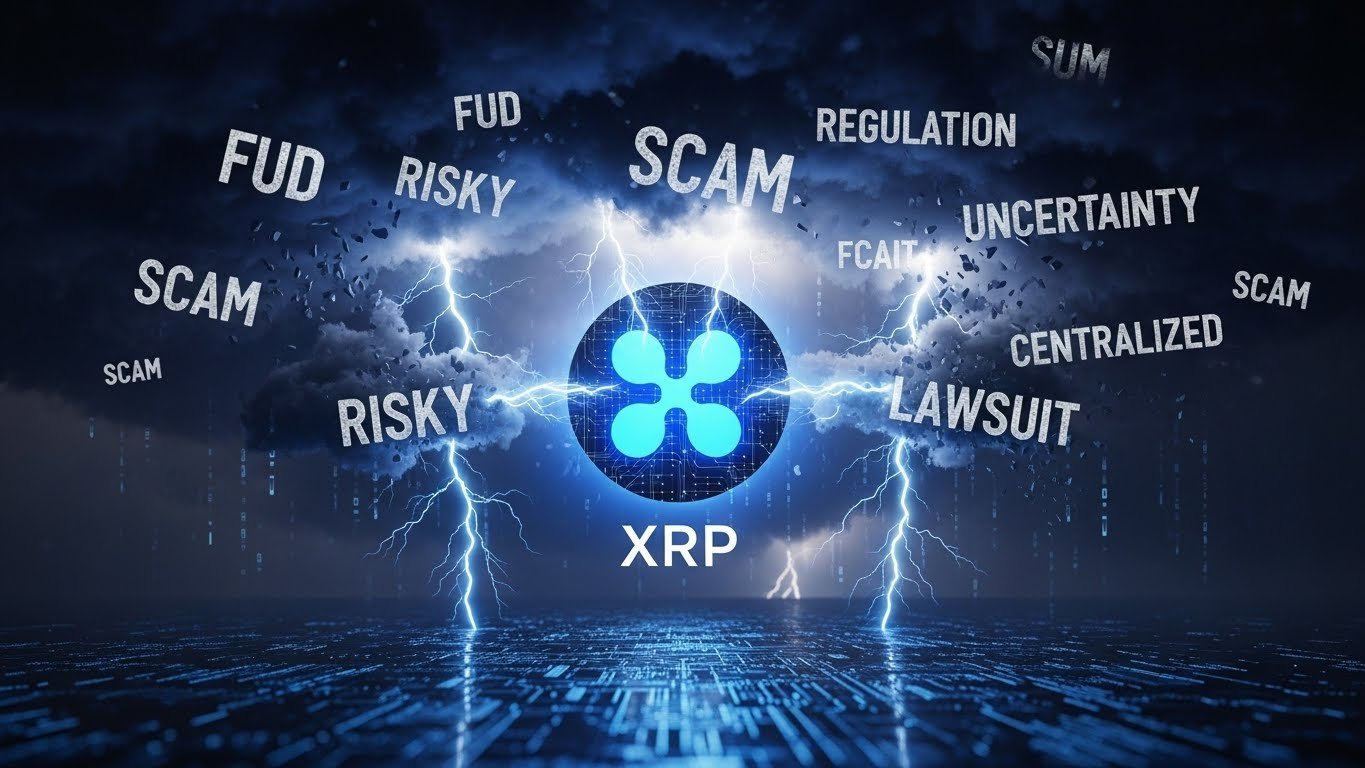
The cryptocurrency market is never quiet, but few digital assets experience emotional swings as intensely as XRP. Every time the market enters a period of uncertainty, a familiar pattern returns. Rumors circulate, long-standing debates resurface and dramatic predictions spread quickly across social platforms. Right now, XRP is facing another one of these episodes, as a fresh FUD storm sweeps through the community and social sentiment turns sharply negative.
For newcomers, the sudden flood of negative messages might seem alarming. For long-time holders, the cycle is familiar but no less frustrating. What makes XRP especially sensitive to FUD is the combination of its complex history, its connection to Ripple and its long-standing regulatory battles. These factors mean that every new headline—whether big or small—has the potential to ignite anxiety across the market.
Yet not every wave of fear is grounded in reality. Sometimes, these bursts of negativity come from incomplete information, exaggerated interpretations or recycled concerns. Understanding how FUD spreads, why it intensifies and what it means for XRP holders can make the difference between reacting emotionally and navigating the moment with confidence. In this article, we will examine why XRP is once again the center of negative sentiment, how the current FUD storm developed, what it means for the asset’s short-term outlook and how investors can approach the situation without falling into panic.
What FUD Means and Why XRP Is Vulnerable to It
Understanding the Nature of FUD in Crypto
FUD stands for fear, uncertainty and doubt. In cryptocurrency, the term describes waves of negativity that cause investors to question their decisions and second-guess the future of a project. FUD often spreads faster than factual information, because it plays directly on emotion. When people see alarming posts or headlines, they react quickly, sometimes before verifying whether the information is accurate.
In the case of XRP, FUD tends to appear more frequently than with many other assets. This is partly because XRP has a long history of controversy. The token has moved through years of legal challenges, community disagreements, market speculation and bold predictions that either inspire hope or trigger anxiety. As a result, it only takes a small spark on social media to reignite old worries.
Why XRP Attracts More Rumors Than Most Digital Assets
XRP’s position in the crypto world is unlike that of most other tokens. It is tied closely to Ripple, a real-world company with corporate partners, legal obligations and ongoing regulatory scrutiny. Because of this connection, XRP’s reputation is affected by events far outside the blockchain itself. An update from a regulator, a new legal filing, a comment from Ripple executives or even a misinterpreted document can send discussions into chaos.
Supporters view XRP as a pioneering solution for global payments, while critics argue that it is too centralized or too dependent on legal outcomes. This divide creates fertile ground for rumors and emotional reactions. Whenever new information appears—no matter how minor—it often triggers heated debates. The result is a market environment where FUD spreads quickly, especially during periods of price weakness or market uncertainty.
How Social Buzz Around XRP Turned Negative
The Shift in Market Conversation
In recent weeks, social media conversations surrounding XRP have taken a noticeably negative tone. Posts criticizing the project have become more common, while supportive commentary has grown quieter. This is reflected across many platforms, from Twitter and Reddit to YouTube discussions and trading forums.
What is driving this negativity? Several factors have contributed. The market has experienced volatility, and XRP’s price movements have not met some traders’ expectations. At the same time, certain influencers have revived old criticisms, while others interpret price consolidation as a sign of weakness rather than a natural phase of the market cycle. This combination has created an atmosphere where pessimistic commentary dominates the narrative.
The Speed at Which Negative Narratives Spread
Part of the challenge for XRP holders is the speed of modern social media. A rumor can circulate globally within minutes, gaining attention before anyone has the chance to verify it. When influential accounts share dramatic statements, thousands of people see them instantly. Even if the information is inaccurate, the emotional reaction it triggers can be very real.
This rapid spread of negativity often makes social sentiment feel worse than the underlying reality. When feeds are filled with warnings, predictions of collapse or complaints about price stagnation, it creates the impression that a disaster is unfolding, even if the actual fundamentals of XRP remain unchanged.
Fundamentals vs Sentiment: What Is Really Happening with XRP?
The Underlying Use Case Remains the Same
Despite the renewed FUD, XRP’s fundamental purpose has not changed. The XRP Ledger continues to process transactions quickly and efficiently. Ripple continues to work on expanding its payment solutions and its partnerships with financial institutions. Court filings, regulatory discussions and business developments continue to evolve, but the underlying technology remains stable. Social sentiment does not alter transaction speed, decentralization mechanics or the ability of XRP to function as a bridge currency. These features stay the same regardless of whether social media is optimistic or fearful.
Market Structure Plays a Major Role in Volatility
Part of XRP’s price behavior is tied to market structure rather than fundamental weakness. XRP is widely traded, and large numbers of traders use leverage when speculating on its price. When FUD spreads, leverage amplifies volatility. Traders who panic may close positions quickly, which accelerates downward movement. At the same time, opportunistic traders may short XRP, expecting fear to grow. All of these activities are normal within cryptocurrency markets. They do not indicate that something is fundamentally wrong with XRP. Instead, they reflect how markets behave when sentiment shifts suddenly and dramatically.
Why XRP FUD Feels Stronger This Time
Emotional Exhaustion Among Long-Term Holders
Long-term XRP supporters have been through many emotional cycles. They have experienced excitement, frustration, hope and doubt multiple times. Because of this, each new wave of negativity feels heavier than the last. People who have held XRP for years may feel tired of defending the project or explaining its potential to skeptics.
This emotional fatigue can make FUD storms feel more intense. Even loyal holders may begin to doubt themselves when they see constant negativity online. This does not necessarily reflect a decline in real fundamentals—it reflects the psychological impact of repeated market cycles.
The Influence of High Expectations
Expectations also play a major role. Many XRP investors entered the market with hopes of major price breakouts, large institutional adoption or dramatic post-lawsuit growth. When those expectations are not immediately met, disappointment creates fertile ground for fear. When price consolidates for an extended period, some investors begin to interpret stability as stagnation. In moments like this, FUD can take root more easily because it resonates with existing disappointment.
How to Interpret the FUD Storm Without Overreacting
Separating Emotion from Information
The most important step when facing negativity around XRP is to distinguish between emotional reactions and factual developments. Emotional posts often use dramatic language and predictions that lack supporting evidence. Informative updates tend to provide data, sources or explanations. By focusing on verified information from reliable channels, you can filter out much of the noise. This does not mean ignoring risks. It means evaluating them calmly and logically rather than reacting based on sentiment alone.
Understanding Your Own Investment Strategy
Every investor has a different strategy, time horizon and risk tolerance. If you are a short-term trader, negative sentiment may influence your decisions more strongly, because trades rely heavily on momentum. If you are a long-term holder, day-to-day sentiment may matter less to you than long-term developments in regulation, adoption and technology.

FUD becomes less overwhelming when you understand your own goals. If your reasons for holding XRP have not changed, then social negativity does not necessarily require a change in your approach. If your reasons have changed, adjusting your position may be appropriate. The key is making decisions based on your own strategy, not temporary social moods.
Opportunities Hidden Within Negative Sentiment
A Potential Reset of Market Expectations
Periods of extreme negativity sometimes provide opportunities for renewed accumulation or for re-evaluating long-term positioning. When sentiment turns overwhelmingly one-sided, it can create moments when prices reflect fear rather than fundamentals.
This does not guarantee immediate gains or a fast recovery. However, many successful investors use negative cycles to observe behavior, study fundamentals and position themselves for the future. Instead of reacting to FUD, they attempt to understand what the sentiment reveals about market psychology.
Contrarian Views and the Long Market Cycle
Cryptocurrency markets operate in cycles that last months or years. Within these cycles, sentiment frequently shifts from optimism to pessimism and back again. A FUD storm is often a sign of a cyclical emotional bottom rather than a fundamental collapse. Contrarian thinkers look at negative sentiment as one part of a larger story, not the conclusion of it.
They analyze whether fear is justified or exaggerated. They consider whether the long-term adoption of XRP is progressing, whether technological development continues and whether partnerships remain active. Although contrarian strategies require discipline and patience, they can help investors avoid being swept up in emotional waves.
Conclusion
The renewed XRP FUD storm and the negative social buzz surrounding the asset can create the impression that something disastrous is happening. But when viewed more calmly, the situation looks familiar. The crypto market is emotional, reactive and sensitive to rumors. XRP, because of its history and visibility, experiences these storms more often than most assets.
Yet storms are temporary. Fundamentals do not change simply because sentiment does. Social media may shout loudly, but it does not determine long-term adoption or the evolution of real-world use cases. The key is to understand what FUD is, how it spreads and how to interpret it without losing perspective.
Whether you choose to trade, accumulate or simply observe, clarity of thought is your strongest advantage. Social negativity will rise again in the future, just as it has many times before. The difference lies in how you respond: with emotional reaction, or with informed analysis. FUD may shake confidence, but it does not define the future of XRP. Only time, development, regulation and real-world adoption will do that.
Frequently Asked Questions
Q: Why is XRP experiencing renewed FUD now?
XRP is facing fresh FUD due to market volatility, revived regulatory concerns and a surge of negative commentary on social media. These factors have combined to create a new wave of uncertainty.
Q: Does negative social buzz mean XRP is fundamentally weak?
No. Social sentiment fluctuates rapidly and does not always reflect the project’s real technological or strategic progress. Fundamentals should be evaluated separately from mood.
Q: How should investors handle XRP FUD?
Investors should focus on verified information, understand their personal risk tolerance and avoid emotional decisions based solely on social media trends. A clear strategy helps reduce stress.
Q: Is XRP’s long-term outlook affected by short-term sentiment?
Short-term sentiment can influence price volatility, but long-term outlook depends more on adoption, regulatory outcomes and continued development of the XRP Ledger ecosystem.
Q: Can FUD ever create opportunities?
Yes. Negative sentiment may provide opportunities for investors who believe in long-term fundamentals. However, any decision should be based on research and not solely on contrarian impulses.
